Our verdict
In Bangkok's Bang Kho Laem district, Khao Tom Pla Kimpo represents a category of late-night Thai rice porridge houses that have fed the city's river-adjacent communities for generations. The menu centres on fish-based khao tom, positioning it firmly within the vernacular comfort-food tier rather than the fine-dining circuit occupied by peers like Sorn or Baan Tepa. It is a neighbourhood proposition first, drawing locals who treat it as a reliable post-midnight anchor.

Pearl is the En Primeur Club membership app — saves, bookings, and concierge access live there. Same editors, same standards.
- Address
- 1901 à¸. à¹à¸à¸£à¸´à¸à¸à¸£à¸¸à¸ Wat Phraya Krai, Bang Kho Laem, Bangkok 10120, Thailand
- Phone
- +66641956665
- Hours
- Mon 4:30–11 PMTue–Fri ClosedSat–Sun 4:30–11 PM
- Website
- facebook.com
- Directions
- Get directions
The menu
What to order
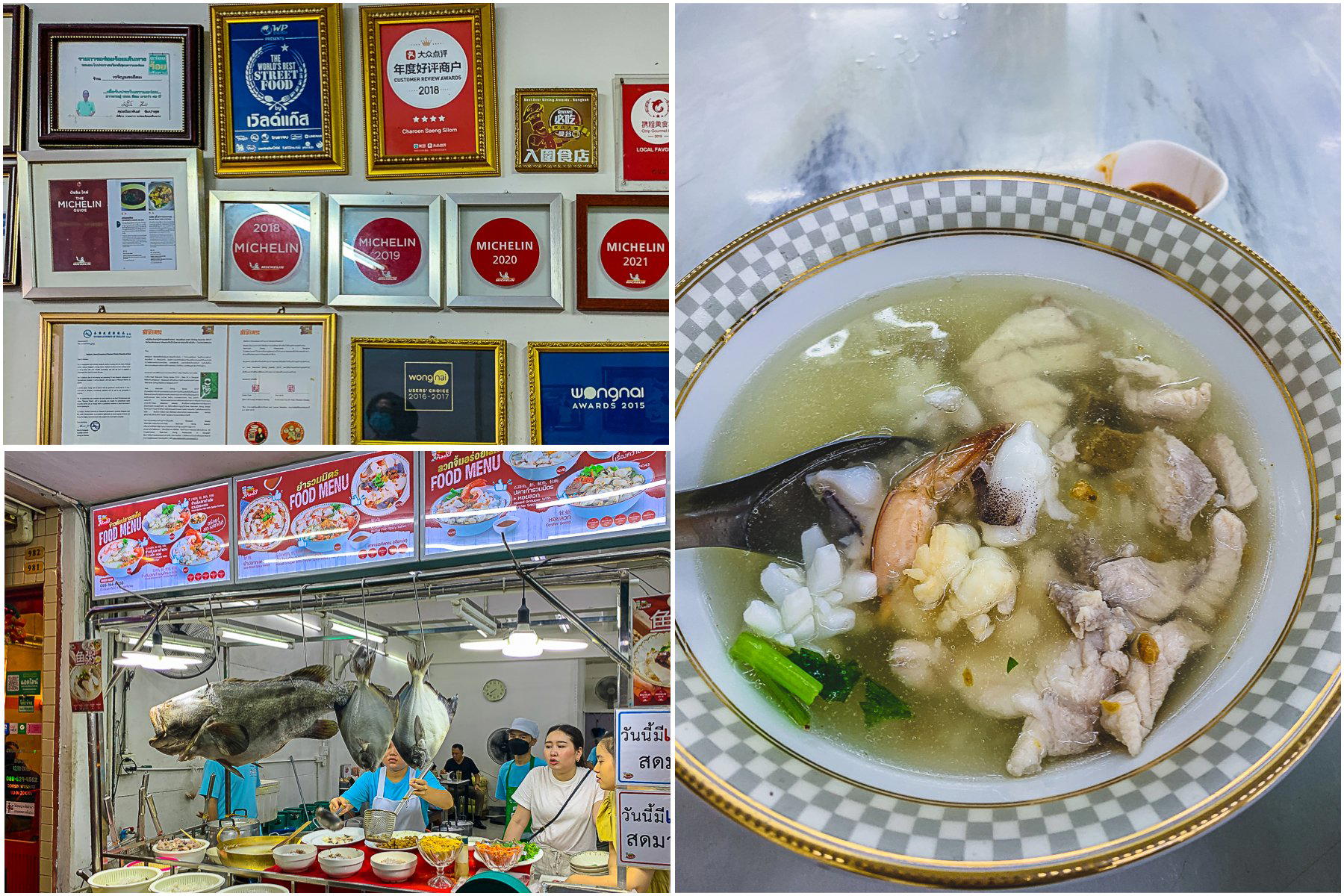
- Mixed Sea Bass Porridge
- Boiled Rice Soup with Seafood
- Seafood Salad
Rice Porridge and the River District
Bangkok's eating geography has always been shaped by water. The Chao Phraya and its network of canals created communities that fished, traded, and ate at the water's edge, and the dishes that emerged from those communities, particularly khao tom, the unadorned rice porridge that forms the backbone of Thai breakfast and late-night eating alike, carry that logic into the present. Along the riverside corridors of Bang Kho Laem, a working district on the west bank south of Silom, that tradition holds with less interruption than almost anywhere else in the city.
Khao Tom Pla Kimpo sits on Charoenkrung Road at address 1901 in the Wat Phraya Krai sub-district, in a part of Bangkok that sees fewer tourist itineraries than Yaowarat or Sukhumvit but maintains a density of long-established eating houses that reward the detour. The area's character is port-district pragmatic: the restaurants here were built around fishermen, dock workers, and the kind of irregular hours that require a kitchen willing to open when other places close.
What the Menu Structure Tells You
The editorial angle that matters most when reading Khao Tom Pla Kimpo is not who runs the kitchen but what the menu's architecture reveals about the category it belongs to. Khao tom restaurants operate on a logic of simplicity and repetition: a base of rice simmered in clear stock, served alongside or mixed with a rotating cast of proteins, condiments, and side dishes. The fish-forward positioning implied by the name, pla meaning fish in Thai, signals that the kitchen's sourcing is oriented toward the river and the Gulf rather than land protein. This is a narrower commitment than generalist khao tom houses, and it places the restaurant in a subcategory where freshness and sourcing consistency matter more than menu breadth.
In the broader context of Bangkok's porridge and congee tradition, this kind of fish-led specialisation sits closer to the Chinese-Thai eating houses of Yaowarat than to the coconut-milk-heavy southern Thai cooking you find at places like Sorn (Southern Thai), or the contemporary Thai tasting formats at Baan Tepa (Thai contemporary). Those venues, both operating at the ฿฿฿฿ tier, represent Bangkok's fine-dining ambition. Khao Tom Pla Kimpo operates in a different economy entirely, one where the value proposition is a bowl built from fresh local fish rather than a multi-course progression.
The condiment array at Thai khao tom houses functions as a form of self-directed seasoning: white pepper, pickled ginger, sliced chillies in fish sauce, crispy garlic, and dried shrimp allow each diner to calibrate the bowl to their own balance of salt, heat, and acid. This structure means the restaurant's job is to produce a stock that is clear-tasting and well-seasoned enough to hold those additions without collapsing into blandness. It is a technically demanding base despite its apparent simplicity, and the gap between a good khao tom stock and an indifferent one is immediately legible.
Where It Sits in Bangkok's Eating Ecosystem
Bangkok's restaurant scene in 2024 and 2025 has drawn international attention almost entirely through its fine-dining corridor: Gaa (Modern Indian, Indian), Sühring (German), and Côte by Mauro Colagreco (Mediterranean, Modern Cuisine) all represent the globalised, chef-driven model that earns column inches and award nominations. That tier is worth knowing, but it describes a narrow cross-section of how Bangkok actually eats. The khao tom houses, the noodle shops, and the open-front seafood restaurants of districts like Bang Kho Laem are the load-bearing infrastructure of the city's food culture, operating across price points and hours that the fine-dining tier cannot touch.
For comparison within Thailand's broader scene, fish-focused informal dining takes different shapes depending on geography. PRU in Phuket represents the farm-to-table fine-dining interpretation of southern seafood, while Krua Laew Tae R-Rom in Pattaya and Hoy Tord Chao Lay (หอยทอดชาวเล) in วัฒนา occupy the casual seafood register closer to Kimpo's positioning. Even within Bangkok's informal seafood and fish-rice category, neighbourhood placement matters: the Charoenkrung corridor has a different customer base and rhythm than the tourist-facing seafood strips of Sukhumvit or the market stalls of Chatuchak.
The informal category also has regional parallels worth noting. AKKEE in Pak Kret shows how Nonthaburi's riverside food culture operates on similar community-service logic, while northern Thai comfort food as seen at Loet Rot in Mueang Chiang Mai or Cherng Doi Roast Chicken (ไก่ย่างเชิงดอย) in Chiang Mai follows the same principle of a single category executed with consistency over years. The throughline is specialisation: the restaurants that persist in these neighbourhoods do so because they do one thing reliably, not because they rotate concepts.
Getting There and Planning the Visit
Bang Kho Laem is accessible via the BTS Silom line to Saphan Taksin station, followed by a short taxi or motorcycle taxi ride south along Charoenkrung Road. The district is also reachable by river ferry, which is consistent with its historical identity as a waterside community. Walk-in is the standard format for neighbourhood khao tom restaurants at this price positioning; formal reservation systems are not characteristic of the category. For broader context on Bangkok's eating scene across all tiers, the EP Club Bangkok restaurants guide covers the full range from street level to tasting-menu format.
Frequently asked questions
What's the address for Khao Tom Pla Kimpo?
Khao Tom Pla Kimpo is located at 1901 à¸. à¹à¸à¸£à¸´à¸à¸à¸£à¸¸à¸ Wat Phraya Krai, Bang Kho Laem, Bangkok 10120, Thailand, Bangkok.
How do you get to Khao Tom Pla Kimpo from central Bangkok?
The restaurant sits at 1901 Charoenkrung Road in Bang Kho Laem, south of the main Charoenkrung dining corridor. The most direct route from central Bangkok is the BTS Silom line to Saphan Taksin, followed by a short taxi or motorcycle taxi south along Charoenkrung Road. The address places it in a working riverside neighbourhood well outside Bangkok's fine-dining circuit.
What dish is Khao Tom Pla Kimpo famous for?
The name says it directly: khao tom pla, fish rice porridge. This is a dish with deep roots in Bangkok's river communities, where Chinese immigrant cooking traditions merged with locally caught fish from the Chao Phraya network. The menu's architecture at Kimpo is built around that single category rather than a broad Thai spread.
Is Khao Tom Pla Kimpo reservation-only?
No reservation contact details are publicly listed for Khao Tom Pla Kimpo, which is consistent with how most khao tom shops in Bangkok's Bang Kho Laem district operate — walk-in, counter service, no advance booking required. Planning around off-peak hours is the practical alternative to a reservation system.
Compact Comparison
Comparable venues nearby, for context on price, style, and recognition.
| Venue | Cuisine | Price | Notes |
|---|---|---|---|
| Khao Tom Pla KimpoThis venue — the venue you are viewing | Teochew-Style Fish Porridge | $10–20 | Not listed |
| Kiew Kai Ka | Traditional Regional Thai | $20–30 | Ban Song Krathiam, Traditional Regional Thai |
| JJ's Kitchen Restaurants | Thai with International Options | $10–20 | Ban Don Muang Khwaeng, Thai with International Options |
| Baan Somtum | Authentic Isaan Thai Somtum | $10–20 | Bang Rak Khwaeng, Authentic Isaan Thai Somtum |
| Ann Guay Tiew Kua Gai | Thai Fried Noodles with Chicken | $1–10 | Bom Phrap Satru Pai Khwaeng, Thai Fried Noodles with Chicken |
| Baan Yai Phad Thai | Charcoal-Grilled Pad Thai | $1–10 | Sam Saen Nok, Charcoal-Grilled Pad Thai |