Our verdict
A Bloor West Village counter serving taiyaki, the Japanese fish-shaped waffle pastry with sweet or savoury fillings. Kevin's sits in a neighbourhood where independent food shops still hold ground against chain encroachment, offering a format rooted in Tokyo street-food tradition at an accessible price point relative to Toronto's broader Japanese dining scene, which runs from counter omakase to kaiseki tasting menus.

Pearl is the En Primeur Club membership app, where members save venues, book tables and use the concierge.
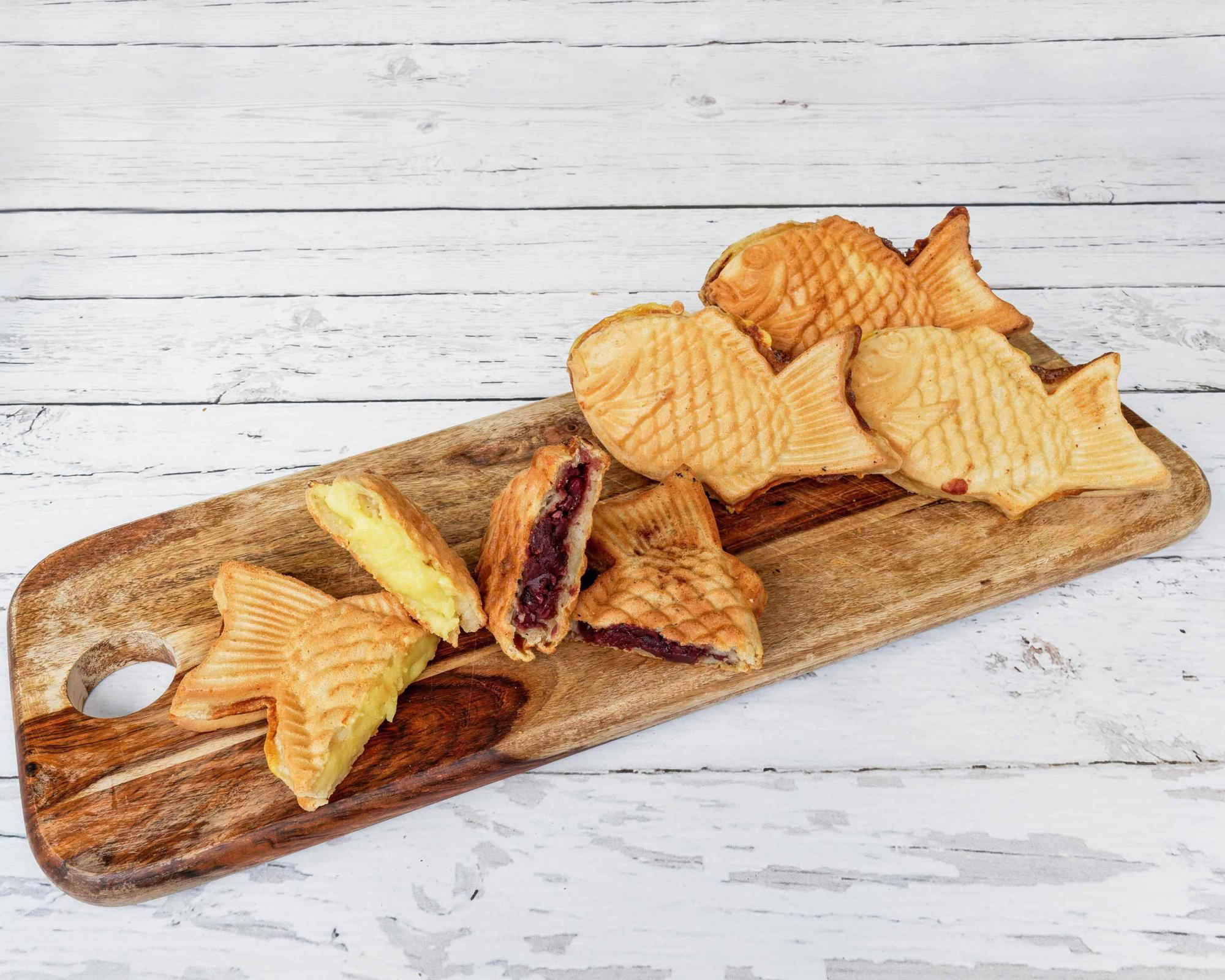
The menu
What to order
- Custard Taiyaki
- Red Bean Taiyaki
A Street-Food Format That Holds Its Ground on Bloor West
Bloor Street West between Bathurst and Lansdowne has long operated as one of Toronto's more durable strips for independent food retail. Bakeries, ramen counters, and specialty shops coexist here in a way that resists the full-service restaurant consolidation visible further east. Kevin's Taiyaki, at 675 Bloor St W, fits that pattern: a specialist counter devoted to a single format, taiyaki, the fish-shaped waffle pastry originating in Meiji-era Japan and now standard street-food fare from Osaka to Tokyo's Harajuku district. In a city where Japanese dining tends to be discussed at the level of omakase counters like Sushi Masaki Saito or kaiseki rooms like Aburi Hana, a taiyaki shop occupies a quieter, less-scrutinised register. That is, in some ways, where its appeal lives.
The Format and What It Represents
Taiyaki's logic is direct: an iron mould shaped like the sea bream (tai, considered auspicious in Japanese culture) produces a crisp, thin waffle shell around a filling, most traditionally azuki red bean paste. The format has survived over a century of Japanese food culture largely intact, which is itself worth noting in an era when street foods are routinely remixed into fusion hybrids. A counter that holds close to that original format makes a quiet argument for restraint over reinvention, a choice increasingly visible in the more serious end of Toronto's food scene. Alo and DaNico operate at opposite ends of the price range from Kevin's, but the underlying instinct, that a defined format executed well beats a sprawling menu executed unevenly, connects them at a structural level.
Sourcing and the Ethics of a Small Format
Single-format counters carry an environmental logic that larger restaurant operations rarely match. Taiyaki production uses minimal ingredients, typically a batter, a filling, and the heat of the iron mould, which means waste per unit is low and sourcing decisions are concentrated rather than diffuse. In Canada's broader hospitality conversation, sustainability has often been framed at the tasting-menu level: fermented house staples, foraged garnishes, farm-direct proteins. The more durable sustainability model may actually be simpler: a shop that makes one thing, orders what it needs, and generates negligible prep waste. That argument has been made explicitly at places like Eigensinn Farm in Singhampton and Restaurant Pearl Morissette in Lincoln, which operate at the production end of the food chain; Kevin's represents it at the retail end, without the ideology made explicit.
Toronto's independent food operators on Bloor West also tend to source regionally by necessity rather than by branding. Smaller operators with tight margins cannot absorb the logistics of global specialty imports, which tends to orient them toward local or national suppliers. That structural constraint produces a sourcing profile that is, functionally, more aligned with low-carbon supply chains than many higher-profile restaurants whose sustainability credentials appear on printed menus but whose ingredient lists tell a more complicated story. Comparable tensions in Canadian dining are examined in the editorial work around venues like Fogo Island Inn Dining Room and Narval in Rimouski, where geography enforces the localism that others perform.
Where Kevin's Sits in Toronto's Japanese Food Continuum
Toronto's Japanese food offering now spans a range that would have been unusual in North America a decade ago. At the formal end, multi-course kaiseki and omakase at premium price points have established the city as a credible destination for serious Japanese dining, putting it in a conversation with Vancouver operators like AnnaLena and Montreal rooms like Jérôme Ferrer - Europea. At the street-food end, however, the infrastructure is patchier. Taiyaki as a format has appeared in Toronto sporadically, usually attached to bubble tea shops or broader Asian dessert menus where it becomes one item among many. A counter that focuses on it specifically is the minority position, and that focus changes the quality threshold: when the mould, the batter hydration, and the filling ratio are your entire product, they receive the attention that a twelve-item menu spreads thin.
The Bloor West Village Context
The neighbourhood around 675 Bloor St W has a pedestrian density and a residential catchment that rewards walk-in specialists. This is not a destination strip in the way that Ossington or King West function for dinner-focused hospitality; it is more accurately a daily-use corridor where residents shop, eat casually, and move. That context suits a counter format. Taiyaki is not a destination meal; it is an in-and-out transaction, eaten warm on the street or wrapped to carry. The format's durability in Japanese cities has always depended on that pedestrian logic, and Bloor West replicates it reasonably well. For visitors making a broader sweep of Toronto's dining, the neighbourhood is accessible via the Bloor-Danforth subway line at either Bathurst or Christie stations, making it a practical stop within a day that might also include dinner at Don Alfonso 1890 or a longer tasting format elsewhere in the city.
Planning a Visit
Kevin's Taiyaki is a counter-service format on Bloor Street West, suited to the kind of casual stop that does not require advance booking. The address, 675 Bloor St W, is the fixed reference point; the nearest subway access is the Bloor-Danforth line. For those building a day around food in the city, our full Toronto restaurants guide covers the range from taiyaki counters through to the formal end of the dining spectrum. Comparable independent food formats elsewhere in Canada include Cafe Brio in Victoria and Busters Barbeque in Kenora, both of which reflect the independent operator model that Kevin's represents in Toronto. For those interested in how international tasting-menu traditions frame street food differently, Tanière³ in Quebec City, Le Bernardin in New York City, and Lazy Bear in San Francisco offer useful counterpoints on format discipline at the other end of the price range, and The Pine in Creemore shows how the single-focus ethos applies in a rural Canadian context.
Frequently asked questions
Does Kevin's Taiyaki work for a family meal?
How would you describe the vibe at Kevin's Taiyaki?
What do people recommend at Kevin's Taiyaki?
Is taiyaki at Kevin's made to order, or held and reheated?
Price and Positioning
Comparable venues nearby, for context on price, style, and recognition.
| Venue | Cuisine | Price | Notes |
|---|---|---|---|
| Kevin's TaiyakiThis venue (the venue you are viewing) | Japanese Taiyaki | $1–10 | Not listed |
| Hanmoto | Japanese-American Fusion Izakaya | $20–30 | Little Italy, Japanese-American Fusion Izakaya |
| Buk Chang Dong Soon Tofu | Korean Soon Tofu Stew | $1–10 | Koreatown, Korean Soon Tofu Stew |
| Latin World Store | Authentic Mexican Taqueria | $10–20 | Dovercourt-Wallace Emerson-Junction, Authentic Mexican Taqueria |
| Allwyn’s Bakery | Parkwoods, Authentic Jamaican Caribbean | $10–20 | Not listed |
| Tacos El Asador | Authentic Salvadoran & Mexican Street Food | $10–20 | Koreatown, Authentic Salvadoran & Mexican Street Food |
Continue exploring
More in Toronto
Restaurants in Toronto
All restaurants in Toronto →
Bars in Toronto
All bars in Toronto →

Details
- Trendy
- Cozy
- Casual Hangout
- A La Carte
- Vegetarian Friendly
Current opening hours
- Monday
- 11:30 AM–8 PM
- Tuesday
- 11:30 AM–8 PM
- Wednesday
- 11:30 AM–8 PM
- Thursday
- 11:30 AM–8 PM
- Friday
- 11:30 AM–8 PM
- Saturday
- 11:30 AM–8 PM
- Sunday
- 11:30 AM–8 PM
Hours can change for holidays and private events. Hours as of .
Casual bustling supermarket food stand with hot, crispy taiyaki.