
Kyoto’s sweet-shop culture has a ceremonial register of its own, and Kamo Mitarashi Chaya belongs to the old-school side of that world: low-cost, shrine-adjacent, and built around wagashi rather than restaurant theatre. Its Tabelog 100 selection for Japanese traditional sweets and sweets cafe in WEST 2023 gives it a clear signal among casual Kyoto sweets rooms, especially for families and small celebratory stops.
Pearl is the En Primeur Club membership app — saves, bookings, and concierge access live there. Same editors, same standards.
- Address
- 53 Shimogamo Matsunokicho, Sakyo Ward, Kyoto, 606-0816, Japan
- Phone
- +81 75-791-1652
- Website
- tabelog.com
 Saves & bookings on Pearl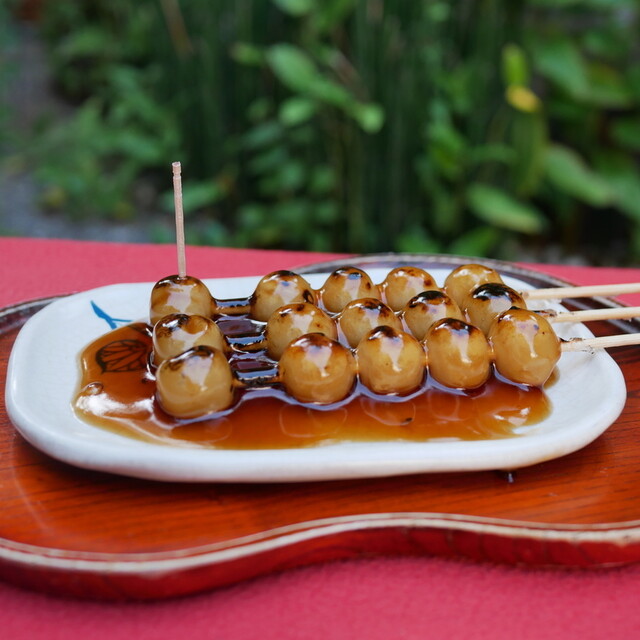
Approaching Shimogamo, Kyoto changes register. The city’s restaurant drama recedes, and the rhythm turns older: shrine paths, residential lanes, small tea rooms, sweets taken with the seriousness other cities reserve for lunch. In that setting, Kamo Mitarashi Chaya makes sense not as a destination meal in the Western sense, but as a Kyoto occasion ritual, the kind of stop that can mark a family visit, a shrine day, or a quiet milestone without asking diners to dress it up.
Kyoto has a long habit of attaching sweets to place. Wagashi shops near temples and shrines are not merely convenient refuelling points; they help define how a neighbourhood is experienced. Mitarashi dango carries particular weight around Shimogamo Shrine, where the sweet is linked to local origin stories rather than imported nostalgia. That matters because the city has two parallel dining cultures: the formal, reservation-led world of kaiseki and counter restaurants, and the casual sweets culture where a short sitting can feel just as rooted in Kyoto’s calendar.
Shimogamo sweets culture is the point, not restaurant theatre
Kamo Mitarashi Chaya sits in the cafe featuring Japanese sweets, kakigori, and traditional sweets category, a format that behaves differently from Kyoto’s tasting-menu rooms. The proof is in the signals: Tabelog selected it for its Japanese traditional sweets and Japanese sweets cafe WEST 2023 list, with additional Tabelog sweets selections noted in 2022 and 2020. For a category where the spending level remains modest and the visit is often brief, that recognition carries more practical meaning than polished dining-room ceremony.
The comparison set in Kyoto is broad. Nakagawa Komugiten and Saruya also operate in the low-cost bracket, while Cafe Verdi represents another casual cafe lane; Kichisen belongs to a different Kyoto dining register altogether. Reading those together clarifies the city’s range. Kyoto is not a single fine-dining story, and its occasion dining is not confined to anniversaries at lacquered counters. A sweets cafe can be the better fit when the occasion is intergenerational, daylight-oriented, and tied to a walk through a neighbourhood rather than a long evening.
That distinction is especially useful for travellers planning around family groups. Formal Kyoto restaurants often demand advance coordination and a controlled dining pace. A Japanese sweets cafe near a major shrine gives the day a softer anchor: children, grandparents, and friends can share the same table without turning the meal into a performance. Kamo Mitarashi Chaya lists 30 seats, take-out service, and family-friendly conditions including children and strollers, which places it firmly in the accessible side of Kyoto’s food culture.
A low-cost Kyoto occasion with award-list credibility
The spending level is part of the editorial case. Kyoto’s reputation often pushes visitors toward expensive meals, yet some of the city’s most culturally specific eating happens below the price of a casual lunch elsewhere in Japan. Here, the listed average sits under JPY 999, which changes the decision. This is not where to allocate a full evening budget; it is where a Kyoto day gains texture between shrine grounds, buses, and neighbourhood walking.
Recognition also needs to be read in category. A Tabelog 100 listing for Japanese traditional sweets does not mean the same thing as a Michelin star, and it should not be treated as such. It does, however, indicate that within the west Japan wagashi and sweets-cafe field, the shop has been singled out in a crowded category. For travellers who use awards as filters, that is the useful takeaway: this is a casual sweets room with external validation, not a luxury restaurant dressed down.
Kyoto’s sweets culture also rewards restraint in planning. A visit here pairs naturally with northern Kyoto itineraries rather than central shopping loops, and it sits closer in spirit to old confectionery traditions than to the dessert-course maximalism of contemporary restaurants. Travellers building a broader Kyoto food day might contrast it with Aburi Mochi Honke Nemoto Kazariya, another sweets-focused reference point, then shift registers with restaurants such as 3TOKU6MI Shijo karasuma ten, 551蓬莱, [ki:], or Abbesses.
How to use it in a Kyoto itinerary
The cleanest way to understand Kamo Mitarashi Chaya is as a daytime punctuation mark. It works for a small celebration because it does not require the choreography of a formal meal: the setting is casual, the category is sweets-led, and the shrine-side context gives the stop cultural shape. For a birthday with children, a multi-generation Kyoto afternoon, or a low-pressure anniversary walk, that can be more appropriate than a room built around courses and wine.
There are practical limits to that ease. Reservations are unavailable, private rooms are unavailable, and parking is unavailable, so the better plan is to treat the visit as part of a Shimogamo route rather than a standalone appointment. The nearest station is Demachiyanagi, with Kyoto City Bus access via the Shimogamo Jinja-mae stop noted for the area. Payment expectations also belong to the casual end of the spectrum: credit cards and electronic money are not accepted, while QR code payments are listed. Those details matter because Kyoto’s old sweets shops can feel informal while operating on specific house rules.
For a broader city read, place this stop within Our full Kyoto restaurants guide, then build the rest of the trip around Our full Kyoto hotels guide, Our full Kyoto bars guide, Our full Kyoto wineries guide, and Our full Kyoto experiences guide. Travellers comparing casual Japanese formats beyond the city can also map it against -Grilled beef Sukiyaki- KAMAKURA TANUKIAN 鎌倉 たぬき庵 in Kamakura,. 鮪と炭火焼き うお炭 秋葉原店 in Tokyo,.cafe in Osaka,.know in Kumamoto, (Shoku) Vietnam in Kawasaki, [Curry Senmon Ten] Maruyama Kyoju. in Sapporo, Jōdo Saké Bar in Los Angeles, and Onigiri Time in Pasadena.
The verdict is simple: choose it when the occasion calls for Kyoto specificity over dining-room grandeur. The value sits in the intersection of place, category, and ease: shrine-area sweets, Tabelog 100 recognition, casual seating, and a format that can include children without diluting the experience for adults.
A Minimal
Comparable venues at the same tier.
| Venue | Cuisine | Price | Notes |
|---|---|---|---|
| Kamo Mitarashi ChayaThis venue — the venue you are viewing | $ | ||
| Jukou Gundan | Sakyō, Ramen, tsukemen & maze-soba shop | $ | |
| Curry Senmon Ten Biyanto | Sakyō, Japanese Curry | $ | |
| Matsuya Tokiwa | Nakagyō, Traditional Japanese Wagashi | $ | |
| Kansen Do | $ | Higashiyama, Traditional Japanese Wagashi & Sweets | |
| Kameya Yoshinaga Honten | $ | Shimogyō, Traditional Kyoto Wagashi & Japanese Sweets |
Continue exploring
More in Kyoto
Restaurants in Kyoto
Browse all →
Bars in Kyoto
Browse all →

Hotels in Kyoto
Browse all →
Wineries in Kyoto
Browse all →
At a Glance
- Classic
- Cozy
- Iconic
- Solo
- Family
- Casual Hangout
- After Work
- Terrace
- Historic Building
- Standalone
- Street Scene
A small, traditional Kyoto sweet shop with a simple, classic interior, relaxed teahouse atmosphere, and a slightly nostalgic feel; guests sit in a modest, cozy space or on the open terrace after visiting nearby Shimogamo Shrine.