
Tabelog Bronze #157
Our verdict
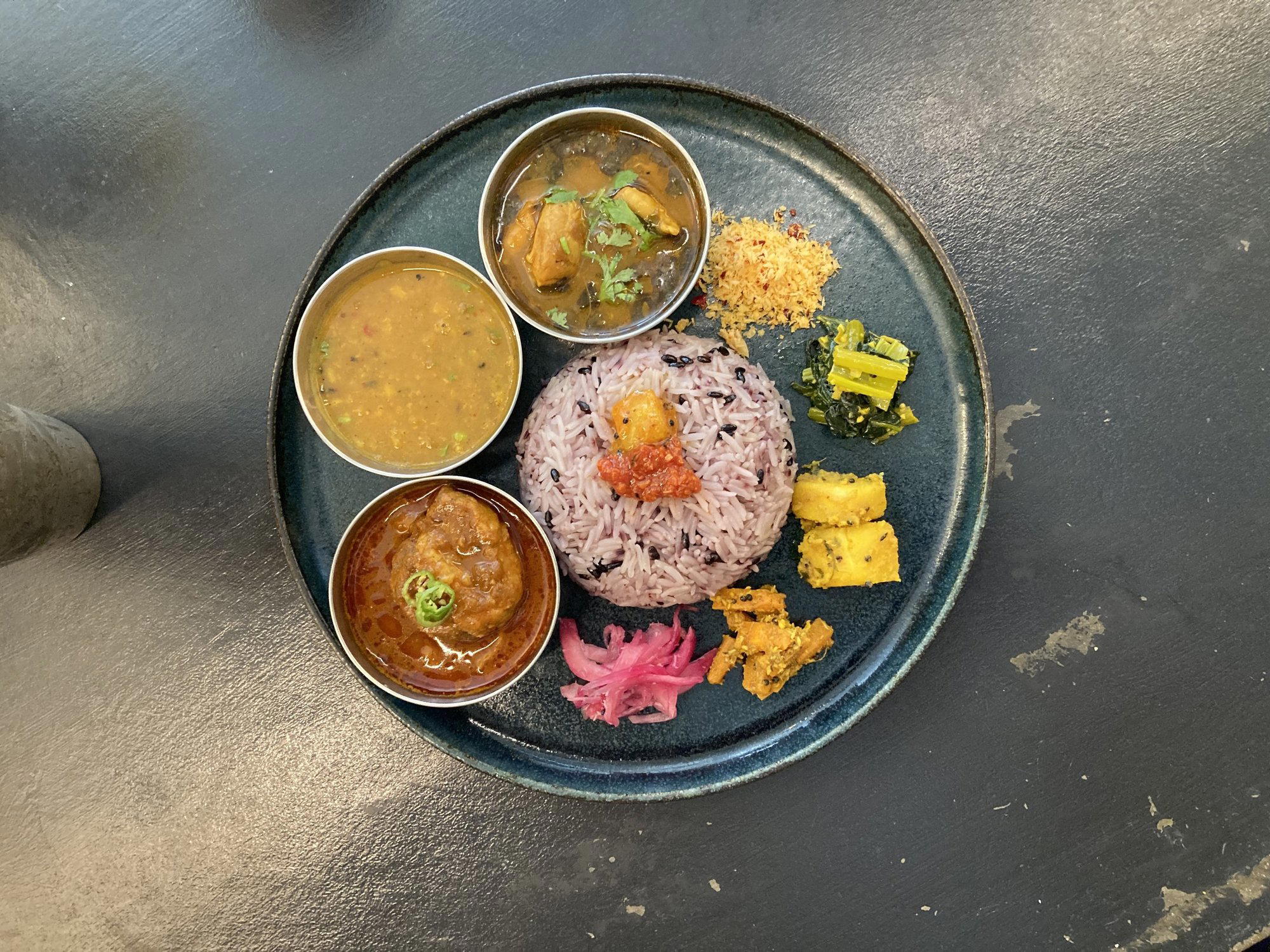
Kalpasi brings Tokyo’s spice-curry conversation into a compact Setagaya room, working across Indian curry, Nepalese and Sri Lankan registers rather than the city’s ramen-and-sushi default. Its weekly one-course format, 11-seat scale and repeated Tabelog recognition place it in the small-format curry tier where structure matters as much as seasoning.

Pearl is the En Primeur Club membership app, where members save venues, book tables and use the concierge.
The menu
What to order
- Thali sets
- Mutton curry
- Sanma curry
- Spice gelato
The room is small enough for the format to matter before the first plate arrives: three counter seats, one four-seat table and two raised tables make an 11-seat dining room feel closer to a controlled tasting session than a casual curry stop. In Tokyo, where curry can mean everything from station-counter katsu plates to spice-driven independent kitchens, Kalpasi occupies the latter camp: compact, structured and built around a weekly one-course curry.
That one-course structure is the point. Rather than asking diners to scan a long menu of familiar choices, the kitchen narrows attention to a changing composition that sits across Indian curry, Nepalese and Sri Lankan categories. The format says plenty about Tokyo’s current curry culture. Serious curry rooms in the city are no longer defined only by heat level or portion size; many now work like small restaurants with a point of view, editing the meal into a set sequence and using limited capacity to keep the cooking tight.
A weekly curry format in a city of specialist counters
Tokyo has long rewarded specialization. Sushi counters, yakitori rooms and tempura bars train diners to accept a kitchen’s sequence rather than negotiate every course. Curry has absorbed part of that logic. Kalpasi’s weekly one-course format belongs to this shift, placing curry in a frame closer to a compact set menu than a broad comfort-food list.
The category mix also matters. Indian curry, Nepalese cooking and Sri Lankan cooking are often flattened into a single “spice” label in casual city guides, but they draw on different starches, aromatics, textures and souring agents. A short menu can make those distinctions clearer because the diner is not jumping across unrelated dishes. The kitchen’s stated attention to fish adds another signal: this is not merely a meat-and-gravy model of curry, and it aligns with Tokyo’s broader habit of reading non-Japanese cuisines through Japanese expectations around ingredient focus.
The comparison within Tokyo is useful. Garam Masala sits in a similar price band for curry, while Hassho operates at a lower spend level; Kalpasi’s repeated awards place it in a more tightly watched group of curry specialists rather than a general neighbourhood-curry bracket. Against higher-priced Tokyo formats such as Sushi Ikki, Quatre Vingt Douze or Sumibi Yakiniku Fuchioka, the meal occupies a different economic lane, but the reservation-only, small-room discipline speaks the same language of scarcity and control.
Recognition without the luxury-restaurant costume
For a curry restaurant at this scale, the recognition profile is unusually strong. Kalpasi holds The Tabelog Award 2026 Bronze with a 3.88 score, following Bronze recognition in 2025, 2022 and 2021. It has also been selected for Tabelog Curry 100 in 2018, 2019, 2020, 2022 and 2023. Those markers are not decorative; in Tokyo’s dining ecosystem, Tabelog carries particular weight for specialist genres that sit outside Michelin’s usual centre of gravity.
The useful reading is not that curry has been turned into luxury dining. It has not. The appeal is sharper than that: a low-seat-count room applying serious menu discipline to a category often treated as casual by default. That is why the format matters more than any single dish name. A weekly one-course curry lets the kitchen control pacing, balance and repetition, while the diner gives up choice in exchange for focus.
Setagaya also changes the feel of the meal. This is not Ginza’s expense-account theatre or Shibuya’s trend traffic. The western residential wards of Tokyo tend to support small restaurants with loyal local followings, where a narrow concept can survive without dressing itself as grand dining. Kalpasi fits that pattern: specialist enough to draw curry obsessives across town, modest enough in scale to remain a neighbourhood room rather than a stage set.
How to place it in a Tokyo itinerary
For visitors building a Tokyo restaurant map, this is the counterweight to the city’s high-gloss tasting menus. It makes sense on an itinerary that already includes tightly focused Japanese formats, because the lesson is comparative: Tokyo applies the same respect for sequencing and category mastery to curry that it applies to sushi, yakitori and kaiseki. For a broader scan of the city’s dining range, Our full Tokyo restaurants guide is the better starting point.
Nearby and citywide context helps sharpen the decision. Diners comparing curry-specific options can look at 3 Chome no Curry Ya San in Tokyo or, outside the capital, [Curry Senmon Ten] Maruyama Kyoju. in Sapporo. Tokyo’s broader casual-to-specialist spread includes 2D Cafe, 12/10 Shinjuku ten, 124. KAGURAZAKA (Yakitori) and. 鮪と炭火焼き うお炭 秋葉原店, each useful for reading how narrow formats behave in different neighbourhoods.
Japan’s wider restaurant field offers parallel contrasts: -Grilled beef Sukiyaki- KAMAKURA TANUKIAN 鎌倉 たぬき庵 in Kamakura.cafe in Osaka.know in Kumamoto, (Shoku) Vietnam in Kawasaki and [ki:] in Kyoto. For travellers stretching the same editorial lens beyond Japan, Jōdo Saké Bar in Los Angeles and Onigiri Time in Pasadena show how Japanese drinking and rice-based formats translate abroad.
The wider trip planning pieces sit elsewhere: Our full Tokyo hotels guide, Our full Tokyo bars guide, Our full Tokyo wineries guide and Our full Tokyo experiences guide. Within that map, Kalpasi is the curry specialist to use when the point of dinner is not breadth, but a tightly edited reading of spice, sequence and Tokyo’s appetite for small-format precision.
Frequently asked questions
What's the address for Kalpasi?
Kalpasi is located in Tokyo.
What days is Kalpasi closed?
Hours at Kalpasi: Mon, Tue, Wed, Thu, Fri, Sat, Sun, Public Holiday, Day before public holiday, Day after public holiday 18:00 - 22:00.
What is Kalpasi known for?
Kalpasi is best approached by focusing on the core concept and signature offerings.
How does Kalpasi handle allergies?
Kalpasi does not publish a detailed allergy protocol in the public record. The practical point is that it is reservation-only, so guests should use the booking step to flag allergies alongside the required name, date, time, party size and contact details. Check the venue's official channels for the latest details.
Where the Accolades Land
Side-by-side context: comparable cuisine and price.
| Venue | Cuisine | Price | Awards | Notes |
|---|---|---|---|---|
| KalpasiThis venue (the venue you are viewing) | Freestyle Japanese-Indian Curry | $30–50 | Tabelog Bronze #157 | Not listed |
| YOGORO | Japanese Curry | Not listed | Tabelog 100 #24 | Shibuya |
| Calical Shimbashi honten | Indian Curry | $1–10 | Tabelog 100 #51 | Minato |
| DELHI Ginza ten | Indian & Pakistani curry house | $10–20 | Tabelog 100 #16 | Chūō |
| Azuki to Kōri | Modern Japanese Kakigori | $20–30 | Not listed | Shibuya |
| Convivio | Regional Italian Course Cuisine | $100–150 | Tabelog 100 #25 | Shibuya |
Recognition history
Dated appearances from independent guides and award organizations, with the underlying list record or original source where available.
Tabelog Bronze #157
Tabelog
Full recognition history (2 entries)
Tabelog Bronze
Tabelog
Continue exploring
More in Tokyo
Restaurants in Tokyo
All restaurants in Tokyo →



Bars in Tokyo
All bars in Tokyo →




Details
- Cozy
- Trendy
- Solo
- Date Night
- Special Occasion
- Sake Program
- Local Sourcing
- Omakase
- Small Plates
- Sake Program
- Vegetarian Friendly
Current opening hours
- Monday
- Closed
- Tuesday
- Closed
- Wednesday
- Closed
- Thursday
- 6–7:40 p.m., 8:15–10 p.m.
- Friday
- 6–7:40 p.m., 8:15–10 p.m.
- Saturday
- 6–7:40 p.m., 8:15–10 p.m.
- Sunday
- Closed
Hours can change for holidays and private events. Hours as of .
Stylish, relaxing space in a residential hideout with counter and tatami seating, quirky plating on compartmentalized trays.