
Jun Teuchi Daruma sits in Tokyo’s quieter ramen conversation: hand-made noodles, light soy sauce broth, and a format built around restraint rather than spectacle. Its repeated selection for Tabelog Ramen TOKYO “Tabelog 100” from 2019 through 2025 gives the small Suginami counter credibility without shifting it into luxury dining territory.
Pearl is the En Primeur Club membership app — saves, bookings, and concierge access live there. Same editors, same standards.
- Address
- 東京都杉並区和田1-18-3
- Website
- tabelog.com
 Saves & bookings on Pearl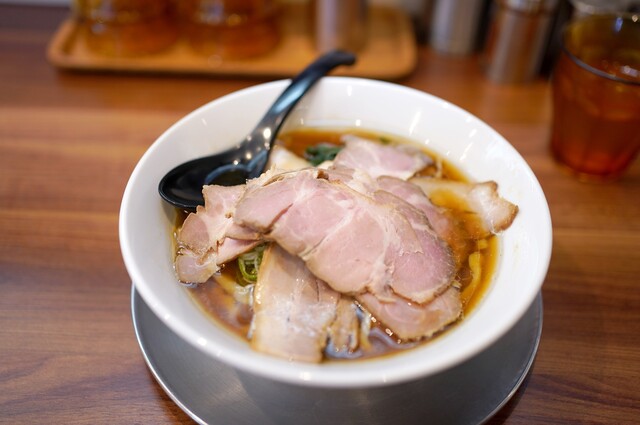
Approaching a small ramen counter in residential Suginami changes the temperature of a Tokyo meal. The city’s ramen culture is often framed through intensity: thick broths, late-night queues, limited bowls, social-media heat. Jun Teuchi Daruma belongs to a quieter branch, where the point is calibration, not escalation. The room is counter-only, the operation deliberately small, and the cooking argues for ramen that fits ordinary life rather than overwhelming it.
That matters because Tokyo ramen has split into different economies. One chases destination status, rare ingredients, and queues that turn lunch into a project. Another stays close to the neighborhood shop: modest, repeatable, personal in scale, and more concerned with balance than spectacle. Jun Teuchi Daruma sits in the second camp while carrying unusually strong recognition for that register, with Tabelog Ramen TOKYO “Tabelog 100” selections from 2019 through 2025. The signal is clear: this is not a luxury counter, but it has been judged seriously within the city’s ramen field.
Light soy ramen as an argument against excess
Tokyo’s lighter shoyu tradition can look plain from a distance, especially to diners trained on pork-heavy richness or aggressive seasoning. Its difficulty is cumulative: broth, salt, oil, wheat, and timing must land without one element dominating. Here, the stated direction is light soy sauce ramen, with an explicit preference for a bowl that does not lean on excess umami, salt, or oil. The sustainability angle becomes concrete rather than decorative: the shop’s own framing rejects luxury ingredients and positions the meal as daily food, leaving the body ready for the next meal rather than stunned by abundance.
Hand-made noodles give the bowl its discipline. Within high-water Chinese-style noodles, this kitchen favors a softer cooking point and asks diners to leave noodle hardness to the house. That resists a common customization reflex, but it is not arbitrary: cooking level is treated as part of how the wheat expresses itself. In a city where firmness is often equated with seriousness, softness becomes a technical stance.
The recipe is not fixed. The kitchen has stated that the wheat blend and overall build keep changing through experimentation. In a larger restaurant, that can become brand theater. At an eight-seat ramen counter, it works as craft maintenance: small adjustments, repeated service, direct feedback from the bowl. The result is restraint that feels contemporary without chasing novelty.
A Suginami counter in Tokyo's anti-spectacle lane
Location shapes the experience. Suginami is not the shorthand many visitors use for Tokyo dining, where Ginza, Ebisu, Shibuya, and Roppongi absorb attention. Ramen, however, rewards movement beyond hotel districts. Neighborhood counters can carry as much authority as central dining rooms, sometimes more, because price, frequency, and local repeat custom remain intact. For broader restaurant planning, Our full Tokyo restaurants guide gives the bigger map, while Our full Tokyo hotels guide, Our full Tokyo bars guide, Our full Tokyo wineries guide, and Our full Tokyo experiences guide place the meal inside a wider itinerary.
Nearby comparison points sharpen the read. Sanuki no Udon Hana wa Saku Shin nakano honten occupies a similar everyday price band but speaks in udon rather than ramen. Komatsu and SEN YO sit in higher dinner-budget territory, showing that Tokyo’s serious food culture does not always announce itself through cost. Sousakumen Hitosuji shares the ramen category, but Jun Teuchi Daruma’s repeated Tabelog 100 recognition and hand-made noodle identity place it in a specific subset of small-format craft ramen.
The restaurant’s refusal of television attention, stated since opening, is unusual in a city where media exposure can turn a small counter into a queue machine. That clarifies the reader decision. This is not for a theatrical ramen pilgrimage or a maximal bowl built for instant impact. It is a study in moderation: light shoyu, soft high-water noodles, limited scale, and a local-shop ethic that treats understatement as a virtue.
How to read the bowl, and the room
Reset expectations before ordering. Tokyo ramen with lighter seasoning often reveals itself over the course of eating rather than in the first spoonful. The kitchen’s explanation notes that the broth is intended to come into balance as the bowl progresses, and that diners may ask about flavor strength. The larger lesson is cultural: not every serious ramen shop chases concentration. Some are built around aftertaste, digestion, and the possibility of returning often.
Capacity affects the mood. A counter-only shop with one person running the operation has a different rhythm from a multi-staff dining room. Service depends on pacing, patience, and the understanding that the meal is compact by design. Payment and reservation habits in small Tokyo ramen shops are often less flexible than in hotel dining, so check structured details before setting out, especially because operating schedules can shift.
For travelers building a Japan food route around everyday formats rather than formal tasting menus, useful contrasts include 3 Chome no Curry Ya San, 124. KAGURAZAKA (Yakitori), 12/10 Shinjuku ten. 鮪と炭火焼き うお炭 秋葉原店, and 2D Cafe. Outside Tokyo, the same low-to-mid-format intelligence appears in different registers at -Grilled beef Sukiyaki- KAMAKURA TANUKIAN 鎌倉 たぬき庵 in Kamakura.cafe in Osaka.know in Kumamoto, (Shoku) Vietnam in Kawasaki, [Curry Senmon Ten] Maruyama Kyoju. in Sapporo, and [ki:] in Kyoto. For Japanese food culture abroad, Jōdo Saké Bar in Los Angeles and Onigiri Time in Pasadena offer a different comparison point.
The verdict is narrow, which is a strength. The restaurant is for diners who appreciate a ramen shop resisting the city’s louder incentives: no luxury ingredient posture, no heavy-broth arms race, no media-chasing mythology. Its appeal lies in craft held at everyday scale, backed by repeated Tabelog recognition and a counter format that leaves little room for disguise.
Price and Positioning
Comparable venues at similar price and category levels.
| Venue | Cuisine | Price | Notes |
|---|---|---|---|
| Jun Teuchi DarumaThis venue — the venue you are viewing | Not listed | $ | Not listed |
| Tsuruse Yushima honten | Not listed | $ | Bunkyō, Traditional Japanese wagashi & tea cafe |
| 玄冶店 濱田家 | Chūō, Japanese Izakaya | $ | Not listed |
| Motenashi Kuroki | Taitō, Modern Japanese Ramen | $ | Not listed |
| Torimeshi Torito Toyosu shijou | Not listed | $ | Kōtō, Chicken-focused Japanese casual dining |
| Gion Tsujiri Toukyou sukaitsurii taun soramachi ten | Sumida, Matcha sweets & Japanese cafe | $ | Not listed |
Recognition history
Dated appearances from independent guides and award organizations, with the underlying list record or original source where available.
Tabelog 100 #7 · No. 7
Tabelog · Tabelog 100 - Ramen - TOKYO - 2025















At a Glance
- Quiet
- Cozy
- Classic
- Solo
- Casual Hangout
- Family
- Chefs Counter
- Standalone