
Michelin Plate
Our verdict
A Michelin Plate recipient in both 2024 and 2025, Jok's Kitchen sits in the Pom Prap Sattru Phai district on a narrow lane where Bangkok's Thai-Chinese heritage remains most concentrated. The kitchen works in a tradition of roasted and braised Chinese technique adapted through decades of Thai context, occupying a mid-range price point that makes Michelin recognition here a genuine signal rather than a prestige exercise.

Pearl is the En Primeur Club membership app, where members save venues, book tables and use the concierge.
The menu
What to order
- Steamed crab
- Shrimp wonton
- Deep-fried snow fish
Where Bangkok's Chinese Roasting Tradition Still Has Weight
Pom Prap Sattru Phai is one of those Bangkok districts where the Chinese merchant heritage never retreated into nostalgia. The lanes running off Yaowarat Road and deeper into the old quarters of this district still carry working restaurants that predate the city's current dining boom by decades. Jok's Kitchen sits on Trok Itsaranuphap, one of the oldest alley markets in Bangkok, a corridor known for dried goods, incense, and the kind of food stalls that operate according to neighbourhood logic rather than tourist-facing calendars. The physical approach tells you something about the cooking before you sit down: this is Thai-Chinese food in its original urban habitat, not a sanitised version reconstructed for another audience.
The Roasting Tradition This Kitchen Belongs To
Thai-Chinese cuisine as practised in Bangkok's old quarters draws directly from Teochew and Cantonese techniques that arrived with immigrant communities in the nineteenth and early twentieth centuries. Among those techniques, the Chinese roasting tradition, char siu pork, roasted duck, and their braised relatives like khao moo daeng, became the backbone of an entire category of Bangkok street and shophouse cooking. What distinguishes the serious practitioners from the casual ones is the degree to which the lacquer, the fat rendering, and the smoke balance are controlled. Char siu at this level is not red-dyed supermarket pork; it is a product of timed marinades, calibrated heat, and finishing technique that produces the caramelised crust without drying the interior. Roasted duck carries a different set of demands: the skin must be dry enough to crisp without the breast meat becoming tough, a balance that exposes any inconsistency in temperature management.
This is the culinary lineage Jok's Kitchen operates within. Michelin's Plate recognition in both 2024 and 2025 places it among Bangkok's acknowledged practitioners of this tradition, a designation that carries more meaning in this price bracket, mid-range, marked ฿฿฿, than it might at a tasting-menu address. A Plate at this level signals that inspectors found consistent technique and clear identity, not just accessibility. Across Bangkok, Michelin Plate addresses in the Thai-Chinese category tend to confirm what neighbourhood regulars have already established through years of return visits.
Pom Prap in Context: Bangkok's Most Concentrated Thai-Chinese Quarter
The area around Trok Itsaranuphap has the density of Thai-Chinese food culture that other Bangkok districts approximate but rarely match. Chinatown proper, a few minutes' walk toward Yaowarat Road, captures more attention, but Pom Prap's interior lanes often carry the more practised, less performative versions of the same traditions. Several Michelin-recognised Thai-Chinese addresses cluster in this zone, which reflects both the historical concentration of Chinese-descended communities here and the continuity of technique passed through family operations. For comparison, similar Thai-Chinese roasting traditions show up at Tang Jai Yang (Bang Kho Laem) on the south bank and at Kor Chun Huad, but the geographic concentration in Pom Prap means you can cover multiple strong addresses in a single afternoon.
Beyond this district, Bangkok's Thai-Chinese cooking appears in different registers across the city. Chop Chop Cook Shop and Por. Pochaya represent other points on the spectrum, while Somboon Seafood (Bang Rak) shows how Chinese seafood technique integrates into Bangkok's broader dining picture. The Thai-Chinese category also extends well beyond Bangkok: Baan Heng in Khon Kaen and Heng Khao Moo Daeng in Surat Thani show how the same roasted-pork and braised traditions adapted to provincial Thai-Chinese communities with their own local inflections.
What Michelin Recognition Means at This Price Point
Bangkok's Michelin guide covers a wider price spectrum than most guides in European or East Asian cities. At the leading end, addresses like Sorn (three stars, Southern Thai, ฿฿฿฿) and Baan Tepa (two stars, Thai contemporary, ฿฿฿฿) operate within fine-dining economics where the guide's recognition aligns with price expectations. The more instructive comparison for Jok's Kitchen is what Michelin Plate status signals when a kitchen operates at ฿฿฿: inspectors are confirming that technique and consistency meet a threshold independent of price or format. In practical terms, a ฿฿฿ mid-range Thai-Chinese address with back-to-back Plate recognition in 2024 and 2025 is a stronger editorial recommendation than most fine-dining stars in cities where Michelin operates a narrower, higher-priced field.
For readers building a Bangkok itinerary that moves across price points and traditions, addresses like Jok's Kitchen function as calibration points. They establish what serious technique looks like without tasting-menu architecture, and they sit in neighbourhoods where the food exists in direct conversation with its own cultural history. The contrast with contemporary addresses like PRU in Phuket or Aeeen in Chiang Mai is instructive: both represent Thai fine dining built on provenance and innovation, while Pom Prap's shophouse kitchens represent continuity of tradition as its own form of quality argument. Neither approach is more valid; they answer different questions.
Elsewhere across Thailand, Michelin recognition at mid-range price points appears at addresses like AKKEE in Pak Kret and Angeum in Phra Nakhon Si Ayutthaya, suggesting the guide's Thai operation has committed to acknowledging regional and neighbourhood-scale cooking on its own terms rather than restricting recognition to urban fine dining. Jok's Kitchen fits that pattern.
Know Before You Go
- Address: 23 Trok Itsaranuphap, Pom Prap, Pom Prap Sattru Phai, Bangkok 10100
- Cuisine: Thai-Chinese (roasted meats, braised dishes)
- Price range: ฿฿฿ (mid-range)
- Awards: Michelin Plate 2024; Michelin Plate 2025
- Getting there: Trok Itsaranuphap runs off the Yaowarat Road corridor; the MRT Wat Mangkon station (Chinatown line) places you within walking distance of the lane entrance
- Booking: No website or phone number is published in; plan to visit directly or check current status through Google Maps or local discovery platforms before travelling
- Leading timing: Roast-meat kitchens in Bangkok's Chinese quarters typically run at full capacity through lunch service; arriving outside peak lunch hours improves availability
Frequently asked questions
What awards or recognition does Jok's Kitchen (Pom Prap Sattru Phai) have?
Jok's Kitchen (Pom Prap Sattru Phai) has received recognition including: Michelin Plate (2025); Michelin Plate (2024).
What's the pricing like at Jok's Kitchen (Pom Prap Sattru Phai)?
Pricing at Jok's Kitchen (Pom Prap Sattru Phai) is listed as ฿฿฿.
What should I eat at Jok's Kitchen (Pom Prap Sattru Phai)?
Jok's Kitchen operates within the Thai-Chinese roasted and braised tradition, the category anchored by char siu pork, roasted duck, and khao moo daeng. These are the dishes that earned the kitchen consecutive Michelin Plates in 2024 and 2025. At the ฿฿฿ price point in this neighbourhood, portions tend to be generous and ordering a mixed roast plate is standard practice.
Where do I go for Jok's Kitchen (Pom Prap Sattru Phai)?
Jok's Kitchen (Pom Prap Sattru Phai) is located at 23 ตรอกอิศรานุภาพ Pom Prap, Pom Prap Sattru Phai, Bangkok 10100, Thailand, Bangkok.
What's the best way to book Jok's Kitchen (Pom Prap Sattru Phai)?
No phone number or website appears in current published records for Jok's Kitchen. For a Michelin Plate shophouse in Pom Prap, the practical approach is to arrive early or during off-peak hours, as walk-in queues at recognised addresses in this district move quickly at lunch but lengthen by early evening.
What's the defining dish or idea at Jok's Kitchen (Pom Prap Sattru Phai)?
The defining idea is the Chinese roasting tradition as it settled into Bangkok's Thai-Chinese quarter across generations. Char siu and roasted duck represent techniques brought by Teochew and Cantonese immigrant communities and refined over decades into a distinctly local register. Jok's Kitchen holds two consecutive Michelin Plates for executing that tradition at a ฿฿฿ price point in one of Bangkok's most concentrated Thai-Chinese neighbourhoods.
Where the Accolades Land
| Venue | Cuisine | Price | Awards | Notes |
|---|---|---|---|---|
| Jok's Kitchen (Pom Prap Sattru Phai)This venue (the venue you are viewing) | Chinese Seafood | $30–50 | Michelin Plate | Not listed |
| Sorn | Fine Southern Thai | $200–300 | 3 Michelin Stars · World's 50 Best #12 | Southern Thai, ฿฿฿฿ |
| Côte by Mauro Colagreco | Riviera Mediterranean Fine Dining | $200–300 | 2 Michelin Stars · World's 50 Best #91 | Mediterranean, Modern Cuisine, ฿฿฿฿ |
| Baan Tepa | Creative Thai Fine Dining | $150–200 | 2 Michelin Stars · World's 50 Best #53 | Thai contemporary, ฿฿฿฿ |
| Gaa | Modern Indian Fine Dining with Thai Influences | $150–200 | 2 Michelin Stars · World's 50 Best #95 | Modern Indian, Indian, ฿฿฿฿ |
| Sühring | Modern German Fine Dining | $200–300 | 3 Michelin Stars · World's 50 Best #18 | German, ฿฿฿฿ |
Recognition history
Dated appearances from independent guides and award organizations, with the underlying list record or original source where available.
Michelin Plate
Michelin
Full recognition history (2 entries)
Michelin Plate
Michelin
Continue exploring
More in Bangkok
Restaurants in Bangkok
All restaurants in Bangkok →
Bars in Bangkok
All bars in Bangkok →


Details
- Rustic
- Intimate
- Special Occasion
- A La Carte
Current opening hours
- Monday
- 8 AM–6:30 PM
- Tuesday
- 8 AM–6:30 PM
- Wednesday
- 8 AM–6:30 PM
- Thursday
- 8 AM–6:30 PM
- Friday
- 8 AM–6:30 PM
- Saturday
- 8 AM–6:30 PM
- Sunday
- 8 AM–6:30 PM
Hours can change for holidays and private events. Hours as of .
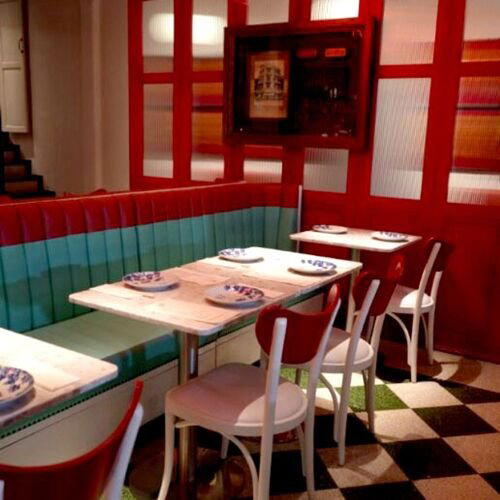
Humble, old shop with torn upholstery, no windows or air conditioning, warm and homey atmosphere.