

Tabelog 100 #74
Our verdict
Honke Daiichi Asahi Honten belongs to Kyoto’s practical ramen tradition rather than its ceremonial dining image: quick turnover, close seating, and a station-area audience that treats noodles as everyday fuel. Its recognition includes selection for Tabelog Ramen WEST “Tabelog 100” from 2019 through 2025 and a 2026 Opinionated About Dining Casual in Japan ranking, placing it in a documented tier of serious casual eating.

Pearl is the En Primeur Club membership app, where members save venues, book tables and use the concierge.
The menu
What to order
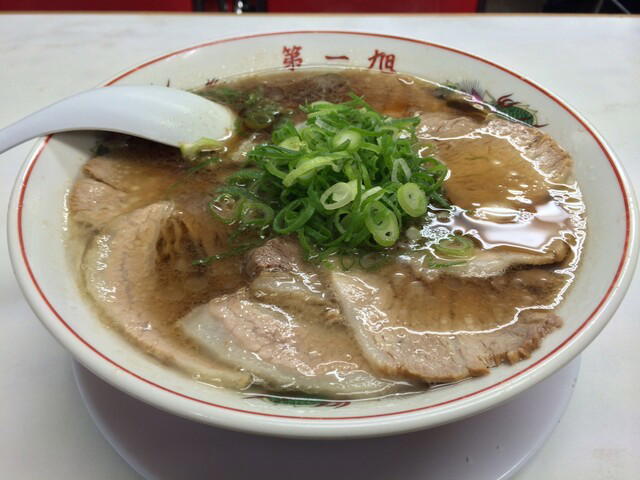
- Signature ramen with chashu and Kujo green onions
- Bamboo shoot ramen
- Gyoza (dumplings)
Approaching Kyoto’s ramen shops means leaving behind the city’s quieter temple rhythm for a more compressed kind of appetite: commuter timing, counter steam, and the practical choreography of diners who know that ramen here is not a long-form performance. The appeal of this part of Kyoto is its refusal to behave like a heritage postcard. Across the city, casual eating is built for movement, and Honke Daiichi Asahi Honten sits inside that current rather than outside it.
That context matters. Kyoto is often reduced to kaiseki rooms, wagashi counters, and seasonal restraint, but its everyday food culture is broader and more muscular. Ramen in Kyoto answers a different question: where does the city eat when ceremony is unnecessary? In that category, credibility is not expressed through tasting-menu pacing or designer interiors. It comes through repeat selection, consistency under pressure, and a format that works without turning the meal into an event.
Kyoto ramen with commuter logic, not tourist theatre
The useful way to read this restaurant is as part of Kyoto’s practical ramen economy. The format points to a compact, high-throughput style rather than a destination dining room. That combination places it closer to the city’s working casual canon than to the reservation-led restaurants that dominate luxury travel itineraries.
Recognition gives the place a clearer signal than nostalgia alone. It was selected for Tabelog Hyakumeiten in 2025, with a listed Tabelog score of 3.74. Those are not decorative facts; they show how a low-cost ramen counter can sit in the same travel conversation as pricier Kyoto dining because the category has its own standards. For readers comparing meals across the city, the point is not that ramen competes with kaiseki. It competes within a different grammar: broth, noodles, speed, access, and local repetition.
Kyoto’s casual range is wide enough that the comparison should stay close to format. Yamamoto Mambo, also in Kyoto, occupies a similarly approachable lane but speaks in a different casual language rather than ramen. OGAWA COFFEE Kyoto eki ten serves the city’s everyday need from another angle, a coffee stop rather than a noodle stop. Other Kyoto dining can sit in a more planned, higher-commitment register, which makes the contrast useful: Kyoto can move from sub-¥1,000 casual eating to more specialist dining within the same urban itinerary. For the broader city map, Our full Kyoto restaurants guide is the better frame than treating any single ramen shop as the whole story.
The value of a serious casual address
Japan’s ramen culture rewards narrow focus. A shop does not need a chef biography, a signature menu narrative, or a luxury vocabulary to earn attention. It needs a repeatable bowl, a room that can absorb demand, and enough local confidence to survive beyond novelty. Honke Daiichi Asahi Honten’s Tabelog Hyakumeiten recognition in 2025 is therefore a more relevant trust marker than a formal fine-dining accolade would be.
The price band reinforces the point. This is not a place where the bill performs status; the listed price range is - JPY 999 - JPY 999, so the value is in the alignment between category, cost, and reputation. In Kyoto, that matters because many visitors overcorrect toward polished dining and miss the city’s everyday infrastructure. Ramen shops are part of that infrastructure. They compress the meal into a short, efficient format without stripping it of local meaning.
There is also a practical social texture to this style of dining. Compact Japanese casual restaurants often change the expectation around pacing and personal space: the experience is communal in the functional sense, not curated for privacy. The format is easier to understand when approached as a working meal rather than a concierge occasion. Its usefulness is part of the appeal, and usefulness is exactly the point.
How to place it in a Kyoto itinerary
Kyoto rewards sequencing. A ramen meal can function as an arrival meal, a departure meal, or a reset between more formal bookings. That role is different from a planned evening at a dining room such as SCALAE or another more structured Kyoto meal. It is closer to the city’s connective tissue: quick, direct, and grounded in everyday appetite.
Travelers building a broader Kyoto food day can use contrast rather than repetition. Pair ramen with old confectionery traditions, or with a different casual register elsewhere in the city. For a more contemporary Kyoto dining thread, other dining rooms point in other directions. The value is in seeing how Kyoto moves between everyday speed and composed dining without treating one as more authentic than the other.
For planning beyond restaurants, Kyoto works better when food, sleep, drinking, and cultural time are mapped together. Our full Kyoto hotels guide, Our full Kyoto bars guide, Our full Kyoto wineries guide, and Our full Kyoto experiences guide give the city a wider structure. Readers extending the same casual-dining lens across Japan and beyond can compare how value formats translate in other cities without forcing those comparisons onto this Kyoto ramen stop.
The editorial verdict is simple: this is the kind of Kyoto address that corrects an over-formal reading of the city. Its documented ramen recognition, Kyoto practicality, and casual price tier make it useful for travelers who want a meal with local weight but without ceremonial pacing. Treat it as a serious casual stop, not as a luxury substitute, and it makes immediate sense.
Frequently asked questions
How do I find Honke Daiichi Asahi Honten?
Honke Daiichi Asahi Honten is located in Kyoto.
What's the pricing like at Honke Daiichi Asahi Honten?
Pricing at Honke Daiichi Asahi Honten is listed as - JPY 999 - JPY 999.
Is Honke Daiichi Asahi Honten open every day?
Current opening days and hours are not specified in the provided record. Check the venue's official channels for the latest details before visiting.
What's the standout thing about Honke Daiichi Asahi Honten?
Its strongest credential is the Tabelog Hyakumeiten selection in 2025, alongside a listed Tabelog score of 3.74. The appeal is a recognized ramen-and-dumpling stop in Kyoto at a casual price tier.
Can Honke Daiichi Asahi Honten handle vegetarian requests?
The public record lists ramen and dumplings, but it does not specify a vegetarian menu. The safest read is to expect a standard ramen-shop line-up at Honke Daiichi Asahi Honten in Kyoto, and ask directly before ordering. Check the venue's official channels for the latest details.
Is Honke Daiichi Asahi Honten a family-friendly restaurant?
If you are visiting with children or a group, check directly with Honke Daiichi Asahi Honten for the latest details.
What It’s Closest To
Side-by-side context: comparable cuisine and price.
| Venue | Cuisine | Price | Awards | Notes |
|---|---|---|---|---|
| Honke Daiichi Asahi HontenThis venue (the venue you are viewing) | Classic Kyoto ramen shop | $10–20 | Tabelog 100 #74 | Not listed |
| Yamamoto Mambo | Kyoto-style okonomiyaki & teppanyaki | $10–20 | Tabelog 100 #6 | Shimogyō |
| Kasagiya | Traditional Japanese sweets café & tea house | $1–10 | Tabelog 100 #50 | Higashiyama |
| Kansen Do | Traditional Japanese Wagashi & Sweets | $10–20 | Tabelog 100 #83 | Higashiyama |
| Umezono Kawaramachi ten | Traditional Japanese sweets café | $10–20 | Tabelog 100 #30 | Nakagyō |
| Okashi Tsukasa Juko | Japanese Wagashi | $1–10 | Tabelog 100 #10 | Kamigyō |
Recognition history
Dated appearances from independent guides and award organizations, with the underlying list record or original source where available.
Opinionated About Dining Casual in Japan Ranked #130
Opinionated About Dining
Tabelog 100 #74 · No. 74
Tabelog · Tabelog 100 - Ramen - WEST - 2025
Continue exploring
More in Kyoto
Restaurants in Kyoto
All restaurants in Kyoto →
Bars in Kyoto
All bars in Kyoto →
Hotels in Kyoto
All hotels in Kyoto →
Wineries in Kyoto
Browse all →
Details
- Lively
- Classic
- Well Known
- Solo
- Casual Hangout
- Late Night
- Family
- Standalone
- Historic Building
- A La Carte
- Counter Dining
- Sake Program
Current opening hours
- Monday
- 6 AM–1 AM
- Tuesday
- 6 AM–1 AM
- Wednesday
- 6 AM–1 AM
- Thursday
- Closed
- Friday
- 6 AM–1 AM
- Saturday
- 6 AM–1 AM
- Sunday
- 6 AM–1 AM
Hours can change for holidays and private events. Hours as of .
A no-frills, classic Kyoto ramen shop with tightly packed counter and table seating, bright functional lighting, and a bustling atmosphere marked by constant lines and quick turnover.