
Tabelog 100 #10
Our verdict
Kyoto’s wagashi culture rewards restraint: small shops, low prices, seasonal forms, and a craft vocabulary that often sits outside restaurant-style dining. Okashi Tsukasa Juko belongs to that tradition, with repeated Tabelog 100 recognition for Japanese traditional sweets and a take-out format near Kuramaguchi that makes it a sharp counterpoint to Kyoto’s reservation-heavy dining circuit.

Pearl is the En Primeur Club membership app, where members save venues, book tables and use the concierge.
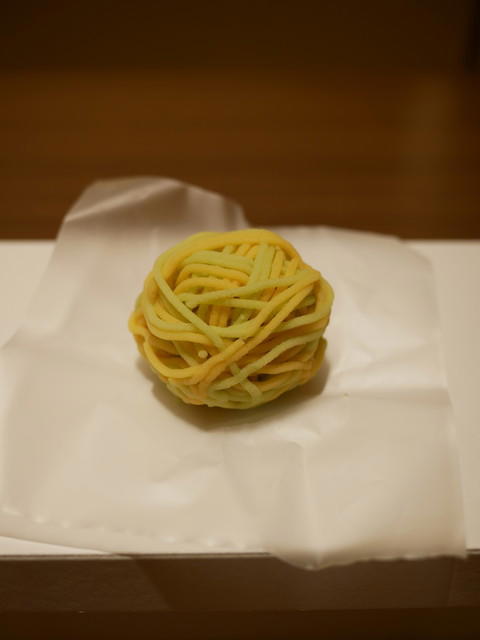
Approaching Kyoto’s older confectionery shops, the register of luxury changes. There is less choreography than at a kaiseki counter and fewer verbal explanations than in a tasting-menu room; the cues are quieter, often compressed into paper wrapping, display-case order, and the discipline of sweets made to travel. In Kyoto, Okashi Tsukasa Juko sits inside that older wagashi rhythm: a focused shop built around Japanese traditional sweets rather than restaurant-style performance.
That distinction matters in Kyoto. Wagashi is not dessert in the Western restaurant sense. It is tied to tea, ceremony, gift-giving, seasonal language, and temple-city habits that make sweetness feel measured rather than decorative. A shop such as Okashi Tsukasa Juko is better read against Kyoto’s confectionery tradition than against patisserie or plated-dessert counters. The spending band is listed as - JPY 999 View spending breakdown, which places the experience in a different category from the city’s formal meals: low-ticket, craft-specific, and dependent on timing rather than table theatre.
Kyoto wagashi without the restaurant performance
The contemporary Kyoto dining circuit often splits into two tracks. One track asks for planning: counters, set courses, multicourse Japanese rooms, and increasingly international pricing. The other remains tied to specialist storefronts where a single craft carries the visit. Wagashi shops belong to the second track. They reward short stops, local routing, and an appetite for formality expressed through small objects rather than long service arcs.
Okashi Tsukasa Juko has the recognition to justify that detour. It appears in the 2023 Tabelog Hyakumeiten record for Japanese traditional sweets, with a listed score of 3.66. In a city crowded with heritage confectionery, that appearance is a meaningful signal: not a luxury badge in the Michelin sense, but evidence of attention inside Japan’s user-driven sweets category.
The format also keeps the focus narrow. A specialist sweets visit changes how the work is judged: presentation, portability, and the first minutes after purchase can matter as much as a room. There is no need to force this into the grammar of a restaurant meal. It belongs closer to a Kyoto day built through small, deliberate stops: a soba lunch, a temple walk, tea, then sweets saved for later.
For readers mapping a wider Kyoto food day, the comparison is useful. Teuchisoba Kanei and Le Petit Mec Imadegawa ten represent other low-to-moderate spend formats in the city, while Nishijin Fujiyoshi and Sobaya Nikola move the decision toward fuller meals and higher commitment. Okashi Tsukasa Juko occupies the compact end of that spectrum, where the listed price is modest but the cultural specificity is high.
Kyoto's slower food geography suits this kind of stop
Kyoto does not behave as one single dining zone. The city’s appeal is less about stacked reservations alone and more about older rhythms, with craft addresses appearing between everyday streets, shrines, schools, and small businesses. A sweets stop such as this can be folded into a morning or afternoon rather than made the anchor of an entire itinerary.
That geography gives the experience its edge. Kyoto’s famous food culture is often consumed through set pieces, but wagashi works better when treated as part of the city’s daily architecture. The point is not spectacle; it is calibration. Sweetness, season, and presentation carry cultural information in a compressed form. A traveller who only books formal dinners misses this quieter register of Kyoto eating.
The sensory frame is accordingly restrained. Expect the pleasure to come from looking closely and moving slowly, not from a long table-side explanation. The shop’s category, Japanese traditional sweets, suggests a controlled, craft-specific environment rather than a high-volume dining hall. The experience is rooted in traditional sweets rather than modern restaurant theatre.
Planning still matters. Specialist Kyoto shops can reward a little preparation, especially when they sit outside the logic of a long restaurant meal. If the stop is being paired with a broader Kyoto route, check current details directly before going; the public record includes the phone number +81-75-431-2800.
How to place it in a Kyoto itinerary
The right expectation is precision over abundance. Okashi Tsukasa Juko is not where to chase a long menu, a chef narrative, or a seated progression. It is where Kyoto’s traditional sweets culture can be read at close range, with 2023 Tabelog Hyakumeiten recognition giving the address more weight than a casual neighborhood sweet shop. The modest listed price band also makes it an unusually efficient way to add craft to a day otherwise dominated by temples, taxis, and formal dining bills.
Pairing matters. A low-key sweets stop makes sense after soba, before tea, or as part of a Kyoto route. For broader planning across the city, Our full Kyoto restaurants guide helps place this kind of specialist shop beside other Kyoto dining rooms and casual stops. The city’s other layers sit in Our full Kyoto hotels guide, Our full Kyoto bars guide, Our full Kyoto wineries guide, and Our full Kyoto experiences guide.
Outside Kyoto, the same specialist-versus-full-meal distinction helps when reading Japan’s dining map: some venues ask for a quick craft-focused stop, while others require a fuller meal commitment. Japanese food culture abroad shifts the frame again, where the same attention to format, price, and purpose can help separate a focused snack from a destination dinner.
Frequently asked questions
What days is Okashi Tsukasa Juko closed?
Check directly with Okashi Tsukasa Juko before visiting.
Is Okashi Tsukasa Juko expensive?
Pricing at Okashi Tsukasa Juko is listed as - JPY 999 View spending breakdown.
What's Okashi Tsukasa Juko's location?
Kyoto.
What makes Okashi Tsukasa Juko worth seeking out?
Its strongest credential is the 2023 Tabelog Hyakumeiten recognition for Japanese traditional sweets, alongside a listed score of 3.66. That makes it a focused Kyoto wagashi stop rather than a full restaurant-style meal.
How does Okashi Tsukasa Juko handle allergies?
The public record lists the phone number +81-75-431-2800, which is the most practical way to confirm ingredients before ordering. Because Okashi Tsukasa Juko is a Japanese traditional sweets shop, the safest approach is to check directly before a visit. Check the venue's official channels for the latest details.
Is Okashi Tsukasa Juko child-friendly?
The setup reads as workable for a short sweets-focused stop rather than a long sit-down meal. Families wanting a quick wagashi break in Kyoto should check current details directly before visiting.
How It Stacks Up
Comparable venues for orientation by cuisine and category.
| Venue | Cuisine | Price | Awards | Notes |
|---|---|---|---|---|
| Okashi Tsukasa JukoThis venue (the venue you are viewing) | Japanese Wagashi | $1–10 | Tabelog 100 #10 | Not listed |
| Jinba Do | Traditional Japanese Yaki-Mochi & Wagashi | $1–10 | Tabelog 100 #57 | Kita |
| Matsuya Tokiwa | Traditional Japanese Wagashi | $1–10 | Tabelog 100 #60 | Nakagyō |
| Umezono Kawaramachi ten | Traditional Japanese sweets café | $10–20 | Tabelog 100 #30 | Nakagyō |
| Yamamoto Menzou | Traditional Kyoto udon noodle shop | $10–20 | Tabelog 100 #87 | Sakyō |
| Hinode Udon | Kyoto-style Curry Udon & Udon Noodles | $10–20 | Tabelog 100 #62 | Sakyō |
Recognition history
Dated appearances from independent guides and award organizations, with the underlying list record or original source where available.
Tabelog 100 #10 · No. 10
Tabelog · Tabelog 100 - Japanese traditional sweets / Japanese sweets cafe - WEST - 2023
Continue exploring
More in Kyoto
Restaurants in Kyoto
All restaurants in Kyoto →


Bars in Kyoto
All bars in Kyoto →

Hotels in Kyoto
All hotels in Kyoto →

Wineries in Kyoto
Browse all →
Details
- Quiet
- Classic
- Cozy
- Casual Hangout
- Solo
- Family
- Standalone
- A La Carte
- Vegetarian Friendly
Current opening hours
- Monday
- 10 AM–5 PM
- Tuesday
- 10 AM–5 PM
- Wednesday
- Closed
- Thursday
- 10 AM–5 PM
- Friday
- 10 AM–5 PM
- Saturday
- 10 AM–5 PM
- Sunday
- Closed
Hours can change for holidays and private events. Last verified .
A small, house-style wagashi shop with a calm, traditional atmosphere centered on seasonal confection display and takeaway service.