
Tabelog Bronze #122
Our verdict
Murayama’s lamb specialist sits in a narrow Japanese dining lane: Jingisukan treated with the seriousness usually reserved for sushi counters and beef kappo. Hitsujiya’s five-seat, reservation-only format, Tabelog Award 2026 Bronze recognition, and homegrown-lamb focus make it a tightly scaled stop for diners who care about cut, grill timing, and regional specificity.

Pearl is the En Primeur Club membership app, where members save venues, book tables and use the concierge.
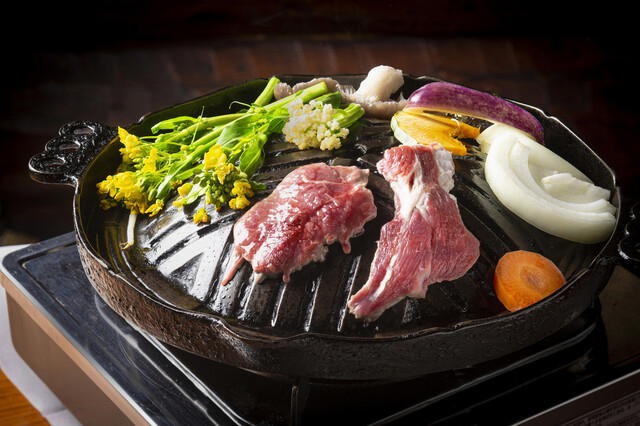
The menu
What to order
- Hitsujiya Genghis Khan
- Sheep merguez sausages
A rural Yamagata grill room changes expectations around Jingisukan. The usual image is communal heat, metal domes, beer, and cheerful roughness. In Murayama, it becomes smaller and more deliberate: five seats, lamb as the central argument, and a room where the grill is not background equipment but the meal’s frame.
That matters because Jingisukan is often treated as Hokkaido shorthand rather than a precision category. The cooking can be casual, but the meat is not simple. Ribeye brings fat and breadth; strip reads leaner and firmer; filet is quieter, prized for tenderness over drama; larger bone-in cuts such as tomahawk shift attention to smoke, exterior browning, and carving rhythm. A specialist counter works only if those differences become legible without turning dinner into a lecture.
Jingisukan reduced to cut, heat, and timing
Hitsujiya belongs to the narrower side of Japan’s lamb culture, where control matters more than abundance. Its category is Jingisukan, grilled lamb, yet the format carries more tension than the label suggests. Lamb needs a different contract with heat than wagyu: too much caution leaves it wan; too much aggression turns it dry and woolly. Ribeye can take a firmer sear because fat protects it, strip rewards careful timing, and filet punishes distraction.
The restaurant’s public description centers on 100% homegrown lamb, a meaningful signal in a country where lamb dining is often tied to regional identity, import supply, or casual group formats. Homegrown lamb shifts the reading from novelty to provenance and from sauce-driven masking to the meat itself. Here, a grill course is less about quantity than how clearly each section of the animal expresses itself under heat.
The Tabelog Award 2026 Bronze listing, with a 4.05 score, puts the room beyond everyday regional yakiniku and lamb shops. Tabelog’s award system rewards sustained diner confidence in a market severe with rural restaurants; a high score outside a major city usually means people make a deliberate trip, not merely reward convenience. Earlier Bronze recognition in 2023 confirms this is not a single-season spike.
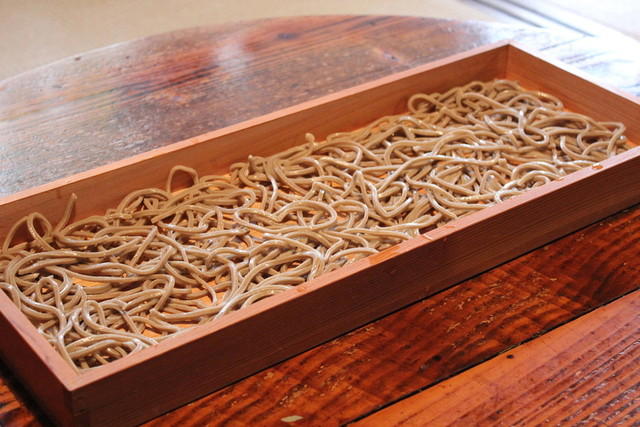
There is useful contrast within Murayama’s dining identity. Soba remains one of the area’s clearest food languages, and Araki Soba represents the older grain-and-broth side of the city’s table. Lamb offers another reading of the same place: rural, ingredient-led, and more exacting than its casual category implies. For a wider map, see our full Murayama restaurants guide.
A five-seat room changes the pace of grilled meat
Small capacity is not automatically a virtue, but it changes how this cooking behaves. At five seats, the meal cannot hide behind the momentum of a large grill hall. The diner sees pacing, portion control, smoke management, and each cut’s handling close up. That intimacy suits lamb, especially when the meal turns on distinctions between tenderness, fat, chew, and aroma rather than unrelated dishes.
The absence of private rooms and private use clarifies the format. This is not built for corporate entertainment or a large celebratory table. It is a focused meal for diners willing to treat grilled lamb with the attention usually given to counter sushi, yakitori, or kappo. The JPY 6,000 to JPY 7,999 lunch or dinner range keeps it below Japan’s luxury tasting-menu tier, while the seat count and reservation-only structure make access more constrained than the tariff suggests.
Murayama adds another layer. In large cities, niche restaurants compete on density, late hours, and novelty. In a smaller Yamagata city, a specialist restaurant must justify travel through clarity of purpose. The logistics are real: this is planned, not a drift-in between department stores. Parking is available, and the rhythm suits diners building a day around Murayama rather than squeezing the room into a loose urban itinerary.
The payment details are notably modern for a small rural dining room: major credit cards and transport IC-style electronic money are accepted, while QR code payments are not. Children are welcome, though there is no child chair, making the experience more plausible for older children comfortable with a compact counter than for families needing extra setup. Non-smoking status keeps focus on lamb and grill rather than the older izakaya atmosphere that can still frame casual meat restaurants in Japan.
How to read it within a Murayama trip
Hitsujiya is strongest as a reason to take Murayama seriously beyond a single dish category. The city’s appeal is not a dense nightlife grid; it is rural specialization, where a few addresses can define a trip more sharply than a long crawl. Travelers can pair restaurant research with our full Murayama hotels guide, our full Murayama bars guide, our full Murayama wineries guide, and our full Murayama experiences guide.
The broader lesson is that Japan’s premium dining map is no longer only metropolitan omakase and luxury beef. Specialist formats now appear across smaller cities, often with fewer seats, sharper ingredient focus, and less theatrical service language. For diners comparing how meat is treated across Japan, the spectrum runs from beef sukiyaki precision at -Grilled beef Sukiyaki- KAMAKURA TANUKIAN 鎌倉 たぬき庵 in Kamakura to charcoal seafood-meat hybrids such as . 鮪と炭火焼き うお炭 秋葉原店 in Tokyo, casual urban cafés like .cafe in Osaka, and regional modern rooms including.know in Kumamoto.
That national range should not flatten Murayama’s distinction. The point is concentration, not variety for its own sake. A five-seat lamb grill with Tabelog Bronze recognition asks for a specific diner: someone interested in how ribeye, strip, filet, and larger cuts behave under direct heat, and in how a rural Japanese restaurant can make grilled lamb feel exact rather than merely hearty.
For adjacent Japan planning, EP Club’s restaurant index also covers focused formats such as (Shoku) Vietnam in Kawasaki, [Curry Senmon Ten] Maruyama Kyoju. in Sapporo, [ki:] in Kyoto, #肉といえば松田 奈良本店 in Kashihara, 1/3 HAMBURGER FACTORY in Kanazawa, and 1000 in Yokohama. For readers extending the same ingredient-first lens beyond Japan, Jōdo Saké Bar in Los Angeles and Onigiri Time in Pasadena show how Japanese formats travel into California’s dining vocabulary.
Frequently asked questions
Is Hitsujiya suitable for children?
Yes. The venue lists children as welcome, and the price range sits at JPY 6,000–7,999 for lunch and dinner in Murayama. There is no child chair, so families should plan accordingly.
What should I expect atmosphere-wise at Hitsujiya?
Expect a small room with only five seats, non-smoking service, and a pace shaped by online reservation-only seating. The setting is practical rather than theatrical, with parking available in Murayama and a focus on Jingisukan rather than a broad menu.
What kind of cuisine does Hitsujiya serve?
Hitsujiya serves Jingisukan (Grilled lamb) cuisine.
How much does it cost to eat at Hitsujiya?
Pricing at Hitsujiya is listed as JPY 6,000 - JPY 7,999 JPY 6,000 - JPY 7,999.
Comparison Snapshot
Comparable venues nearby, for context on price, style, and recognition.
| Venue | Cuisine | Price | Awards | Notes |
|---|---|---|---|---|
| HitsujiyaThis venue (the venue you are viewing) | Jingisukan (Grilled Lamb) | $50–100 | Tabelog Bronze #122 | Not listed |
| Araki Soba | Traditional Murayama soba noodle shop | $10–20 | Tabelog 100 #57 | Murayama |
| Inakaan | Traditional Japanese Unagi | $30–50 | Not listed | Kokura |
| Shokusai Shubo Matsumoto | Agu pork shabu-shabu & Okinawan izakaya | $50–100 | Tabelog 100 #19 | Matsuyama |
| 白露 | Fusion Japanese-French Local Cuisine | Not listed | Not listed | 安比高原 |
| 虎屋壺中庵 | Traditional Japanese Kaiseki | Not listed | Not listed | 佐那河内村 |
Recognition history
Dated appearances from independent guides and award organizations, with the underlying list record or original source where available.
Tabelog Bronze #122
Tabelog
Continue exploring
More in Murayama
Restaurants in Murayama
All restaurants in Murayama →
Hotels in Murayama
Browse all →
Wineries in Murayama
Browse all →
Details
- Rustic
- Cozy
- Intimate
- Date Night
- Special Occasion
- Standalone
- Natural Wine
- Local Sourcing
- A La Carte
- Sake Program
Current opening hours
- Monday
- Closed
- Tuesday
- Closed
- Wednesday
- 11 AM–3 PM, 5–9 PM
- Thursday
- 11 AM–3 PM, 5–9 PM
- Friday
- 11 AM–3 PM, 5–9 PM
- Saturday
- 11 AM–3 PM, 5–9 PM
- Sunday
- 11 AM–3 PM, 5–9 PM
Hours can change for holidays and private events. Hours as of .
Cozy log house atmosphere with a fireplace and natural wine selection.