
Higashi Shinjuku Sanrasa sits in Tokyo’s serious curry conversation rather than the city’s luxury dining lane. Its Tabelog Curry TOKYO 100 selection in 2023 and 2024, compact counter format, and low lunch price bracket place it among the small-format specialists where sourcing, spice discipline, and daily limits matter more than spectacle.
Pearl is the En Primeur Club membership app — saves, bookings, and concierge access live there. Same editors, same standards.
- Address
- Japan, 〒160-0021 Tokyo, Shinjuku City, Shinjuku, 6 Chome−27−17 カノープス新宿 3F
- Website
- sanrasa.wordpress.com
 Saves & bookings on Pearl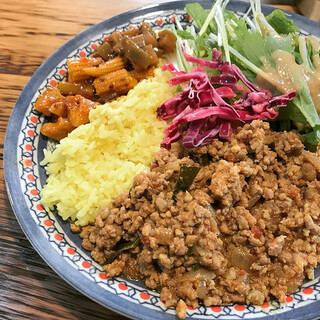
Shinjuku’s curry rooms rarely announce themselves with sushi-counter ceremony or tempura-bar theatre. The persuasive ones feel clipped and practical: a counter, a short service window, turnover built into the room, and aroma doing the explaining. Higashi Shinjuku Sanrasa belongs to the Tokyo category where curry is less comfort-food shorthand than a format for spice structure, rice quality, and tightly managed production.
Tokyo curry has several lanes: the old yoshoku lineage of roux-based plates rooted in military and cafeteria history; the Indian and South Asian restaurant circuit, strong around railway hubs and office districts; and the newer specialist lane of small shops with sharper spice profiles, limited daily output, and diners willing to plan lunch around a single plate. Sanrasa shows how that third lane now competes for attention in a city better known internationally for sushi, ramen, and kaiseki.
Tokyo curry as a sourcing argument, not a luxury signal
The ingredient story in Tokyo curry is rarely prestige produce in the Western fine-dining sense. It is control: base, spice mix, rice, vegetable work, and keeping output narrow enough to avoid mass-service compromise. In Shinjuku, where volume can flatten food quickly, a compact curry counter has less room for error and less distance between cooking and serving.
Sanrasa’s recognition by Tabelog Curry TOKYO 100 in both 2023 and 2024 places it in a competitive group that rewards category depth over general restaurant glamour. Tabelog’s curry lists are revealing because they capture a Tokyo scene that does not map neatly onto Michelin-style luxury. A shop can be inexpensive, brief in service, and operationally austere, while still commanding attention from diners who care about spice balance and consistency.
The price bracket reinforces the point. This meal does not ask to be justified by ceremony. It sits in the everyday-lunch range, but limited production changes the transaction: the value is the plate and the discipline behind how many plates can be made well. That is a different sourcing logic from a tasting menu; the kitchen’s restraint becomes part of the editorial case.
For travellers mapping Tokyo through food categories, curry corrects the city’s luxury stereotype. An itinerary with yakitori, sushi, or a hotel bar should leave space for a specialist curry lunch because it shows how Tokyo rewards narrow mastery at modest prices. For broader planning, Our full Tokyo restaurants guide gives the wider dining frame, while Our full Tokyo hotels guide, Our full Tokyo bars guide, Our full Tokyo wineries guide, and Our full Tokyo experiences guide help place the meal within a full city schedule.
Shinjuku's specialist counters reward decisiveness
Shinjuku is often misread as one dining district. It is a cluster of micro-scenes: station-department dining, late-night drinking streets, Korean and Chinese corridors, Golden Gai’s compact bars, and quieter east-side pockets where small restaurants operate with fewer visual signals. Curry fits because it needs no street-level drama. A third-floor room can build a following if the food has identity and the operation is consistent.
The move from Golden Gai in 2017 is context, not a romantic origin story. Golden Gai is dense, late, and bar-led; Higashi Shinjuku gives a lunch-focused curry specialist a different rhythm. The shift says Tokyo curry has grown confident enough to leave nightlife mythology behind and function as a daytime destination.
Compared with the provided Tokyo peers, Sanrasa occupies the low-price specialist end rather than the dinner-led bracket represented by Pizzeria LUMEN or Michishirube. Sansar Shinjuku ten sits nearer the accessible curry-adjacent price conversation, but Sanrasa’s Tabelog Curry TOKYO 100 listing gives it a clearer category signal. The useful comparison is not which room feels grander, but which format tells the sharper story about what Tokyo diners currently reward.
That explains why curry specialists travel poorly in generic recommendation lists. Ramen can be reduced to broth type; sushi to lineage or counter price. Curry is harder: the meaningful distinctions are sourcing choices, spice architecture, and production limits, details that resist neat headlines. Sanrasa’s appeal sits in that gap between everyday affordability and serious category credibility.
How to place it in a Tokyo food itinerary
Use this meal not as a substitute for Tokyo’s formal dining rooms, but for precision at street-level scale. Pair it mentally with places such as 3 Chome no Curry Ya San rather than an omakase counter or hotel dining room. The question is whether a curry lunch can carry enough craft to justify planning around it. Here, the awards history and tight format make the case.
Tokyo’s range is the point. A day can move from specialist curry to grilled fish, yakitori, sweets, or drinks without forcing one definition of Japanese dining. Nearby and citywide references such as 12/10 Shinjuku ten, 124. KAGURAZAKA (Yakitori). 鮪と炭火焼き うお炭 秋葉原店, and 2D Cafe show how quickly the city changes registers. That variety is not a distraction; it is how Tokyo’s dining culture works.
For readers building a Japan-wide food map, the comparison widens. Curry in Sapporo, sake-led cooking in Los Angeles, Vietnamese cooking in Kawasaki, and Kyoto’s compact dining rooms sit in different cultural frames, but share the same EP Club question: what does the format reveal that a generic guide would miss? See [Curry Senmon Ten] Maruyama Kyoju. in Sapporo, [ki:] in Kyoto, (Shoku) Vietnam in Kawasaki, -Grilled beef Sukiyaki- KAMAKURA TANUKIAN 鎌倉 たぬき庵 in Kamakura.cafe in Osaka.know in Kumamoto, Jōdo Saké Bar in Los Angeles, and Onigiri Time in Pasadena for that wider lens.
The verdict is simple without ceremony: Higashi Shinjuku Sanrasa is a serious curry address because it compresses Tokyo’s specialist-dining values into a small, disciplined lunch format. It is for travellers who know some of the city’s clearest food arguments are made without white tablecloths, long menus, or luxury pricing.
Cuisine and Credentials
Comparable venues to anchor price and recognition.
| Venue | Cuisine | Price | Notes |
|---|---|---|---|
| Higashi Shinjuku SanrasaThis venue — the venue you are viewing | Japanese Curry | $ | Not listed |
| Umemura | Japanese Soul Food | $ | Koto |
| Katei Saien Sasaki | Japanese home-style fish teishoku cafeteria | $ | Shinjuku |
| CHANTOYA COCONUT CURRY | Coconut-focused Japanese curry | $ | Chiyoda |
| Shigekuniya 55 Bakery | Japanese neighborhood bakery | $ | Suginami |
| Kagawa Ippuku Kanda ten | Sanuki udon & curry udon | $ | Chiyoda |
Recognition history
Dated appearances from independent guides and award organizations, with the underlying list record or original source where available.
Tabelog 100 #13 · No. 13
Tabelog · Tabelog 100 - Curry - TOKYO - 2024













At a Glance
- Cozy
- Minimalist
- Intimate
- Solo
- After Work
- Casual Hangout
- Standalone
Current opening hours
- Monday
- Closed
- Tuesday
- 11 AM–3 PM
- Wednesday
- 11 AM–3 PM
- Thursday
- 11 AM–3 PM
- Friday
- 11 AM–3 PM
- Saturday
- Closed
- Sunday
- Closed
Hours can change for holidays and private events. Last verified .
A compact, standing-only curry spot with a restrained, no-frills atmosphere centered on a calm, restorative spice-curry experience.