Henry's End
Henry's End on Henry Street in Brooklyn Heights occupies a different tier from the four-star Manhattan circuit, operating as a neighborhood dining room where the cooking draws on classic American technique applied to seasonal and wild ingredients. Compared to destination restaurants like Le Bernardin or Per Se, the draw here is proximity and constancy rather than spectacle, a Brooklyn institution that rewards regulars as much as first-time visitors.
Pearl is the En Primeur Club membership app — saves, bookings, and concierge access live there. Same editors, same standards.
- Address
- 72 Henry St, Brooklyn, NY 11201
- Phone
- +17188341776
- Website
- henrysend.com
- Directions
- Get directions
 Saves & bookings on Pearl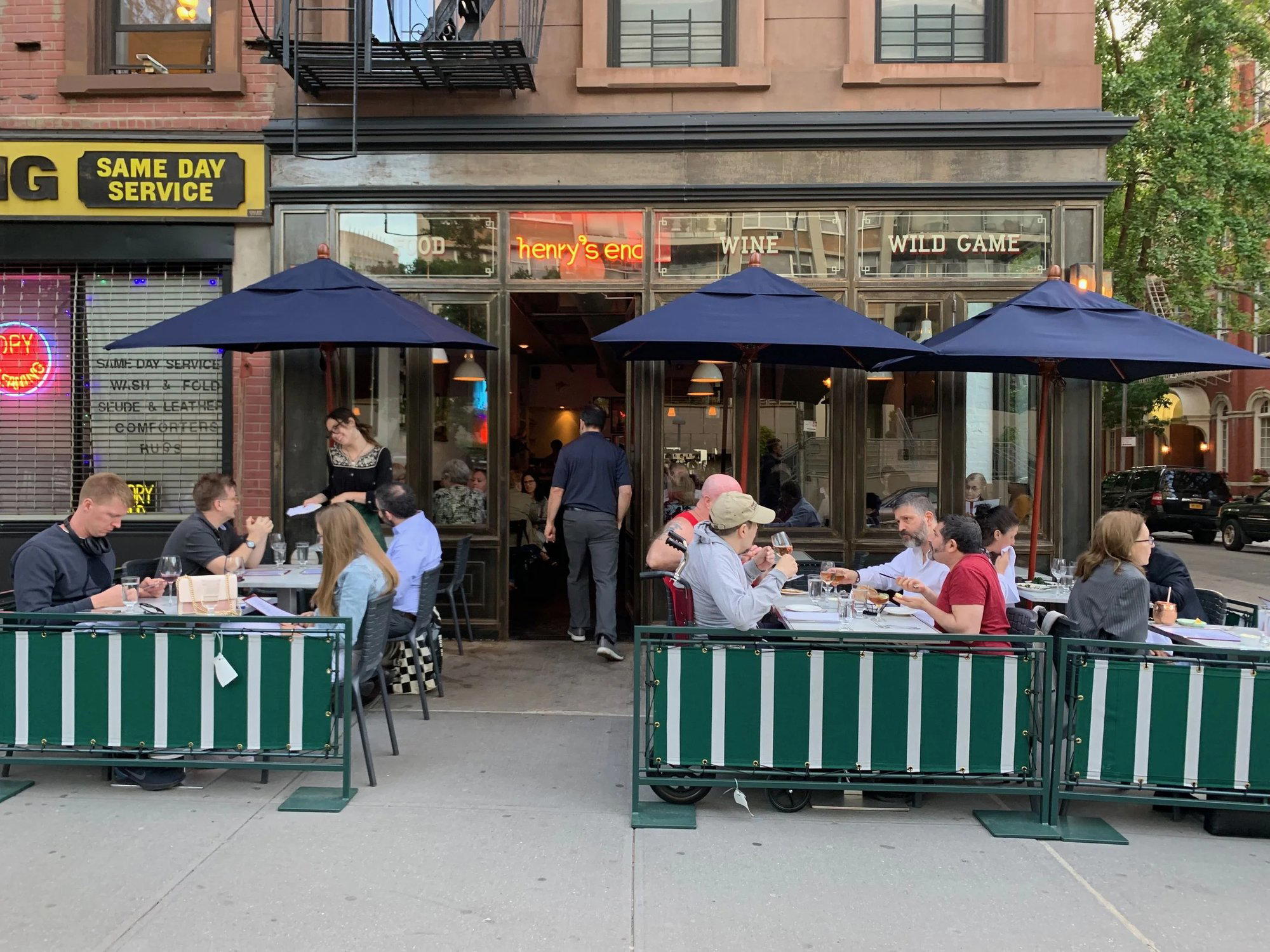
Brooklyn Heights and the Independent Dining Room
Brooklyn Heights has resisted the wave of concept-driven restaurant openings that reshaped Williamsburg and Carroll Gardens over the past decade. Henry Street, in particular, retains the character of a residential dining corridor, the kind where a restaurant survives not on press cycles but on neighborhood loyalty. Henry's End is a restaurant at 72 Henry St in Brooklyn Heights, Brooklyn, known for New American with Wild Game. It is the kind of room that Manhattan's tasting-menu circuit, represented at the leading end by counters like Masa or prix-fixe institutions like Per Se, rarely competes with directly, because it is solving a different problem for a different diner.
The independent American dining room is a category under pressure across most major cities. Rising labor costs, accelerating rents, and the gravitational pull of group-backed restaurant brands have steadily narrowed the space that places like Henry's End occupy. That the address has endured on Henry Street is itself a data point about the Brooklyn Heights dining community and its appetite for continuity over novelty.
American Technique, Seasonal Range
The editorial angle that applies most cleanly to Henry's End is one that recurs across American regional dining: the application of trained classical technique to ingredients that sit outside the European fine-dining canon. Across the United States, a cohort of independent restaurants has spent decades building menus around game, wild fish, and foraged material, ingredients that modernist tasting-menu programs at places like Alinea in Chicago or Lazy Bear in San Francisco approach through a different lens, one of transformation and technical spectacle. The independent American dining room tends toward a more direct relationship with its raw material.
The restaurant has historically been associated with this approach, a menu that changes with availability, weighted toward game and seasonal proteins, handled with the kind of classical grounding that does not call attention to itself. The kitchen's orientation places it in a peer group closer to Blue Hill at Stone Barns in Tarrytown in spirit, if not in format or price point. Where Blue Hill operates as a destination with agricultural infrastructure behind every plate, the restaurant functions as a neighborhood expression of the same underlying conviction: that local and seasonal sourcing, handled with competence rather than theater, produces better food than the alternative.
That approach connects the restaurant to a longer American tradition. Restaurants like Emeril's in New Orleans, Bacchanalia in Atlanta, and Providence in Los Angeles each built their identities around regional ingredient specificity filtered through serious kitchen training. The restaurant operates at a smaller scale and lower price tier, but the underlying logic, imported technique applied to indigenous product, is consistent.
Where It Sits in New York's Dining Structure
New York's restaurant structure has bifurcated sharply over the past fifteen years. At the leading, a small cluster of destination restaurants commands international attention and prices that benchmark against global peers. Le Bernardin, Atomix, and Jungsik New York compete in that tier, drawing diners from outside the city and pricing accordingly. Below that, a middle layer of ambitious neighborhood restaurants operates with tighter margins, smaller rooms, and a repeat-visitor model that makes local reputation the primary currency.
The restaurant belongs to the second group. Its value proposition is not discovery or prestige, it is reliability and specificity. In a borough where restaurant turnover has accelerated, longevity functions as a trust signal. The equivalent dynamic plays out in other American cities: Addison in San Diego and The Inn at Little Washington each demonstrate that sustained local loyalty, over time, produces a different kind of authority than award cycles alone.
The Brooklyn Heights location also matters contextually. The neighborhood draws a mix of long-term residents, legal and financial professionals working near downtown Brooklyn, and visitors staying in the area rather than Midtown. That demographic tends toward repeat visits and mid-week reliability over weekend occasion dining, a pattern that suits the independent dining room format well.
The Broader Game Dining Tradition
The restaurant's association with game cookery connects it to a strand of American restaurant culture that predates farm-to-table branding by decades. Game dinners and wild ingredient programs have deep roots in New York's dining history, traceable to the chophouse tradition of the nineteenth century and forward through the regional American revival of the 1980s and 1990s. Restaurants that built serious game programs, duck, venison, boar, and seasonal wild fish, were positioning themselves against the Europeanized fine dining of that era, asserting that American ingredients deserved treatment as serious as imported ones.
That argument has largely been won. The farm-sourcing transparency now standard at places like Single Thread Farm in Healdsburg or The French Laundry in Napa reflects a broader cultural shift that independent New York restaurants helped move. The restaurant's position within that history is as a practitioner rather than a headliner, a restaurant that continued doing the work while trends moved around it.
For a comparative international frame: the equivalent dynamic in European dining sees restaurants like Alain Ducasse's Louis XV in Monte Carlo or 8½ Otto e Mezzo Bombana in Hong Kong apply classical French technique to regional and seasonal material. The scale and price differ enormously from the restaurant, but the structural logic, trained technique meeting local ingredient, is the same argument made at different price points.
Planning Your Visit
The restaurant is located at 72 Henry St in Brooklyn Heights. Reservations are essential, especially on weekend evenings. The price point is about $60 per person.
Compact Comparison
Comparable venues nearby, for context on price, style, and recognition.
| Venue | Price | Notes |
|---|---|---|
| Henry's EndThis venue — the venue you are viewing | $$$ | Not listed |
| Gair | $$$ | Downtown Brooklyn-DUMBO-Boerum Hill, Modern American Gastropub |
| One Dine | $$$ | Tribeca-Civic Center, Contemporary American with Global Influences |
| Bell Book & Candle | $$$ | West Village, Contemporary American with Rooftop Garden Produce |
| David Burke Tavern | $$$ | Upper East Side-Carnegie Hill, Modern American Steakhouse |
| Beast | $$$ | Prospect Heights, Modern American Rooftop Lounge |
Continue exploring
More in New York City
Restaurants in New York City
Browse all →
Bars in New York City
Browse all →
Hotels in New York City
Browse all →


Wineries in New York City
Browse all →


At a Glance
- Cozy
- Classic
- Intimate
- Date Night
- Special Occasion
- Historic Building
- Extensive Wine List
- Local Sourcing
Current opening hours
- Monday
- 5–9 PM
- Tuesday
- 5–9 PM
- Wednesday
- 5–9 PM
- Thursday
- 5–9 PM
- Friday
- 5–9:30 PM
- Saturday
- 11 AM–3 PM, 5–9:30 PM
- Sunday
- 11 AM–3 PM, 5–8:30 PM
Hours can change for holidays and private events. Last verified .
Inviting and cozy atmosphere with friendly service, well-suited for a relaxed neighborhood dining experience.