
Michelin Plate
Our verdict
Located at 6 Jiayufang in the Gusu District, it draws locals and informed visitors to one of the old city's most concentrated noodle corridors. The price point stays firmly in the single-¥ bracket.

Pearl is the En Primeur Club membership app, where members save venues, book tables and use the concierge.
The menu
What to order
- Crab roe noodles
- Xiao long bao
- Pan-fried pork buns
Suzhou's Noodle Culture and the Gusu District's Old-Street Corridor
Suzhou has a long and specific relationship with noodles that sets it apart from neighbouring Shanghai's soup-dumpling focus or Hangzhou's fish-forward Jiangnan cooking. The city's signature format is the lidded bowl of fine wheat noodles served in a pale, slow-cooked broth, topped with combinations of braised pork, eel, dried tofu skin, and river shrimp depending on season and preference. The Gusu District, which contains much of Suzhou's preserved canal-side architecture, also holds the highest concentration of historically rooted noodle houses, many occupying narrow shopfronts on lanes that predate the city's modern expansion. Jiayufang is one such lane, and the density of recognised noodle operations along and around it is notable enough that visiting more than one in a single morning is both feasible and common practice.
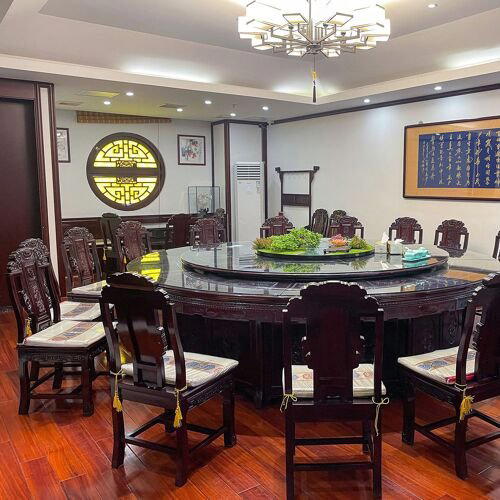
Within that corridor, Gu Su Qiao (Diyi Tianmen) sits at 6 Jiayufang. The approach is typical of the neighbourhood: a modest facade, queuing that begins before the kitchen is fully running, and a room organised entirely around throughput rather than atmosphere in the Western sense. The audience is predominantly local. These are not tourist-oriented spaces; they function as neighbourhood infrastructure for the surrounding residential and commercial lanes of the old city.
Where the Michelin Plate Sits in Suzhou's Noodle Tier
Michelin's Plate designation, awarded to Gu Su Qiao (Diyi Tianmen) in 2025, signals cooking that meets a consistent quality threshold without necessarily reaching the Star tier. In Suzhou's noodle category, that distinction matters because it separates a short list of operations from the much larger pool of unremarked shops. The city's noodle scene is not stratified by price in the way that Jiangsu cuisine restaurants are: Michelin-starred dining at places like Dingshan·Jiangyan or Pingjiangsong (the latter in the ¥¥¥¥ bracket) occupies an entirely different register. At the noodle level, the single-¥ price point is near-universal across recognised and unrecognised shops alike, which means quality signals have to come from other sources.
The sample size is modest, which is not unusual for a bowl-format operation that attracts local regulars rather than international reviewers. Regulars at this kind of establishment tend not to review; the rating reflects a skew toward first-time visitors or travellers who came specifically because of the Michelin Plate recognition.
For comparison across the region's noodle-focused category, the same Plate-level recognition pattern appears in Hangzhou at A Bing Bao Shan Mian and in Taichung at A Kun Mian, both of which operate in comparable budget tiers with formal culinary acknowledgment in cities known for specific noodle traditions.
The Service Model and What Collaboration Means at This Scale
Noodle houses at this price point do not operate with a sommelier or a formal front-of-house team in the way that a ¥¥¥ Jiangsu cuisine restaurant does. The relevant collaboration here is between the kitchen, typically a small team managing broth temperature, noodle timing, and topping preparation simultaneously, and the counter or service staff who coordinate order flow, seating, and the speed at which tables turn. At a single-¥ operation in a residential lane, the alignment between these two functions is what separates a consistent experience from a chaotic one. The 4.8 rating suggests that coordination is working.
This is a distinct service model from the more elaborate team structures found at Suzhou's higher-end addresses or at comparable Chinese fine dining elsewhere in the country, such as Xin Rong Ji (Xinyuan South Road) in Beijing, 102 House in Shanghai, Chef Tam's Seasons in Macau, Ru Yuan in Hangzhou, Xin Rong Ji in Chengdu, or Imperial Treasure Fine Chinese Cuisine in Guangzhou. The comparison is not intended to diminish the format; a well-run fast-service noodle kitchen demands its own form of precision, particularly in broth consistency and noodle texture across a high volume of covers.
How to Read the Menu and What to Prioritise
Suzhou noodle menus are typically structured around a choice of broth base and a selection of toppings ordered separately or in combination. The broth is the constant and the most telling indicator of kitchen quality: a well-made Suzhou noodle broth is pale amber to near-white, with depth that comes from long reduction of pork and sometimes eel bones rather than heavy seasoning. The noodles themselves are thin and springy, designed to remain distinct rather than absorbing broth into softness.
Toppings at Gusu District shops traditionally include braised pork belly (焖肉), river eel (爆鱼 or 焖鳝), dried tofu skin (千张), and spring-seasonal river shrimp when available. Ordering what the kitchen produces in volume on any given morning is the practical approach: high-turnover items reflect what the kitchen does consistently well, and at a noodle house with this kind of recognition, that instinct is reliable.
Planning Your Visit
Gu Su Qiao (Diyi Tianmen) is at 6 Jiayufang, Gusu District, Suzhou, a short walk from the preserved canal network of the old city and within reach of other noodle operations on the same lane, including Tong De Xing (Jiayu Fang) and Wei Ji Ao Mian Guan (East Baita Road). Suzhou's noodle culture is a morning practice: peak hours run from roughly 7am to 9am, and many shops reduce topping options or close entirely by late morning. Arriving early is the practical approach for both availability and the most consistent kitchen output. No booking infrastructure applies at this format and price point; arrival and queue management is the only admission mechanism.
For broader context on where this venue sits within Suzhou's dining options, see our full Suzhou restaurants guide. The city's hotel, bar, winery, and experience options are covered separately at our full Suzhou hotels guide, our full Suzhou bars guide, our full Suzhou wineries guide, and our full Suzhou experiences guide.
Frequently asked questions
How do I find Gu Su Qiao (Diyi Tianmen)?
Gu Su Qiao (Diyi Tianmen) is located at 6 Jiayufang, Gusu District, Suzhou, Jiangsu, China, 215005, Suzhou.
What's Gu Su Qiao (Diyi Tianmen) known for in terms of accolades?
Gu Su Qiao (Diyi Tianmen) has received recognition including: Michelin Plate (2025).
What should I order at Gu Su Qiao (Diyi Tianmen)?
At a Suzhou noodle house holding a 2025 Michelin Plate, the broth is the kitchen's primary credential, that is where consistency is judged and where to focus first. Suzhou-style noodle menus typically separate the broth base from the toppings, so ordering a classic broth with a single well-regarded topping gives a clearer read on kitchen quality than a loaded combination bowl. The ¥ price tier means the entire visit costs very little, which makes ordering a second bowl to compare broth depth a reasonable approach rather than a luxury.
Just the Basics
Comparable venues nearby, for context on price, style, and recognition.
| Venue | Cuisine | Price | Awards | Notes |
|---|---|---|---|---|
| Gu Su Qiao (Diyi Tianmen)This venue (the venue you are viewing) | Modern Jiangnan Noodles | Not listed | Michelin Plate | Not listed |
| Chao 27 | Refined Chaozhou Cuisine | $100–150 | Michelin Plate | Suzhou Industrial Park, Refined Chaozhou Cuisine |
| Chai Court | Cantonese | Not listed | Michelin Plate | Huqiu, Authentic Cantonese |
| Jin Jing Ge | Modern Jiangnan Cuisine | $100–150 | Michelin Plate | Suzhou Industrial Park, Modern Jiangnan Cuisine |
| Yu Mian Tang | Suzhou Heritage Noodles | $20–30 | Michelin Bib Gourmand | Gusu, Suzhou Heritage Noodles |
| Jinhai Huayue Food Oriental CHAO27 | Teochew fine dining | $50–100 | Black Pearl 1 Diamond | Not listed |
Recognition history
Dated appearances from independent guides and award organizations, with the underlying list record or original source where available.
Michelin Plate
Michelin
Continue exploring
More in Suzhou
Details
- Elegant
- Classic
- Cozy
- Sophisticated
- Special Occasion
- Private Dining
- Sake Program
- Local Sourcing
- A La Carte
Current opening hours
- Monday
- 10:30 AM–2 PM, 5–9 PM
- Tuesday
- 10:30 AM–2 PM, 5–9 PM
- Wednesday
- 10:30 AM–2 PM, 5–9 PM
- Thursday
- 10:30 AM–2 PM, 5–9 PM
- Friday
- 10:30 AM–2 PM, 5–9 PM
- Saturday
- 10:30 AM–2 PM, 5–9 PM
- Sunday
- 10:30 AM–2 PM, 5–9 PM
Hours can change for holidays and private events. Hours as of .
Serene and streamlined with pale woods, ink-brush accents, and sculptural lighting that flatters both porcelain and conversation.