Sun Island Resorts, Shanghai
Sun Island Resorts occupies a quieter corner of Qingpu District, positioned along Shanghai's western waterway network at 2588 Shentai Road. The resort format places it in a growing category of lake-facing Shanghai retreats that prioritise space and distance from the city centre over urban convenience. For travellers who find the Bund corridor properties too dense, this is the operative alternative.

Pearl is the En Primeur Club membership app, where members save venues, book tables and use the concierge.
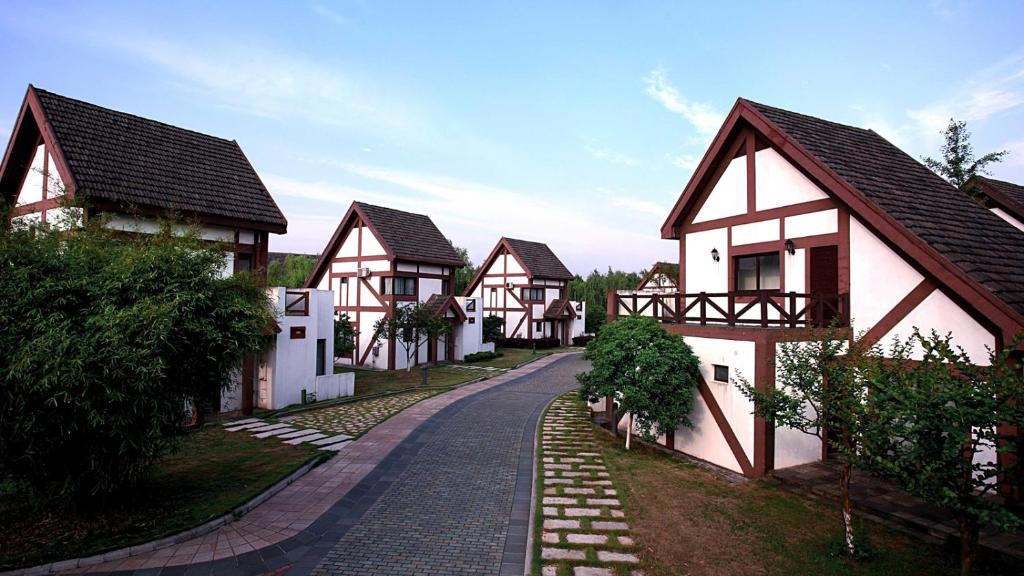
On the Western Fringe: Resort Design in Qingpu District
Shanghai's resort development has pushed steadily westward over the past two decades, following the lakes, canals, and relative quiet of Qingpu District as the city's interior districts grew denser and more expensive. The pattern mirrors what happened in comparable megacities: as central land values rose, leisure properties migrated outward, trading urban proximity for space, water, and the design ambition that only a larger footprint permits. Sun Island Resorts, at 2588 Shentai Road, sits within this westward arc, occupying a position in Qingpu that positions it as a destination stay rather than a convenience hotel. Getting there from central Shanghai involves roughly 40 to 50 minutes by road depending on traffic, which is the standard tradeoff for any Qingpu property and one that guests tend to accept in exchange for scale and landscape that the inner city cannot offer.
The Architecture of Escape: How Shanghai's Leisure Properties Define Themselves Through Space
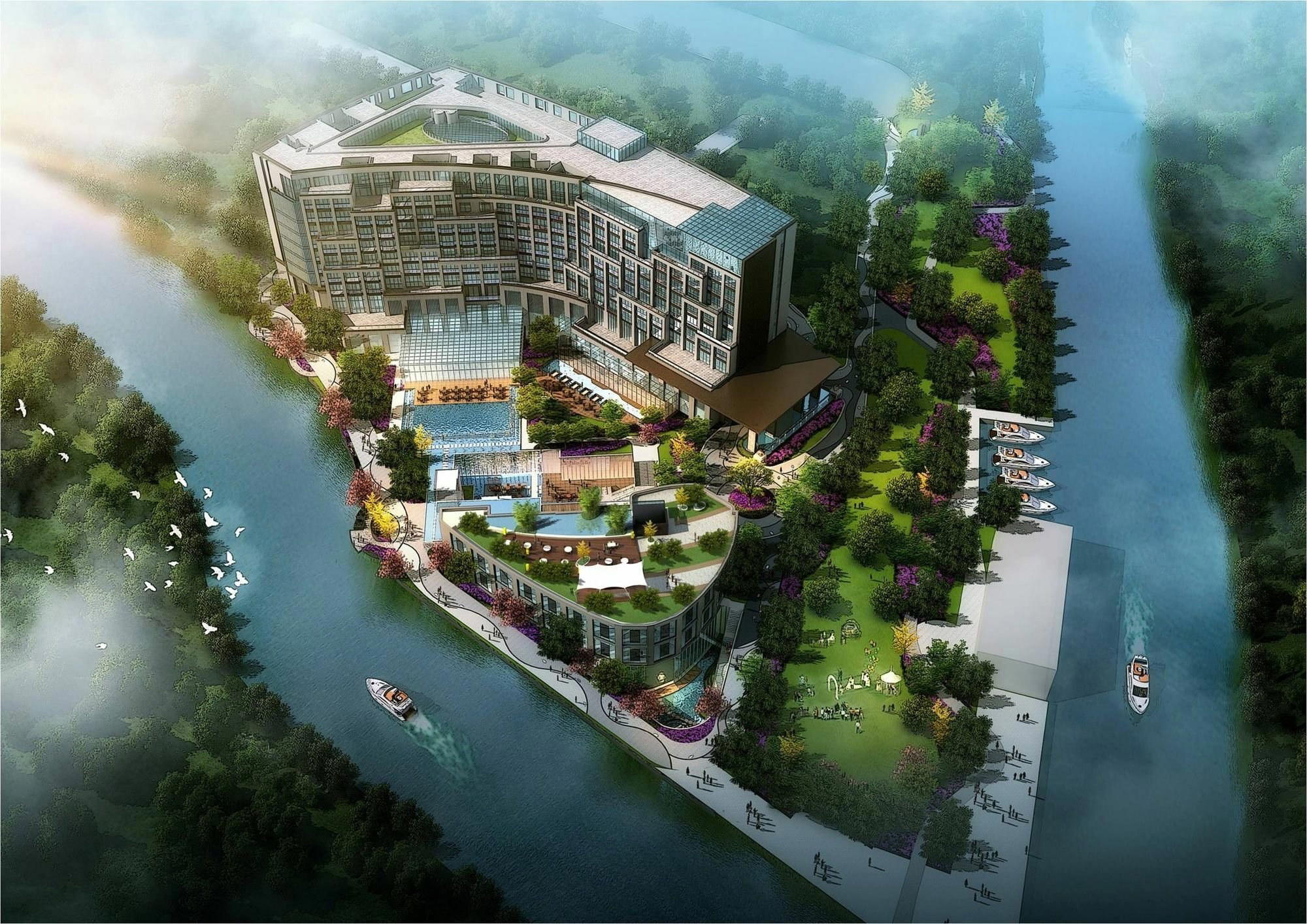
Across China's resort tier, the design conversation has shifted considerably. A decade ago, the dominant language was pastiche grandeur: European classical facades applied to Chinese suburban sites, lobbies designed to signal aspiration through chandelier volume and marble square footage. That approach has given way, in the more considered properties, to something closer to environmental integration: buildings that respond to their water settings, that use local material references, and that treat arrival as a spatial sequence rather than a single theatrical moment. Sun Island, as the name suggests, positions itself within a geography defined by water. Qingpu's network of lakes and canals, part of the broader Taihu Lake basin, gives properties in this zone a natural design advantage that inland sites lack: the ability to use water as the primary organizing element of the guest experience, framing views, separating zones, and providing the acoustic and visual calm that resort guests are paying for.
This is the design context in which Sun Island Resorts should be read. Properties that work with Qingpu's water geography tend to separate themselves from the suburban hotel category entirely, functioning less as hotels with gardens and more as contained resort environments where movement between spaces is itself part of the experience. Whether Sun Island fully realizes that ambition in its current configuration is a question leading answered by checking current guest documentation and on-site reporting; what the address and district positioning confirm is that the site conditions are there to support it. For travelers comparing this property to centrally located options like the JW Marriott Hotel Shanghai at Tomorrow Square, the calculus is direct: one offers the city at your window, the other offers a deliberate remove from it.
Qingpu as a Resort District: Peer Context and What It Signals
Qingpu has developed a recognizable resort identity distinct from Shanghai's hotel districts closer to the Bund or Jing'an. The area attracts properties that need room to breathe: golf resorts, spa compounds, wedding venues, and family leisure destinations that would be economically impossible to build at urban densities. This clustering creates a self-reinforcing dynamic: as more leisure properties arrive, the district becomes more clearly coded as a destination for a particular kind of stay, and guests arrive with expectations calibrated accordingly. Sun Island Resorts operates within that coding, which matters for setting expectations correctly. This is not a base for urban sightseeing; it is a property where the grounds, the water, and the resort facilities are the primary draw.
Travelers familiar with resort properties in comparable Chinese leisure zones, whether the lake districts of Hangzhou (where Amanfayun has set a high benchmark for environmental integration) or the more tropical settings of Sanya (where 1 Hotel Haitang Bay represents a sustainability-driven approach to resort design), will recognize the category logic. The question for any Qingpu property is whether it delivers on the site's intrinsic advantages or merely occupies them. Sun Island's positioning within a water-rich district gives it the raw material; execution is what separates the category leaders from the also-rans.
Shanghai's Broader Resort and Luxury Hotel Context
Shanghai as a market covers a wider range of property types than almost any other Chinese city, running from hyper-urban towers in Pudong to rural-adjacent retreats in its outer districts. The city's premium hotel scene is well-documented in our full Shanghai Shi restaurants and hotels guide, and the picture that emerges is one of meaningful segmentation: properties are increasingly distinct in their positioning rather than competing on the same generic luxury metrics. A business traveler and a weekend leisure guest are looking at almost entirely different maps of the city's accommodation options.
Sun Island Resorts fits the leisure and retreat segment of that map. Comparisons with properties like Andaz Shenzhen Bay or Banyan Tree Chongqing Beibei are instructive: across China's major cities, resort properties attached to scenic or water geography have carved out a defensible niche by offering what urban hotels structurally cannot. Space, quiet, and a design sensibility that responds to natural setting rather than ignoring it. For travelers who have experienced comparable properties, whether the heritage-led approach of Amandayan in Lijiang or the mountain resort format of Xiamen Yunding Resort, the appeal of this category is familiar: the property becomes the destination, not simply accommodation near one.
Planning a Stay: What to Know Before You Go
Reaching Sun Island Resorts from central Shanghai is most practical by private car or taxi; Qingpu District is not directly served by the Shanghai Metro in a way that puts the Shentai Road address within comfortable walking distance of a station. Guests arriving from Hongqiao Airport are in a better position geographically, with Qingpu sitting west of the city center and accessible without crossing the entire urban area. Given the resort's positioning, advance booking for weekend stays and public holidays is advisable, as water-adjacent leisure properties in the greater Shanghai area tend to fill early during national holidays and Golden Week periods.
For travelers building a broader circuit of China's resort properties, Sun Island Resorts represents one point on a wider map that includes mountain retreats like Banyan Tree Ringha in, heritage properties like Mandarin Oriental Qianmen in Beijing, and wilderness outposts like Mohe Youran Mountain Residence in the country's far north. Each occupies a distinct ecological and experiential niche; Sun Island's is the water-garden resort format within day-trip distance of one of the world's largest cities, which is a specific and commercially durable position to hold.
Comparison Snapshot
| Venue | Price | Awards |
|---|---|---|
| Sun Island Resorts, ShanghaiThis venue (the venue you are viewing) | $100–200 | Not listed |
| Aman Summer Palace | $1,000–1,500 | Forbes 4-Star |
| Amanfayun | Not listed | Michelin Selected · La Liste Top Hotels |
| Amanyangyun | Not listed | 2 Michelin Keys · Vogue 2026 Vogue Best Hotels in Shanghai |
| Andaz Xintiandi, Shanghai | $100–200 | Michelin Selected · Forbes Recommended |
| Banyan Tree Hangzhou | $300–500 | Michelin Selected · Forbes 4-Star |
Continue exploring
More in Shanghai Shi
Hotels in Shanghai Shi
All hotels in Shanghai Shi →
Details
- Scenic
- Quiet
- Elegant
- Family Vacation
- Weekend Escape
- Wellness Retreat
- Beachfront
- Infinity Pool
- Golf Course
- Waterfront
- Pool
- Spa
- Fitness Center
- Room Service
- Concierge
- Kids Club
- Waterfront
- Garden
Tranquil and rejuvenating atmosphere surrounded by forest and river, ideal for relaxation amid nature.