Goaßhittn
A Styrian hut address in Bad Mitterndorf's alpine valley, Goaßhittn operates from a rural setting at Neuhofen 19 that anchors it firmly in the region's livestock-farming and mountain-pasture traditions. The name itself, dialect for 'goat hut', signals the sourcing logic before any plate arrives. Visitors willing to seek it out find a kitchen built around local provenance rather than destination spectacle.
Pearl is the En Primeur Club membership app — saves, bookings, and concierge access live there. Same editors, same standards.
- Address
- Neuhofen 19, 8983 Neuhofen, Austria
- Phone
- +436645058220
- Website
- goasshittn.at
- Directions
- Get directions
 Saves & bookings on Pearl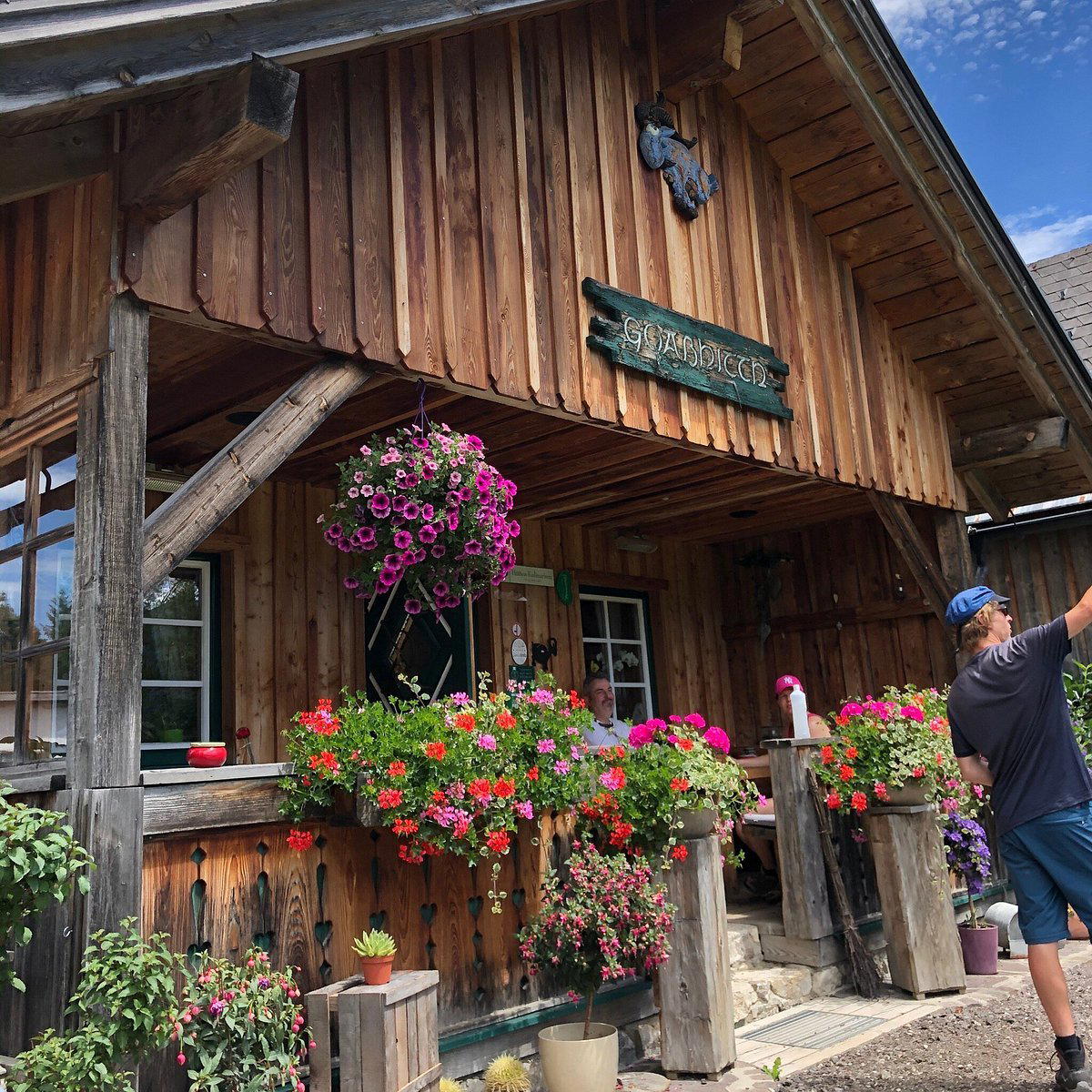
A Goat Hut at the Edge of the Salzkammergut
Goaßhittn is a casual restaurant in Neuhofen, Austria, serving Traditional Austrian Jause & Most. The villages that ring Bad Mitterndorf sit inside one of Austria's quieter alpine corridors, where the Styrian hills flatten just enough to support dairy farming, mountain grazing, and the kind of small-settlement hospitality that big resort towns rarely sustain. The address at Neuhofen 19 places Goaßhittn outside the main township, in agricultural land where the building's function was always as practical as its name. Goaßhittn is Styrian dialect for goat hut, and in a region where naming a food business after a livestock shelter is a statement of intent rather than an affectation, that etymology carries weight.
Bad Mitterndorf itself draws visitors through its thermal baths, cross-country skiing, and proximity to the Tauplitzalm plateau, but the dining culture in this part of the Ausseerland-Salzkammergut district has historically been built around sustenance rather than gastronomy. What distinguishes a place like Goaßhittn in that context is not ambition dressed up as rusticity, but an approach that uses the surrounding land as its actual supply chain. The cooking tradition here connects to the broader Styrian hut cuisine, Hüttenküche, that runs from farmyard charcuterie through to slow-cooked game, dairy from local pastures, and breads built on regional grain. That tradition has outlasted every hospitality trend because it is, at its core, a direct expression of what the land produces at each point in the year.
Where the Ingredients Come From and Why That Shapes the Plate
Styrian highland cuisine rests on a sourcing logic that precedes the word 'local' becoming a marketing claim. In this part of Austria, the growing season is short, the altitude influences what animals can graze and for how long, and the summer pasture calendar is still observed with practical seriousness. Goat milk and goat cheese from high-altitude farms carry a mineral sharpness that lowland dairy cannot replicate, a result of the mineral-dense grasses and wild herbs that define alpine grazing. When a kitchen draws from that supply directly, the difference arrives on the plate without needing to be announced.
The broader Styrian food tradition relies heavily on what is either farmed or foraged close to hand: pumpkin in its many forms, Steirisches Kürbiskernöl (pumpkin seed oil, protected designation of origin), smoked meats from the valley farms, trout from cold mountain streams, and wild mushrooms from the surrounding forests. A kitchen situated at Neuhofen, in the agricultural fringe of Bad Mitterndorf, has access to that supply network in a way that an urban restaurant cannot replicate by sourcing the same ingredients from a distance. The proximity closes the gap between harvest and table in a manner that is measurable, not rhetorical.
This ingredient logic places Goaßhittn in a category that Austrian regional dining has quietly refined over decades. It sits in a similar conceptual space to how Kräuterreich by Vitus Winkler in Sankt Veit im Pongau uses alpine herb cultivation as a structural element of its menu, or how Obauer in Werfen has spent decades building its identity around the specific produce of the Salzach valley corridor. The scale and recognition differ, but the sourcing discipline belongs to the same school of thought.
Bad Mitterndorf's Dining Context
Within Bad Mitterndorf, the restaurant scene is small enough that each address has a clearly defined role. Schupfer's Dorfschmiede occupies a different register, as does Schöni-Alm and Zum Troadkastl. In a town where the restaurant count is limited by population and seasonality, the positioning of each address is less competitive than complementary, with visitors assembling an itinerary across a handful of options rather than choosing from a deep field. Goaßhittn's rural location at Neuhofen reinforces its function as a destination in itself: you go specifically, not by chance.
For context against the wider Austrian alpine dining spectrum, the regional hut tradition in Styria and Salzburg has produced a tier of addresses that use their rural positioning as a creative and sourcing advantage. Gourmetrestaurant Tannenhof in Sankt Anton am Arlberg and Griggeler Stuba in Lech demonstrate how that format can operate at the decorated end of the spectrum. Steirereck im Stadtpark in Vienna has built its reputation in part on the same Styrian provenance logic, sourcing from the alpine region that Goaßhittn sits inside. Closer to the Salzkammergut register, Döllerer in Golling an der Salzach offers a comparison point for how alpine-ingredient kitchens can operate across a broader price tier. Further afield, Schwarzer Adler in Hall in Tirol and Stüva in Ischgl show how the alpine setting informs kitchen identity across different Austrian regions.
The contrast with fully urban European fine dining is useful to name. A kitchen at Le Bernardin in New York City or a community-driven format like Lazy Bear in San Francisco operates on imported supply chains regardless of sourcing care. The geography of Neuhofen removes that intermediary step in a way that is specific to this part of the Austrian highlands.
Comparison Snapshot
Comparable venues nearby, for context on price, style, and recognition.
| Venue | Cuisine | Price | Notes |
|---|---|---|---|
| GoaßhittnThis venue — the venue you are viewing | Traditional Austrian Jause & Most | $ | Not listed |
| Schöni-Alm | Traditional Austrian Mountain Hut | $$ | Bad Mitterndorf |
| Zum Troadkastl | Traditional Austrian Gastropub | $$ | Tauplitz |
| Schupfer's Dorfschmiede | Traditional Austrian with Innovative Twists | $$ | Bad Mitterndorf |
| Schönwetterhütte | Austrian Mountain Hut Fare | $ | Solk |
| Die* Obelisk | Modern Austrian Sausage Stand | $ | JKU Campus |
Continue exploring
More in Bad Mitterndorf
Restaurants in Bad Mitterndorf
Browse all →

Bars in Bad Mitterndorf
Browse all →

At a Glance
- Rustic
- Cozy
- Casual Hangout
- Garden
- Beer Program
- Local Sourcing
- Mountain
Gemütlich and urig mountain hut atmosphere with cozy seating and sunny outdoor spots.