On Via di Monte Giordano in the historic Regola rione, Giulio Passami L'olio occupies the kind of Roman trattoria space that the city's more theatrical dining scene rarely replicates: low-key, neighbourhood-rooted, and built around the table rather than the spectacle. Positioned well below the formal tasting-menu tier occupied by venues like Il Pagliaccio or Enoteca La Torre, it reads as an argument for a different kind of Roman meal.
Pearl is the En Primeur Club membership app — saves, bookings, and concierge access live there. Same editors, same standards.
- Address
- Via di Monte Giordano, 28, 00186 Roma RM, Italy
- Phone
- +39 06 6880 3288
- Website
- giuliopassamilolio.it
- Directions
- Get directions
 Saves & bookings on Pearl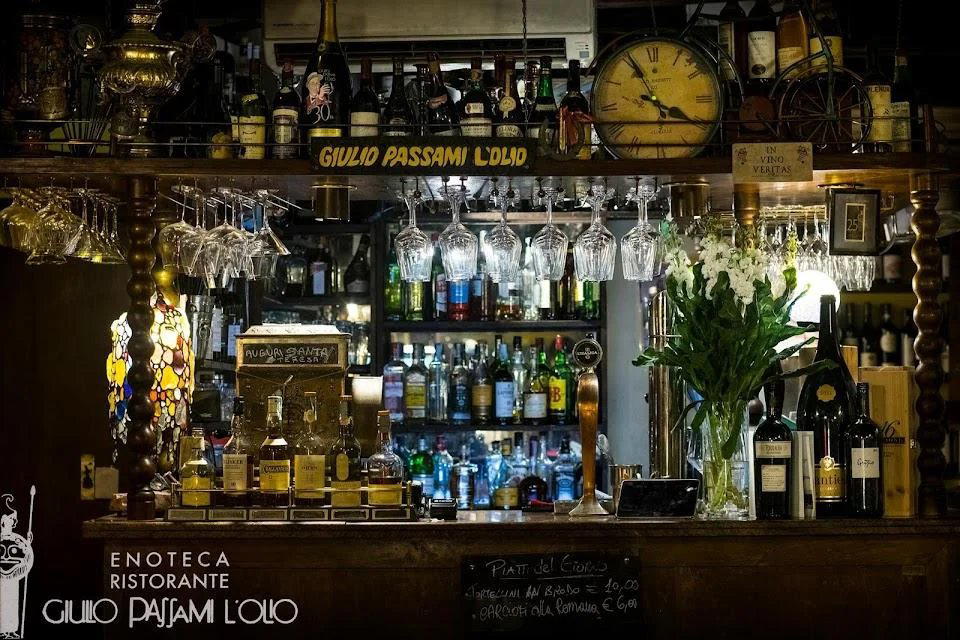
A Street in Regola, and What It Tells You About Roman Dining
Via di Monte Giordano is not a street that announces itself. It curves off the tangle of medieval lanes between Campo de' Fiori and the Tiber, in the Regola rione, and it carries the particular quiet of a Rome that exists slightly outside the tourist circuit without being remote from it. Giulio Passami L'olio sits at number 28 on that street, and its address is itself an editorial statement: this is not the kind of restaurant that positions itself near a monument or a piazza for foot traffic.
Giulio Passami L'olio occupies a different register entirely, and understanding where it sits in that spectrum is the first thing a visitor needs to settle before planning an evening in the neighbourhood.
The Physical Container: What the Space Communicates
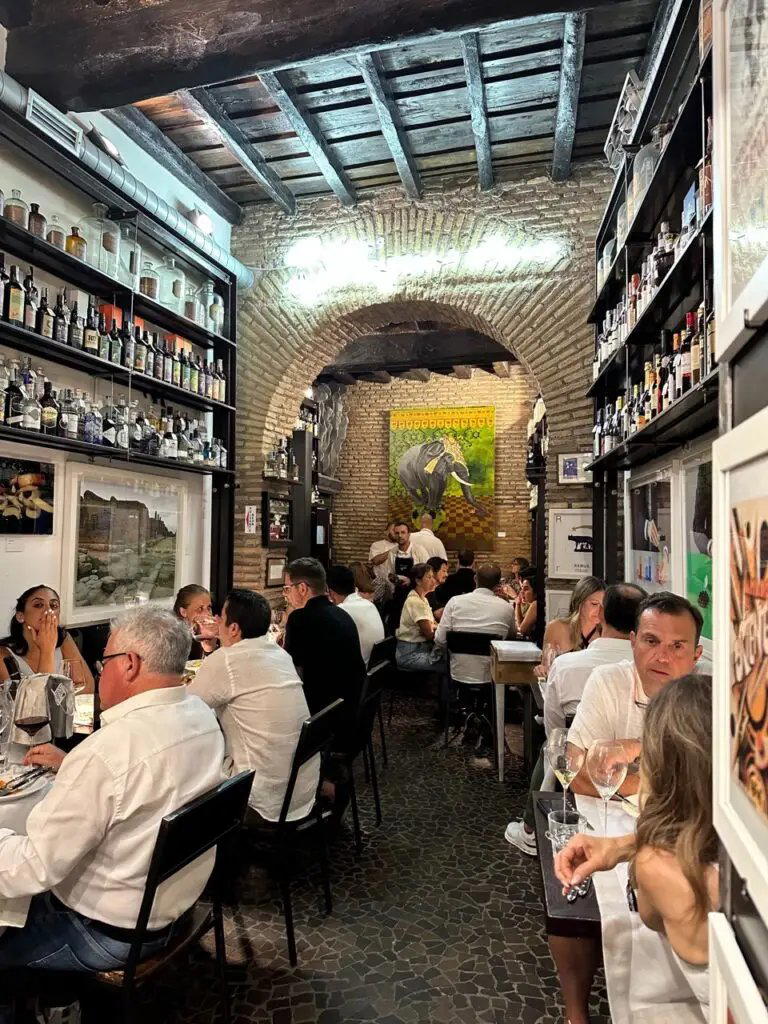
Roman trattorie of this type tend to share a set of spatial instincts: rooms that are smaller than they appear from the street, walls that carry decades of accumulated atmosphere rather than a designer's intention, tables arranged for conversation rather than performance. The address on Via di Monte Giordano conforms to that tradition. The scale is intimate without being contrived, the kind of room where the distance between tables is a function of the building's original footprint rather than a hospitality decision about acoustics or privacy.
This is worth dwelling on, because the physical container of a Roman trattoria is often its most legible signal. In the upper bracket of Rome dining, venues like Acquolina or Achilli al Parlamento have invested in spaces that frame the meal as an event. Here, the architecture does the opposite: it frames the meal as an ordinary, repeatable pleasure. That is not a lesser ambition. It is a different one, and in Rome's centro storico it is increasingly harder to find done with any authenticity.
The name itself, Giulio Passami L'olio, roughly translating as "Giulio, pass me the oil", sets the register before you walk in. It is a line from a table, not a kitchen, and it signals informality as a value rather than a default. In a city where La Pergola represents the formal apex of Roman dining with its three Michelin stars and refined remove, a name like this places itself at the opposite end of the intention spectrum.
Where It Sits in the Roman Trattoria Tradition
Rome's trattoria tradition is one of the more documented in Italian dining. The format has roots in a civic eating culture that predates restaurant dining as a modern construct, built around shared tables, oil-heavy Roman preparations, and a kitchen repertoire that resists novelty as a matter of principle. Cacio e pepe, coda alla vaccinara, supplì, the offal preparations of the quinto quarto tradition: these are not dishes that evolved toward refinement so much as dishes that have been defended against it.
Venues like Giulio Passami L'olio inherit that tradition not as a branding exercise but as a geographical and cultural condition. The Regola neighbourhood, with its proximity to the old Jewish Ghetto and its distance from the more tourist-saturated areas around the Pantheon or Navona, has historically supported a denser concentration of this kind of eating than many comparable central zones. The street's own quietness is part of the offer.
For context on where Italian dining ambition operates at a different register, the country's broader scene runs from Osteria Francescana in Modena and Le Calandre in Rubano at one end, to neighbourhood tables like this one at the other. Neither end is dispensable to an understanding of Italian food culture. Uliassi in Senigallia, Piazza Duomo in Alba, Reale in Castel di Sangro, these are the addresses where Italian cuisine argues for its place in a global conversation. A trattoria on Via di Monte Giordano argues for something else: that the conversation has always been local, and that locality has its own integrity.
Planning Your Visit
Via di Monte Giordano 28 is walkable from Campo de' Fiori in under five minutes and from Piazza Navona in roughly ten, placing it in one of Rome's most navigable historic zones. Reservations are recommended. Visiting earlier in the week generally improves access at addresses of this type.
The Minimal Set
Comparable venues nearby, for context on price, style, and recognition.
| Venue | Cuisine | Price | Notes |
|---|---|---|---|
| Giulio Passami L'olioThis venue — the venue you are viewing | Ponte, Traditional Roman Trattoria | $$$ | Not listed |
| Osteria La Gensola | Not listed | $$$ | Trastevere, Traditional Roman & Sicilian Seafood |
| Ristorante Moscati | Not listed | $$$ | Trionfale, Mediterranean and Roman Italian |
| Il Margutta | Campo Marzio, Modern Italian Vegetarian | $$$ | Not listed |
| 532 restaurant & grill | Marcigliana, Italian Grill | $$$ | Not listed |
| The Hive | Castro Pretorio, Modern Italian Rooftop | $$$ | Not listed |
Continue exploring
More in Rome
Restaurants in Rome
Browse all →
Bars in Rome
Browse all →
Hotels in Rome
Browse all →

At a Glance
- Cozy
- Classic
- Intimate
- Date Night
- Special Occasion
- Casual Hangout
- Wine Cellar
- Extensive Wine List
- Street Scene
Current opening hours
- Monday
- 12:30–4 PM, 6:30–11 PM
- Tuesday
- 12:30–4 PM, 6:30–11 PM
- Wednesday
- 12:30–4 PM, 6:30–11 PM
- Thursday
- 12:30–4 PM, 6:30–11 PM
- Friday
- 12:30–4 PM, 6:30–11 PM
- Saturday
- 12:30–4 PM, 6:30–11 PM
- Sunday
- 12:30–4 PM, 6:30–11 PM
Hours can change for holidays and private events. Last verified .
Cozy wood-panelled interior with a warm, informal atmosphere, complemented by outdoor seating well-suited for balmy nights.