Giorgio's of Gramercy
Our verdict
Giorgio's of Gramercy sits on East 21st Street in one of Manhattan's most architecturally consistent residential neighbourhoods, where the dining scene trades spectacle for substance. The address places it inside a compact corridor of independent restaurants that serve a local clientele more than a destination crowd, making it a reliable reference point for understanding the quieter register of New York's Italian-American dining tradition.

Pearl is the En Primeur Club membership app, where members save venues, book tables and use the concierge.

The menu
What to order
- Veal Parmesan
- Herb Crusted Rack of Lamb
- New York Strip
- Giorgio's Greek Salad
East 21st Street and the Gramercy Dining Register
Gramercy Park operates on a different frequency than the neighbourhoods that generate most of New York's dining headlines. The blocks surrounding the park's private iron gate have long attracted a residential population that prefers consistency over novelty, and the restaurants that survive here tend to reflect that preference. East 21st Street, where Giorgio's sits at number 27, sits just at the edge of the Flatiron district's commercial pull without fully belonging to it. The result is a block that feels more embedded in the neighbourhood than the cluster of destination restaurants a few streets north, where the press cycles faster and the tables are harder to secure.
That positioning matters when reading the room at Giorgio's. The dining culture around Gramercy and the lower Flatiron has historically rewarded places that deliver a dependable experience over those chasing critical attention. Compare this to the top tier of New York's restaurant hierarchy: Le Bernardin on West 51st Street, Per Se at Columbus Circle, and Masa in the Time Warner Center all operate as destination addresses where the neighbourhood is almost incidental to the experience. A place like Giorgio's belongs to a different category entirely, one where the address shapes the experience rather than the reverse.
The Neighbourhood as Context for the Meal
Gramercy has been a settled Manhattan address since the 1830s, and the density of pre-war apartment buildings on its surrounding streets has kept the area largely residential through decades of commercial development elsewhere. That stability has a culinary consequence: the restaurants that populate the side streets here serve people who live nearby, not visitors working through a list. Italian-American restaurants fit this pattern well. The format, which trades on familiarity, generosity of portion, and the kind of repetition that builds loyalty, has always performed better in residential corridors than in the high-profile blocks where novelty commands a premium.
New York's Italian-American dining tradition is broader and more stratified than it sometimes appears from the outside. At one end sit formal establishments operating in the register of European fine dining, closer in spirit to the northern Italian cooking that informed the city's earliest upscale Italian restaurants. At the other end, neighbourhood trattorias function more as social infrastructure than culinary destination.
Reading the Competitive Set
New York's restaurant market has bifurcated sharply over the past decade. The upper end, anchored by places like Atomix and Jungsik New York in the modern Korean category, or by Le Bernardin in classical European fine dining, competes for a global audience willing to plan trips around a reservation. The middle and lower tiers, meanwhile, have faced sustained pressure from rising rents, labour costs, and a delivery economy that has restructured how neighbourhood residents eat at home versus out.
Independent Italian-American restaurants in Manhattan's midtown-adjacent neighbourhoods occupy a position that requires managing both pressures simultaneously. They cannot command the pricing power of a destination restaurant, but they face many of the same fixed costs. Survival in this tier over multiple years is itself a signal worth noting. The longevity of an address on a block like East 21st Street implies a consistent local clientele, which in the absence of award recognition or critical fanfare is the clearest available trust signal.
For context on how Italian-American cooking has been interpreted at the highest level across the United States, Emeril's in New Orleans and Bacchanalia in Atlanta represent regional fine dining institutions that have built long-term reputations through consistency rather than reinvention. Blue Hill at Stone Barns in Tarrytown and Single Thread Farm in Healdsburg sit at the opposite pole, where the sourcing narrative is as central as the food itself. Giorgio's, from its Gramercy address, fits neither of those poles.
What Gramercy Tells You About the Experience
Arriving at 27 East 21st Street, the block reads as Manhattan does in its quieter residential registers: brownstone facades, relatively modest foot traffic compared to the avenues, and the kind of unhurried pace that the neighbourhood's layout, away from major subway exits and tourist corridors, tends to produce. Restaurants in this position typically skew toward longer stays and lower table-turn pressure, which shapes the experience in ways that have nothing to do with the menu. A neighbourhood that doesn't rush you in or out of its restaurants tends to produce a different meal.
The Italian-American format at the neighbourhood level in New York has historically meant generous portions, a wine list that leans on the major Italian regions without requiring expertise to navigate, and a room that fills with regulars over the course of a service. What the address does confirm is the context: a Gramercy side-street location in 2024 is a deliberate choice, and it tends to self-select for a certain type of dining relationship.
For those building a broader New York itinerary, the full range of the city's dining options across every category and price tier is covered in our full New York City restaurants guide. Internationally, the gap between neighbourhood dining and destination fine dining can be illustrated by contrasting somewhere like Giorgio's with Alain Ducasse's Louis XV in Monte Carlo or 8 1/2 Otto e Mezzo Bombana in Hong Kong, where Italian cooking operates at a price and ambition level that removes it almost entirely from its neighbourhood-dining origins.
Closer to home, places like Alinea in Chicago, Lazy Bear in San Francisco, Providence in Los Angeles, Addison in San Diego, and The French Laundry in Napa represent American fine dining at its most ambitious and controlled. The Inn at Little Washington adds a destination-hotel dimension. Giorgio's of Gramercy sits at a considerable remove from those addresses in format, ambition, and pricing tier, which is not a criticism. The neighbourhood restaurant tradition it appears to occupy serves a function that destination dining cannot replicate: the kind of meal that requires no occasion to justify.
Planning Your Visit
Giorgio's of Gramercy is located at 27 East 21st Street in Manhattan's Gramercy neighbourhood, accessible via the N, R, W trains at 23rd Street or the 6 train at 23rd Street and Park Avenue. As a neighbourhood restaurant rather than a high-profile destination, reservation lead times are generally shorter than the multi-week windows required at the city's upper-tier tables, though confirming current availability and hours directly with the venue is advisable given that operational details are subject to change. The Gramercy and Flatiron area offers a range of dining options across multiple price points, making East 21st Street a practical base for an evening that might extend beyond a single table.
Frequently asked questions
Is Giorgio's of Gramercy suitable for children?
Gramercy-area neighbourhood restaurants generally operate with a quieter, more settled atmosphere than high-traffic Manhattan dining rooms, which tends to make them more accommodating for families. If the price point and format sit in the mid-range neighbourhood tier typical of the area, the environment is likely less formal than the city's leading destination tables. Confirming the specific format and any age-related policies directly with the venue is the practical step before planning a family visit.
What is the atmosphere like at Giorgio's of Gramercy?
The Gramercy address on a residential side street, away from major commercial corridors, points toward an atmosphere that runs quieter than restaurants in the Flatiron's higher-traffic zones. Neighbourhood Italian-American restaurants in this part of Manhattan typically attract a regular clientele rather than a rotating visitor crowd, which produces a particular kind of room: familiar, unhurried, and oriented toward the meal rather than the occasion. Current operational data is limited, so verifying the current room format before booking is worth the step.
What dish should I order at Giorgio's of Gramercy?
Italian-American restaurants of this type in New York typically anchor their menus around pasta, secondi built on familiar proteins, and a wine list that tracks the major Italian regions. Asking the kitchen directly for current recommendations at the time of booking will give you more reliable guidance than any pre-visit list.
Should I book Giorgio's of Gramercy in advance?
A Gramercy side-street address without major award recognition typically operates with shorter booking windows than New York's most competitive tables, where months of lead time are standard. That said, weekend tables in even mid-tier Manhattan restaurants fill faster than the format might suggest. Booking at least a week ahead for weekend evenings is a practical baseline; weekday visits in this neighbourhood generally leave more flexibility.
How does Giorgio's of Gramercy fit into the broader Italian-American dining tradition in New York?
New York's Italian-American restaurant history stretches across multiple boroughs and well over a century of immigration and culinary evolution, producing a dining category that ranges from red-sauce institutions in outer-borough neighbourhoods to upscale northern Italian formats in Midtown. A Gramercy address positions Giorgio's within the Manhattan mid-tier of that tradition, serving a neighbourhood clientele rather than a destination audience. For a fuller picture of where it sits relative to the city's broader dining scene, our New York City restaurants guide maps the full range of options across cuisine type and price tier.
Budget Reality Check
Comparable venues nearby, for context on price, style, and recognition.
| Venue | Cuisine | Price | Awards | Notes |
|---|---|---|---|---|
| Giorgio's of GramercyThis venue (the venue you are viewing) | Classic Italian-American | $50–100 | Not listed | Not listed |
| Isabelle's Osteria | Modern Italian Osteria | $50–100 | Wine Spectator Best of Award of Excellence | Midtown South-Flatiron-Union Square, Modern Italian Osteria |
| Vic's | Seasonal Italian | $50–100 | Not listed | Greenwich Village, Seasonal Italian |
| Locanda Verde Hudson Yards | Urban Italian Osteria | $50–100 | Wine Spectator Best of Award of Excellence | Chelsea-Hudson Yards, Urban Italian Osteria |
| Osteria Morini | Northern Italian Emilia-Romagna Trattoria | Not listed | Not listed | SoHo-Little Italy-Hudson Square, Northern Italian Emilia-Romagna Trattoria |
| La Piazza | Venetian Italian | $50–100 | Not listed | Midtown-Times Square, Venetian Italian |
Continue exploring
More in New York City
Restaurants in New York City
All restaurants in New York City →
Bars in New York City
All bars in New York City →


Details
- Classic
- Elegant
- Cozy
- Intimate
- Business Dinner
- Date Night
- Special Occasion
- Private Dining
- Farm To Table
- Local Sourcing
- A La Carte
- Vegetarian Friendly
- Gluten Free Options
Current opening hours
- Monday
- 12–3:30 PM, 5–10 PM
- Tuesday
- 12–3:30 PM, 5–10:30 PM
- Wednesday
- 12–3:30 PM, 5–10:30 PM
- Thursday
- 12–3:30 PM, 5–11 PM
- Friday
- 12–3:30 PM, 5–11 PM
- Saturday
- 5–11 PM
- Sunday
- 5–10 PM
Hours can change for holidays and private events. Hours as of .
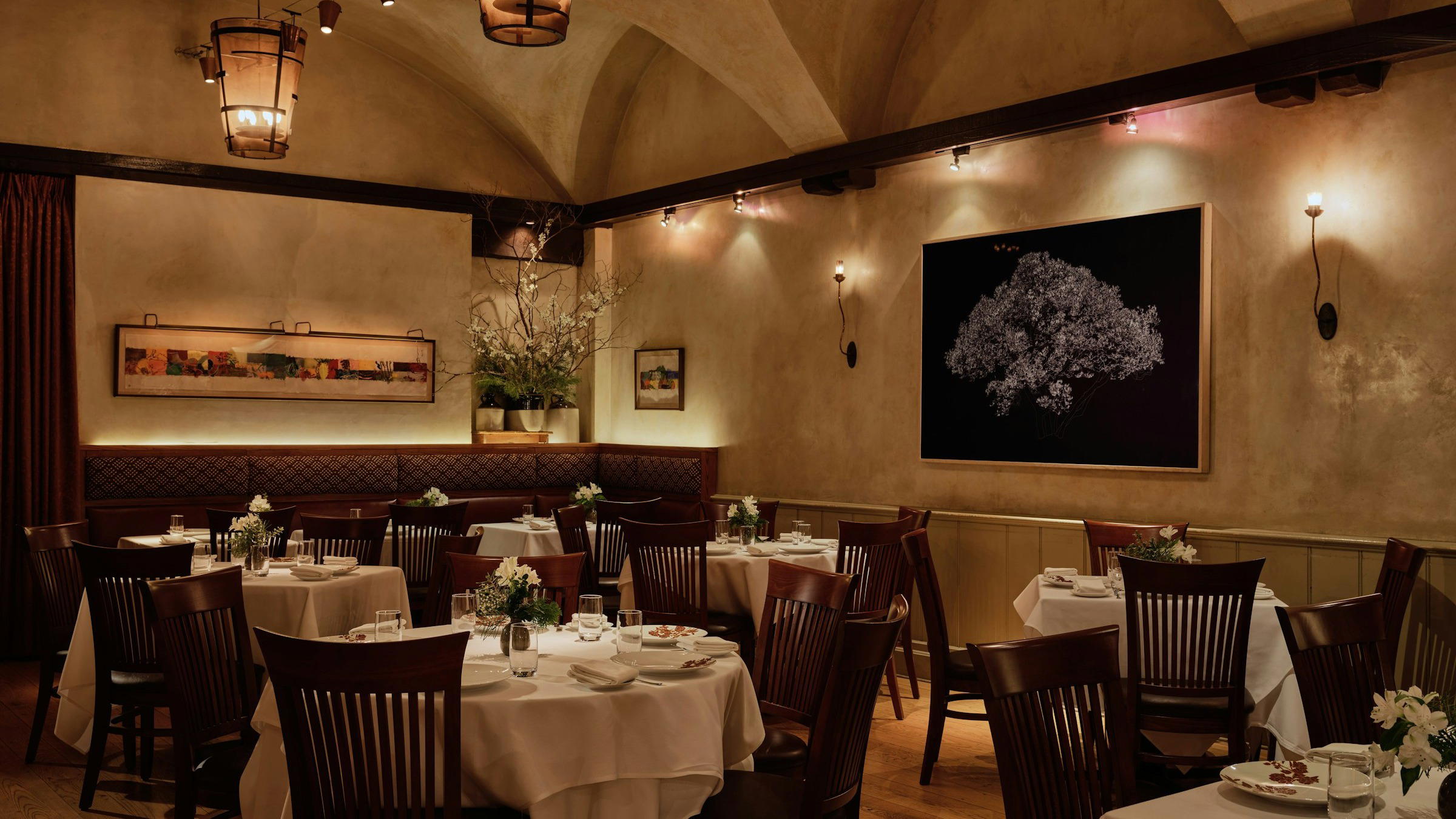
Classy and inviting with beige and burgundy decor creating a warm, elegant atmosphere.