George W.P.A.
George W.P.A. occupies a residential stretch of Willemsparkweg in Amsterdam's Oud-Zuid, positioning itself within a neighbourhood that has quietly accumulated some of the city's more considered dining. The address places it a short walk from Vondelpark, in a district where the dining register runs more subdued than the canal-belt tourist circuit, and where residents tend to eat with some regularity and expectation.
Pearl is the En Primeur Club membership app — saves, bookings, and concierge access live there. Same editors, same standards.
- Address
- Willemsparkweg 74, 1071 HK Amsterdam, Netherlands
- Phone
- +31207371035
- Website
- georgewpa.nl
- Directions
- Get directions
 Saves & bookings on Pearl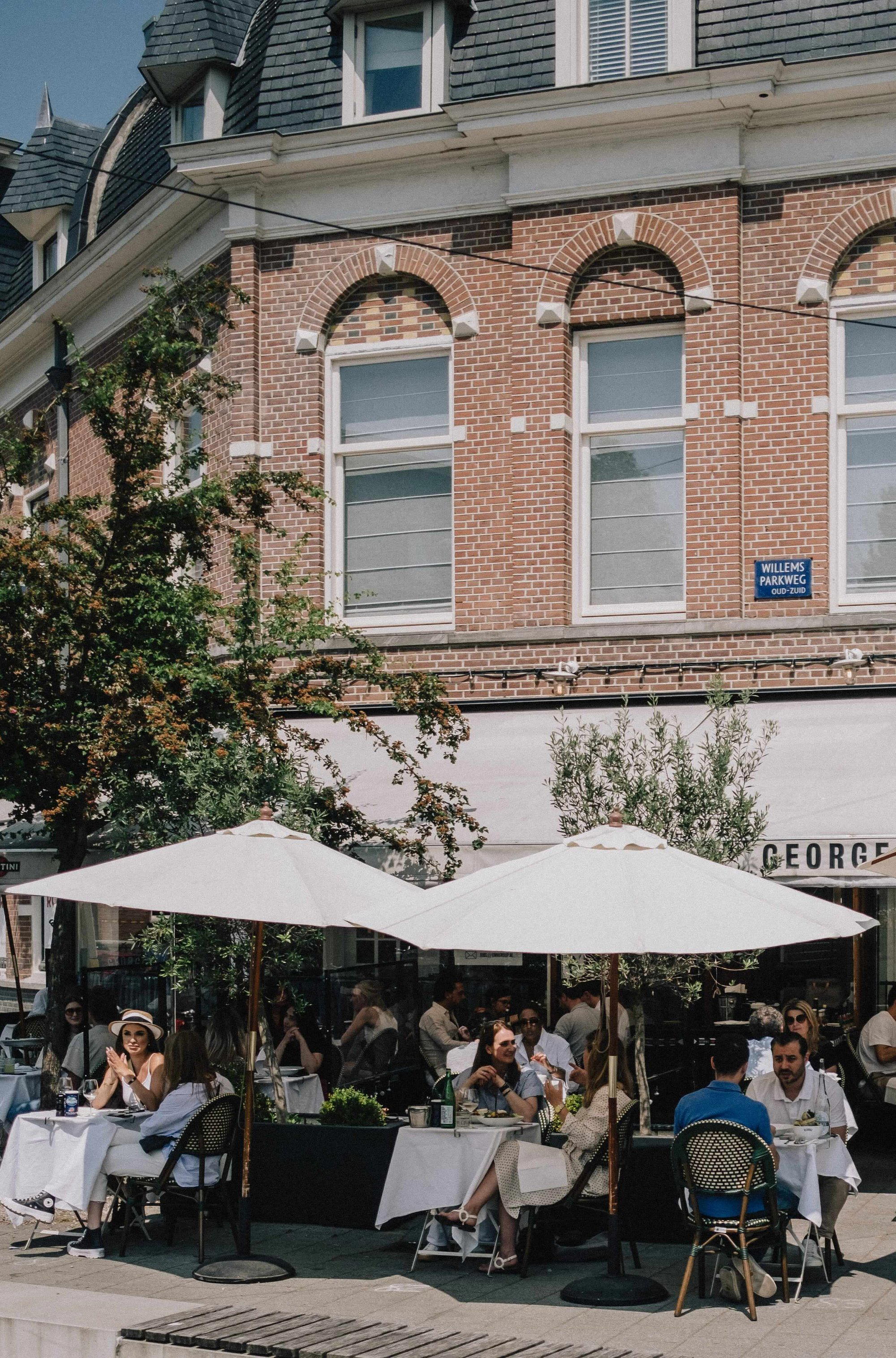
Oud-Zuid and the Quieter End of Amsterdam Dining
George W.P.A. is a French-New York Brasserie on Willemsparkweg 74 in Amsterdam's Oud-Zuid. The street runs south of Vondelpark, through blocks of late-19th-century apartment buildings and ground-floor premises that have housed neighbourhood restaurants for decades. It is the kind of address where a restaurant survives on repeat custom rather than tourist flow, which tends to produce a different kind of operation than the canal-belt rooms that fill up on weekend reservations from abroad.
Amsterdam's broader restaurant scene has split noticeably in recent years between the high-investment creative tasting-menu format, represented at the leading by rooms like Ciel Bleu, Flore, and Spectrum, and a quieter tier of neighbourhood-anchored venues that operate without the infrastructure of a hotel kitchen or a multi-course prestige format. George W.P.A. at Willemsparkweg 74 sits in that second tier, in a part of the city where the dining proposition is built around access and familiarity rather than spectacle.
The Wine Dimension in a Neighbourhood Context
Across Amsterdam's mid-to-upper restaurant segment, wine has become one of the more reliable differentiators between venues that think editorially about their offer and those that treat the list as an afterthought. At the tasting-menu end, rooms like Vinkeles pair their creative menus with lists that have been assembled over years, with cellar depth that reflects a deliberate curation philosophy rather than a distributor's standard portfolio. The question for a neighbourhood venue on Willemsparkweg is whether it can bring that same seriousness to a more accessible format.
Wine programs in residential-district restaurants across the Netherlands have historically tracked the conservative end, French classics, Dutch-market staples, limited by-the-glass range. The more interesting operations have moved away from that pattern, bringing in bottles from smaller producers in Burgundy, the Loire, and the Alpine regions, and in some cases extending into natural and low-intervention wines that have found a receptive audience among Amsterdam's younger professional demographic. The Oud-Zuid resident base, skewing toward financially established households with some exposure to European travel, tends to support a list that goes a step further than the house-wine-plus-safe-Bordeaux model.
For context, the Dutch fine-dining circuit beyond Amsterdam has produced cellars with genuine depth: De Librije in Zwolle maintains among the more discussed wine programs in the country, and operations like Inter Scaldes in Kruiningen and De Lindehof in Nuenen have built reputations partly on the quality of their wine service. The standard those venues set has raised expectations across the category, including at neighbourhood level.
The Oud-Zuid Approach to Atmosphere
Restaurants on Willemsparkweg tend to occupy ground-floor conversions of residential buildings, which gives them a particular spatial character: low ceilings, windows that face the street at pavement level, interiors that feel proportioned for the neighbourhood rather than for a dining destination drawing from across the city. That physical constraint shapes the experience in ways that distinguish this kind of venue from the hotel-adjacent rooms that dominate the top end of the Amsterdam market. The dining room at an address like this is unlikely to have the dramatic sightlines of Bistro de la Mer or the architectural ambition of a purpose-built creative kitchen. What it typically offers instead is a closer, more human scale, tables near enough together that the room has a continuous hum, service that recognises returning guests, and a pace calibrated to an evening rather than a performance.
That format has its own logic. Amsterdam's neighbourhood dining culture, particularly in Oud-Zuid and the adjacent streets around Cornelis Schuytstraat, developed partly in contrast to the city-centre model. These rooms are less likely to be booked three months in advance on the basis of a magazine feature, and more likely to fill through word of mouth among residents who can walk there. The model is not dissimilar to what has sustained long-running neighbourhood bistros in Paris's 11th or London's Islington, venues that endure because they serve a local community consistently rather than chasing a global audience seasonally.
Placing George W.P.A. in the Dutch Restaurant Picture
The Netherlands has a wider distribution of serious restaurants than its international reputation sometimes suggests. Beyond the Amsterdam circuit, venues including De Nieuwe Winkel in Nijmegen, De Lindenhof in Giethoorn, Tribeca in Heeze, De Groene Lantaarn in Staphorst, Brut172 in Reijmerstok, De Bokkedoorns in Overveen, and De Treeswijkhoeve in Waalre demonstrate that the country's serious dining is not concentrated in one city. Within Amsterdam itself, the creative tasting-menu format has attracted most of the critical attention, but the neighbourhood tier, quieter, less decorated, often more personally run, forms the base of the dining culture that residents actually use week to week.
The restaurant's position on Willemsparkweg places it in that residential tier, in a district with the income profile and the cultural expectations to support a venue that takes its food and wine seriously without operating at the prestige price point of the city's decorated rooms. For comparison, internationally acclaimed tasting-menu venues such as Le Bernardin in New York City or Lazy Bear in San Francisco represent a different scale of ambition and investment entirely, the neighbourhood model in Oud-Zuid is answering a different question about what a restaurant is for.
For a fuller picture of where Amsterdam's dining sits across price points and styles, the Amsterdam restaurants guide maps the city's options from the canal-belt tasting rooms to the neighbourhood operations across the city.
Know Before You Go
Address: Willemsparkweg 74, 1071 HK Amsterdam, Netherlands
Neighbourhood: Oud-Zuid, south of Vondelpark
Price range: About $45 per person
Reservations: Recommended
Hours: Mon to Sat 11 AM to 12 AM; Sun 10 AM to 12 AM
Getting there: The Willemsparkweg address is accessible by tram and is a walk from the museum quarter. The street is walkable from the museum quarter.
Cuisine and Credentials
Comparable venues nearby, for context on price, style, and recognition.
| Venue | Cuisine | Price | Notes |
|---|---|---|---|
| George W.P.A.This venue — the venue you are viewing | French-New York Brasserie | $$$ | Not listed |
| Kien | Modern French-European | $$$ | Filips van Almondekwartier |
| Copain | Modern French Seasonal Bistro | $$$ | Terrasdorp |
| Restaurant De Belhamel | Traditional French with Italian and Dutch influences | $$$ | Haarlemerbuurt |
| Gertrude | French Bistro with Seasonal Small Plates | $$$ | Da Costabuurt Zuid |
| Hemelse Modder | Contemporary Dutch-French Cuisine | $$$ | Scheepvaarthuisbuurt |
Continue exploring
More in Amsterdam
Restaurants in Amsterdam
Browse all →
Bars in Amsterdam
Browse all →
Hotels in Amsterdam
Browse all →
Wineries in Amsterdam
Browse all →
At a Glance
- Romantic
- Elegant
- Scenic
- Sophisticated
- Lively
- Date Night
- Brunch
- Casual Hangout
- Group Dining
- After Work
- Terrace
- Standalone
- Extensive Wine List
- Craft Cocktails
- Local Sourcing
- Street Scene
Current opening hours
- Monday
- 11 AM–12 AM
- Tuesday
- 11 AM–12 AM
- Wednesday
- 11 AM–12 AM
- Thursday
- 11 AM–12 AM
- Friday
- 11 AM–12 AM
- Saturday
- 11 AM–12 AM
- Sunday
- 10 AM–12 AM
Hours can change for holidays and private events. Last verified .
Bright, airy terrace setting with warm, inviting atmosphere; combines the elegance of a fancy brasserie with casual neighborhood vibes; excellent for people-watching.