Gasthaus "Zum Roten Ochsen"
On Heidelberg's Hauptstraße, Gasthaus Zum Roten Ochsen represents the older, more durable strand of Baden-Württemberg tavern culture: a house where the room itself makes the argument before the food arrives. For visitors tracing the region's deep-rooted Gasthaus tradition rather than its contemporary fine-dining tier, this address on Germany's most-photographed pedestrian street carries both geographical and cultural weight.
Pearl is the En Primeur Club membership app — saves, bookings, and concierge access live there. Same editors, same standards.
- Address
- Hauptstraße 217, 69117 Heidelberg, Germany
- Phone
- +49 6221 20977
- Website
- roterochsen.de
- Directions
- Get directions
 Saves & bookings on Pearl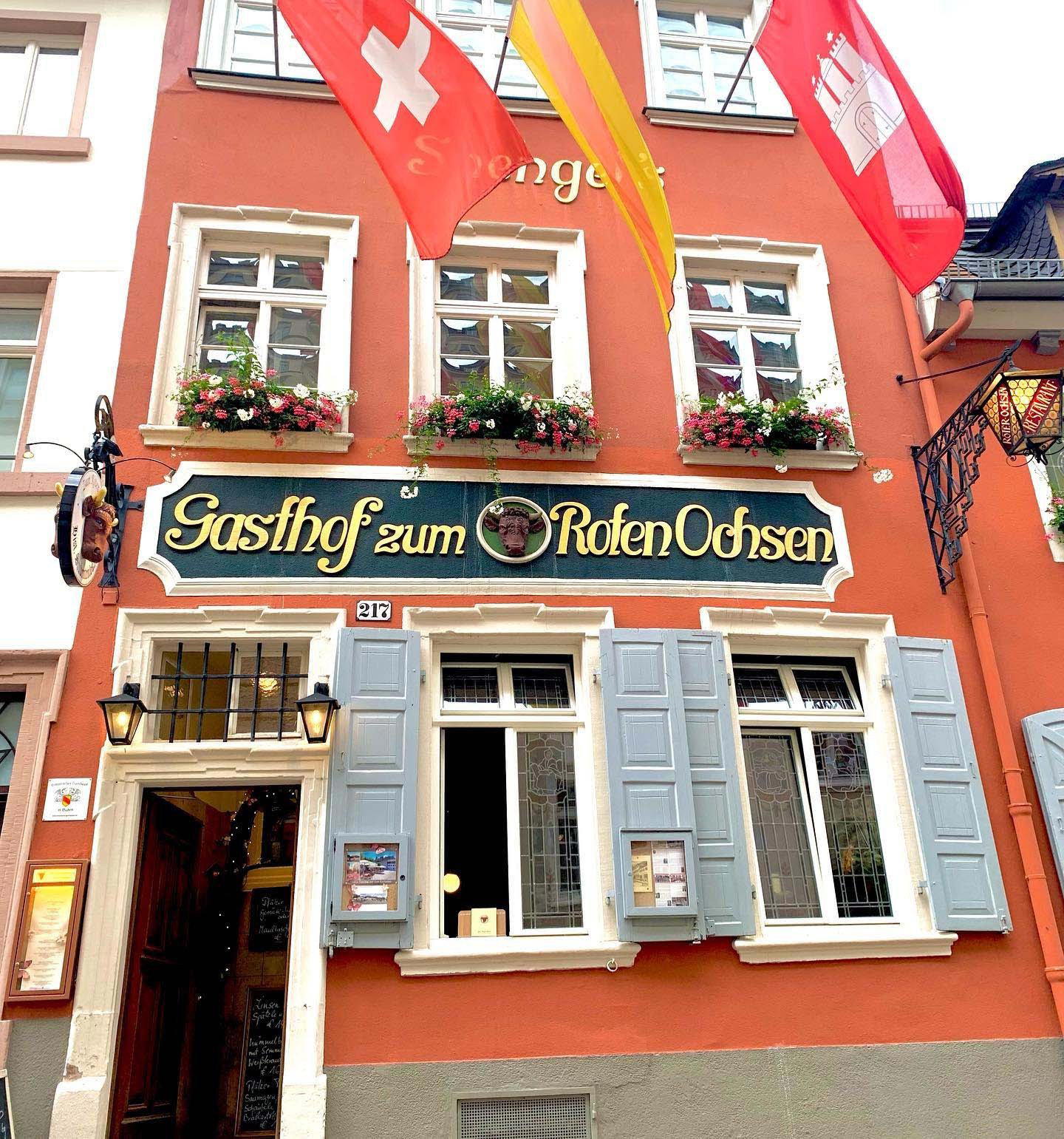
Where the Room Does the Talking
Heidelberg's Hauptstraße runs the full length of the old town, and by the time you reach number 217 the street has already done considerable editorial work on your expectations. The approach to Gasthaus Zum Roten Ochsen, the Red Ox Inn, delivers exactly the visual grammar that Baden-Württemberg's tavern tradition promises: a façade that reads as architectural record rather than deliberate restoration, the kind of exterior that accumulates credibility over decades rather than being designed to suggest it. In a city where the tourist infrastructure along the Hauptstraße can blur into interchangeable hospitality, the Roten Ochsen sits in a different register, operating as a reference point for what a German Gasthaus was before the category fractured into wine bars, casual bistros, and regional-modern dining rooms.
Inside, the room carries the weight of accumulated use in a way that newer venues in the city cannot replicate. The long-tavern format, heavy wood, and the ambient sense that the space has absorbed generations of conversation are all consistent with a Stammtisch-era model of hospitality that predates contemporary German dining's bifurcation into fine-dining and fast-casual. This is the type of room that explains itself without signage.
The Gasthaus Model and What It Means for the Food
Baden-Württemberg's tavern food has always been shaped as much by what the surrounding region produces as by any chef's individual agenda. The Gasthaus format, at its most coherent, functions as a distribution mechanism for local agriculture: game from the forested hills above the Neckar valley, river fish, root vegetables and legumes from the Rhine plain to the west, and the dense, sustaining preparations that cold months in the region historically demanded. Sourcing in this tradition is not a marketing position but a structural fact, the kitchens were built around what the land offered seasonally, not around year-round supply chains for luxury ingredients.
This places Zum Roten Ochsen in a meaningful contrast with Heidelberg's contemporary dining tier. Venues like Oben (Modern European, Creative) and 959 (Contemporary) operate with tasting-menu architecture and creative European frameworks that place them in conversation with Germany's broader high-end scene, the same conversation occupied by destinations like Schwarzwaldstube in Baiersbronn, Aqua in Wolfsburg, and Vendôme in Bergisch Gladbach. The Gasthaus model works from a different premise entirely: the sourcing logic is regional and seasonal by default, the preparation vocabulary is inherited rather than invented, and the measure of quality is fidelity to that tradition rather than departure from it.
That distinction matters when deciding where Zum Roten Ochsen fits in a Heidelberg itinerary. It is not competing with [CANTINACCIA] for Italian sourcing credibility, nor with Chambao (International) for global-pantry range. Its comparable set is the dwindling stock of German taverns that have held the regional-ingredient line without pivoting to either contemporary fine dining or tourist-simplified versions of regional food.
Heidelberg's Dining Spectrum and Where This Address Sits
The city's restaurant scene has diversified considerably over the past decade. The top tier has grown more ambitious, Akam's Heidelberg and the creative-format addresses have given the city more reasons to visit beyond its university and castle. Germany's broader fine-dining ambition, visible in venues from JAN in Munich to CODA Dessert Dining in Berlin, has filtered into Heidelberg's upper bracket. At the other end, international casual formats have filled the tourist-facing middle of the market.
What this compression has done, across German cities generally, is make the surviving Gasthaus format more culturally significant even as its commercial position becomes more pressured. A house like Zum Roten Ochsen on the Hauptstraße occupies territory that cannot be recreated from scratch: the address, the room's age, and the accumulated social function of a Stammtisch-oriented tavern are not things a new opening can manufacture. That makes the venue an argument for a type of dining that the broader market is not replicating at scale.
For context on how Germany's most ambitious regional kitchens approach the same raw-ingredient questions from a fine-dining angle, Schanz in Piesport, Waldhotel Sonnora in Dreis, ES:SENZ in Grassau, Victor's Fine Dining by christian bau in Perl, and Restaurant Haerlin in Hamburg all demonstrate how Baden-Württemberg and wider German terroir translates into Michelin-rated formats. The Gasthaus sits at the opposite end of the formality spectrum but draws from the same geographic larder.
Planning Your Visit
The Hauptstraße address makes arrival direct from anywhere in Heidelberg's old town; the pedestrian zone runs directly through the historic centre, and the venue sits well within walking distance of both the Bismarckplatz tram hub and the Heidelberg Hauptbahnhof bus connections to the old town. For visitors arriving from further afield, the comparison with European fine-dining benchmarks like Le Bernardin in New York City or Lazy Bear in San Francisco is instructive primarily as a reminder of how differently the Gasthaus tradition frames the dining occasion: informality, shared tables, and an expectation of staying rather than turning over are built into the format. Reservations are recommended, especially on Friday and Saturday evenings. For a broader map of where this address fits among the city's options, the full Heidelberg restaurants guide covers the complete range from contemporary creative to regional tavern.
Quick Comparison
Comparable venues nearby, for context on price, style, and recognition.
| Venue | Cuisine | Price | Awards | Notes |
|---|---|---|---|---|
| Gasthaus "Zum Roten Ochsen"This venue — the venue you are viewing | Traditional German Hausmannskost | $$ | Not listed | Not listed |
| Akam's Heidelberg | Middle Eastern | $$ | Not listed | Bahnstadt |
| Scharffs Schlossweinstube | Classic German Fine Dining | $$$$ | Not listed | Heidelberger Altstadt |
| Grenzhof | Modern Seasonal German | $$$ | Michelin Plate | Boxberg |
| Weinstube Schnitzelbank | Traditional German Regional | $$ | Not listed | Altstadt |
| Heid's Grill & Restaurant | American Steakhouse | $$$ | Not listed | Heidelberg |
Continue exploring
More in Heidelberg
Restaurants in Heidelberg
Browse all →
Bars in Heidelberg
Browse all →

Hotels in Heidelberg
Browse all →


At a Glance
- Rustic
- Cozy
- Historic
- Lively
- Casual Hangout
- Group Dining
- Historic Building
- Live Music
- Beer Program
Current opening hours
- Monday
- Closed
- Tuesday
- Closed
- Wednesday
- Closed
- Thursday
- Closed
- Friday
- 5:30–10 PM
- Saturday
- 5:30–10 PM
- Sunday
- Closed
Hours can change for holidays and private events. Last verified .
Cozy and inviting with dark wood furnishings, low lighting, and live piano music on select evenings creating a traditional, lively historic ambiance.