
A Tenjin ramen counter with deep local roots, Ganso Akanoren Setchan Ramen Tenjin hon ten belongs to Fukuoka’s everyday tonkotsu culture rather than the tasting-menu economy. Its Tabelog Ramen WEST 100 selections in 2023, 2024, and 2025 give it a clear trust signal, while the format stays grounded in quick pacing, shared tables, counter seats, and repeatable comfort.
Pearl is the En Primeur Club membership app — saves, bookings, and concierge access live there. Same editors, same standards.
- Address
- Japan, 〒810-0041 Fukuoka, Chuo Ward, Daimyo, 2 Chome−6−4 プラスゲート天神 1F
- Phone
- +81 92-741-0267
- Website
- tabelog.com
 Saves & bookings on Pearl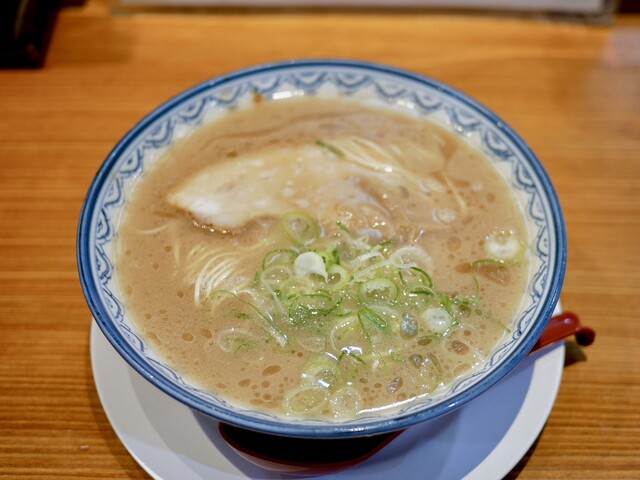
Tenjin’s ramen ritual is not built around ceremony in the fine-dining sense. It is brisk, practical, and closely tied to the movement of the city: office workers between meetings, shoppers cutting across Daimyo, families treating noodles as an easy shared meal rather than an occasion. Ganso Akanoren Setchan Ramen Tenjin hon ten sits inside that rhythm. The room’s counter seating and larger dining-room format place it closer to Fukuoka’s daily-use ramen houses than to the smaller chef-led noodle counters that have become common in Tokyo and Osaka.
That matters because Fukuoka ramen has a different social code. Hakata-style tonkotsu is often judged less by theatrical plating than by consistency, speed, and the way a bowl fits into a day. The city’s noodle culture rewards places that can handle solo diners, groups of friends, and families without turning lunch into a production. Here, ramen and dumplings form the core identity, with sake and shochu listed for diners who want the meal to stretch beyond a fast bowl.
Fukuoka ramen as a daily ritual, not a special-occasion performance
The strongest way to read this address is through pacing. Fukuoka ramen shops tend to compress the meal: order, eat while the noodles hold their texture, leave the seat for the next diner. That does not make the experience casual in the weak sense. It makes it disciplined. A bowl of tonkotsu in Tenjin is part of the city’s infrastructure, as essential to the neighbourhood’s food life as izakaya counters and department-store basements.
The recognition gives useful context. Ganso Akanoren Setchan Ramen Tenjin hon ten was selected for Tabelog Ramen WEST 100 in 2023, 2024, and 2025, placing it among a documented group of western Japan ramen addresses rather than merely among neighbourhood favourites. Its Tabelog score of 3.68 is another useful signal in a category where incremental differences often reflect heavy local scrutiny. The point is not luxury. The point is that an inexpensive, high-turnover ramen shop can carry enough local confidence to register on a regional ramen list.
Compared with Fukuoka restaurants operating at higher spend levels, such as Tori Kami Garden City, the decision here is not about service arc, course progression, or wine-depth equivalents. It is about whether the traveller wants to understand the city through one of its core eating habits. A useful Fukuoka dining day could move from ramen to curry at Afterglow, South Indian food at 106 South Indian Fukuoka tenjin ten, or local Japanese cooking at Aji Dokoro Taro Gen Sougyou ten; the contrast is the education.
How the room shapes the meal
Ramen etiquette in Fukuoka is mostly common sense, but it has consequences. Solo diners are part of the intended audience, not an afterthought. Counter seating keeps the meal focused, while the larger seating count makes the place more flexible than compact eight-seat counters where every movement feels observed. Children are welcome, which shifts the room away from the austere ramen pilgrimage model and toward the intergenerational shop, the kind of place where repetition matters more than novelty.
The menu categories also put the restaurant in a familiar Fukuoka register. Ramen is the anchor, dumplings play the side role, and the drinks list includes sake and shochu. That combination is common in older local noodle houses: the bowl can be a quick lunch, but the table can also carry a looser evening rhythm. There is no need to overread the format. Its strength lies in being legible: noodles first, side dish if the appetite calls for it, drink if the meal turns social.
The location in Daimyo, within the Tenjin orbit, adds another layer. This is a neighbourhood where retail, offices, and casual dining overlap, so restaurants need to function across different speeds. Nearby choices such as Aji Furai Shokudo Kaba and Aji no Katsueda show how central Fukuoka dining often privileges specialization over broad, hotel-style menus. Ramen belongs naturally in that pattern.
Where it fits in a Fukuoka itinerary
For travellers, the useful question is not whether this is a destination restaurant in the global awards sense. It is whether a meal here clarifies Fukuoka’s relationship with ramen. The answer is yes, provided expectations are set correctly. This is not the place to look for a long tasting sequence, chef biography, or decorative dining-room narrative. It is a shop where the city’s noodle habit is visible in its ordinary form, supported by enough third-party recognition to justify attention from visitors who are sorting through a crowded field.
That makes it a practical anchor for a Tenjin day. Pair it with another compact, category-specific meal rather than a drawn-out restaurant crawl. In Fukuoka, variety often comes from moving between tight formats: ramen, fried fish, curry, izakaya cooking, yakitori. For broader planning, use Our full Fukuoka restaurants guide, then layer in Our full Fukuoka hotels guide, Our full Fukuoka bars guide, Our full Fukuoka wineries guide, and Our full Fukuoka experiences guide to build the rest of the trip around neighbourhood movement rather than isolated bookings.
Travellers extending the same appetite for everyday Japanese formats beyond Fukuoka can compare the country’s casual dining range through -Grilled beef Sukiyaki- KAMAKURA TANUKIAN 鎌倉 たぬき庵 in Kamakura. 鮪と炭火焼き うお炭 秋葉原店 in Tokyo.cafe in Osaka.know in Kumamoto, (Shoku) Vietnam in Kawasaki, and [Curry Senmon Ten] Maruyama Kyoju. in Sapporo. Across the Pacific, Jōdo Saké Bar in Los Angeles and Onigiri Time in Pasadena show how Japanese drinking and snack formats translate abroad, though Fukuoka ramen remains tied to the speed and density of its home city.
Cuisine and Credentials
Comparable venues to calibrate price, style, and recognition.
| Venue | Cuisine | Price | Notes |
|---|---|---|---|
| Ganso Akanoren Setchan Ramen Tenjin hon tenThis venue — the venue you are viewing | Traditional Fukuoka Tonkotsu Ramen Shop | $ | Not listed |
| Yayoi (やよい軒 筑紫口店) | Japanese Teishoku | $ | Hakata |
| Hakata Gion Tetsu Nabe | Hakata izakaya & iron-pan gyoza | $ | Hakata |
| Maki no Udon (牧のうどん 空港店) | Traditional Fukuoka Kamaage Udon | $ | Hakata |
| Tempura Dokoro Hirao Honten | Casual Tempura Specialist | $ | Hakata |
| Hagakure Udon | Traditional Fukuoka-style Udon | $ | Hakata |
Recognition history
Dated appearances from independent guides and award organizations, with the underlying list record or original source where available.
Tabelog 100 #2 · No. 2
Tabelog · Tabelog 100 - Ramen - WEST - 2025
At a Glance
- Classic
- Cozy
- Lively
- Well Known
- Solo
- Family
- Casual Hangout
- After Work
- Group Dining
- Standalone
- Sake Program
- Beer Program
Current opening hours
- Monday
- 11 AM–8:30 PM
- Tuesday
- Closed
- Wednesday
- 11 AM–8:30 PM
- Thursday
- 11 AM–8:30 PM
- Friday
- 11 AM–8:30 PM
- Saturday
- 11 AM–8:30 PM
- Sunday
- 11 AM–8:30 PM
Hours can change for holidays and private events. Last verified .
A humble, long‑established ramen shop with a spacious yet simple interior, counter and table seating, and a relaxed, lively feel suited to solo diners and families rather than design‑driven dining.