Gallopin, on Rue Notre Dame des Victoires in Paris's 2nd arrondissement, is one of the city's enduring grand café-brasseries, where the etched glass, polished brass, and mahogany fixtures have drawn the same loyal crowd for well over a century. It sits in a different tier from the €€€€ temples of French haute cuisine — this is the Paris of regulars, not revelations — and that distinction is precisely what keeps serious diners returning.
Pearl is the En Primeur Club membership app — saves, bookings, and concierge access live there. Same editors, same standards.
- Address
- 40 Rue Notre Dame des Victoires, 75002 Paris, France
- Phone
- +33142364538
- Website
- gallopin.com
- Directions
- Get directions
 Saves & bookings on Pearl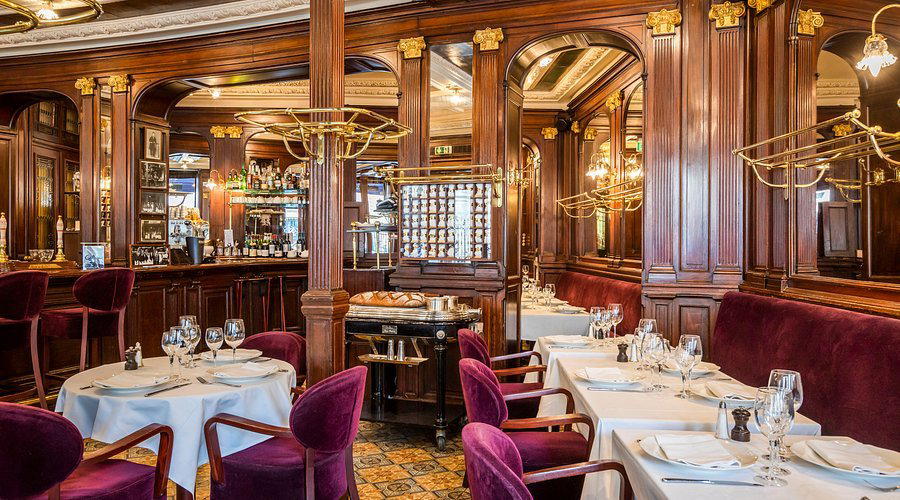
The Brasserie as Institution: What Gallopin Represents in Paris's Dining Order
Paris operates two parallel restaurant economies. The first is the one documented by Michelin and covered in the international press — the €€€€ world of places like Alléno Paris au Pavillon Ledoyen, Arpège, and Le Cinq, where tasting menus run to dozens of courses and booking windows stretch months ahead. The second economy is older, quieter, and considerably less photographed: the grand brasserie, which has served as the civic dining room of the city since the late nineteenth century. Gallopin, at 40 Rue Notre Dame des Victoires in the 2nd arrondissement, belongs firmly to that second economy — and has done so since 1876.
That founding date matters. Most of Paris's grand brasseries were established in the decades surrounding the Third Republic, when the Bourse de Paris was the commercial heartbeat of the Right Bank and the surrounding streets filled with brokers, journalists, and traders who needed somewhere reliable to eat before markets opened and after they closed. Gallopin was built for exactly that crowd, and the neighbourhood has never entirely stopped functioning that way. The Bourse de Commerce, a few minutes' walk west, was repurposed in 2021 as the Pinault Collection museum; the journalists and financiers of the quartier have shifted and evolved, but the appetite for a serious lunch at a fixed address has not.
What Keeps Regulars Returning: The Logic of the Grand Brasserie
The category of grand brasserie has its own internal logic, distinct from both the bistro and the haute cuisine restaurant. Where the bistro prizes informality and the Michelin table prizes transformation, the brasserie prizes consistency. Regulars return because they already know what they will find: the same room, the same menu architecture, the same rhythm of service. The pleasure is not surprise but recognition. This is the unwritten contract that places like Gallopin have upheld for generations, and it is why a certain kind of Paris diner, one who could easily afford an evening at L'Ambroisie or Kei, chooses a zinc-topped counter and a carafe of Bordeaux instead.
The room itself functions as a trust signal. Gallopin's Belle Époque interior, mahogany panelling, etched glass partitions, ornate brass fittings, is not a renovation or a pastiche. It is original, and its survival communicates something about the continuity of the enterprise. In a city where restaurant openings and closures move at considerable speed, a dining room that has looked the same for over a century carries a particular authority. Regulars read it as evidence that the kitchen is not chasing trends, and they are correct to do so.
Brasserie format also rewards those who understand its internal hierarchy. There is an unwritten menu beyond the printed one: the knowledge of which tables face the room and which face the wall, which service hours are quietest, which seasonal preparations are worth ordering when they appear. This intelligence accumulates through repetition, and it is the kind of knowledge that a first-time visitor cannot access. It is also, frankly, the reason that brasseries like Gallopin can feel impenetrable on a first visit and revelatory on a third or fourth.
The 2nd Arrondissement: A Neighbourhood That Rewards the Patient Diner
Quartier around Rue Notre Dame des Victoires is not one that appears at the top of most Paris dining itineraries, which is part of what defines it. The 2nd arrondissement lacks the Left Bank intellectual cachet of Saint-Germain and the tourist density of the Marais. What it has instead is a working professional character: printing houses, financial firms, and the covered passages that run between the grands boulevards. The Galerie Vivienne and the Passage des Panoramas are both within a few minutes' walk, and both reward the same kind of unhurried attention that the brasserie format encourages.
For a visitor planning around Gallopin, the practical approach is a midday visit. Brasseries of this generation operate most naturally at lunch, when the clientele skews toward the local professional crowd rather than the evening's tourist traffic. The Bourse metro station on Line 3 puts you directly in the neighbourhood; from the platform exits it is a short walk along Rue Réaumur to Rue Notre Dame des Victoires. No reservation architecture as elaborate as you would encounter at the €€€€ Michelin tier is required for lunch at a brasserie of this type, though for dinner on a Friday or Saturday, securing a table in advance is prudent.
Gallopin in the Broader French Dining Tradition
It is worth placing the grand Parisian brasserie alongside the wider register of French restaurant culture to understand why it still matters. France's most celebrated addresses, from Paul Bocuse's Auberge du Pont de Collonges to Auberge de l'Ill in Illhaeusern to Georges Blanc in Vonnas, belong to a tradition of destination dining where the room, the history, and the table are inseparable from the food. The brasserie shares that logic at a more democratic price point. It is a living institution rather than a special-occasion spectacle, which is, for many serious diners, the more interesting proposition.
Other celebrated French addresses that have sustained their identity over decades, Bras in Laguiole, Les Prés d'Eugénie in Eugénie-les-Bains, Auberge du Vieux Puits in Fontjoncouse, have done so by refusing to separate the cooking from its place. Gallopin operates on a version of the same principle, albeit expressed through brass and glass rather than rolling countryside. The room and the address are the argument.
For context on how Paris's highest-tier tables compare, our full Paris restaurants guide maps the city's dining tiers from haute cuisine to neighbourhood institutions. And for those building a broader France itinerary, the comparison with destination addresses like Mirazur in Menton, Flocons de Sel in Megève, or Troisgros in Ouches illustrates the range of registers in which French dining operates. Gallopin does not compete with any of them, it occupies a different category entirely, which is precisely why it remains relevant.
Planning Your Visit
Gallopin is located at 40 Rue Notre Dame des Victoires in the 2nd arrondissement, a two-minute walk from Bourse metro station. Lunch is the moment when the room functions closest to its historical purpose: the professional crowd from the surrounding quartier fills the banquettes, the pace of service is brisk, and the dining experience feels anchored in something the city has been doing for a very long time. Those travelling from elsewhere in France for a day in Paris, perhaps after visiting La Table du Castellet in the south, will find Gallopin a useful corrective to the idea that serious French dining only happens at €€€€ price points. For international visitors arriving via New York's dining scene, the contrast with places like Le Bernardin or Lazy Bear in San Francisco clarifies how differently the French brasserie tradition frames the relationship between a diner and their regular table.
How Gallopin Paris compares with similar nearby venues.
| Venue | Cuisine | Price |
|---|---|---|
| Qasti Green | Lebanese | €€ |
| Jòia par Hélène Darroze | Cuisine from South West France | €€€ |
| Caffè Stern | Italian | €€€€ |
Continue exploring
More in Paris
Restaurants in Paris
Browse all →
Bars in Paris
Browse all →
Hotels in Paris
Browse all →
At a Glance
- Classic
- Elegant
- Historic
- Well Known
- Business Dinner
- Late Night
- Historic Building
- Extensive Wine List
Current opening hours
- Monday
- 12–3 PM, 7 PM–12 AM
- Tuesday
- 12–3 PM, 7 PM–12 AM
- Wednesday
- 12–3 PM, 7 PM–12 AM
- Thursday
- 12–3 PM, 7 PM–12 AM
- Friday
- 12–3 PM, 7 PM–12 AM
- Saturday
- 12–3 PM, 7 PM–12 AM
- Sunday
- 12–3 PM, 7 PM–12 AM
Hours can change for holidays and private events. Last verified .
Beautiful old-fashioned setting with Belle Époque charm, glass roof, chandeliers, bright sun lounge, and elegant historic atmosphere.
Know Before You Go
- Getting there
- 40 Rue Notre Dame des Victoires, 75002 Paris, France