Fuku
Our verdict
Fuku sits at 9 Rue de la Gare in Vianden, a small Luxembourg town better known for its medieval castle than its restaurant scene. The address alone signals something worth investigating: a dining room operating at a remove from the capital's competitive circuit, where the sourcing logic and kitchen focus tend to speak more clearly than in busier urban settings. For travellers already heading north through the Ardennes, it is a meaningful stop.

Pearl is the En Primeur Club membership app — saves, bookings, and concierge access live there. Same editors, same standards.
- Address
- 9 Rue de la Gare, 9420 Vianden, Luxembourg
- Phone
- +352 27 93 25 86
- Hours
- Mon ClosedTue–Sun 11:30 AM–2:30 PM, 5:30–10:30 PM
- Website
- fuku.lu
- Directions
- Get directions
- Booking
- Book on the venue's website
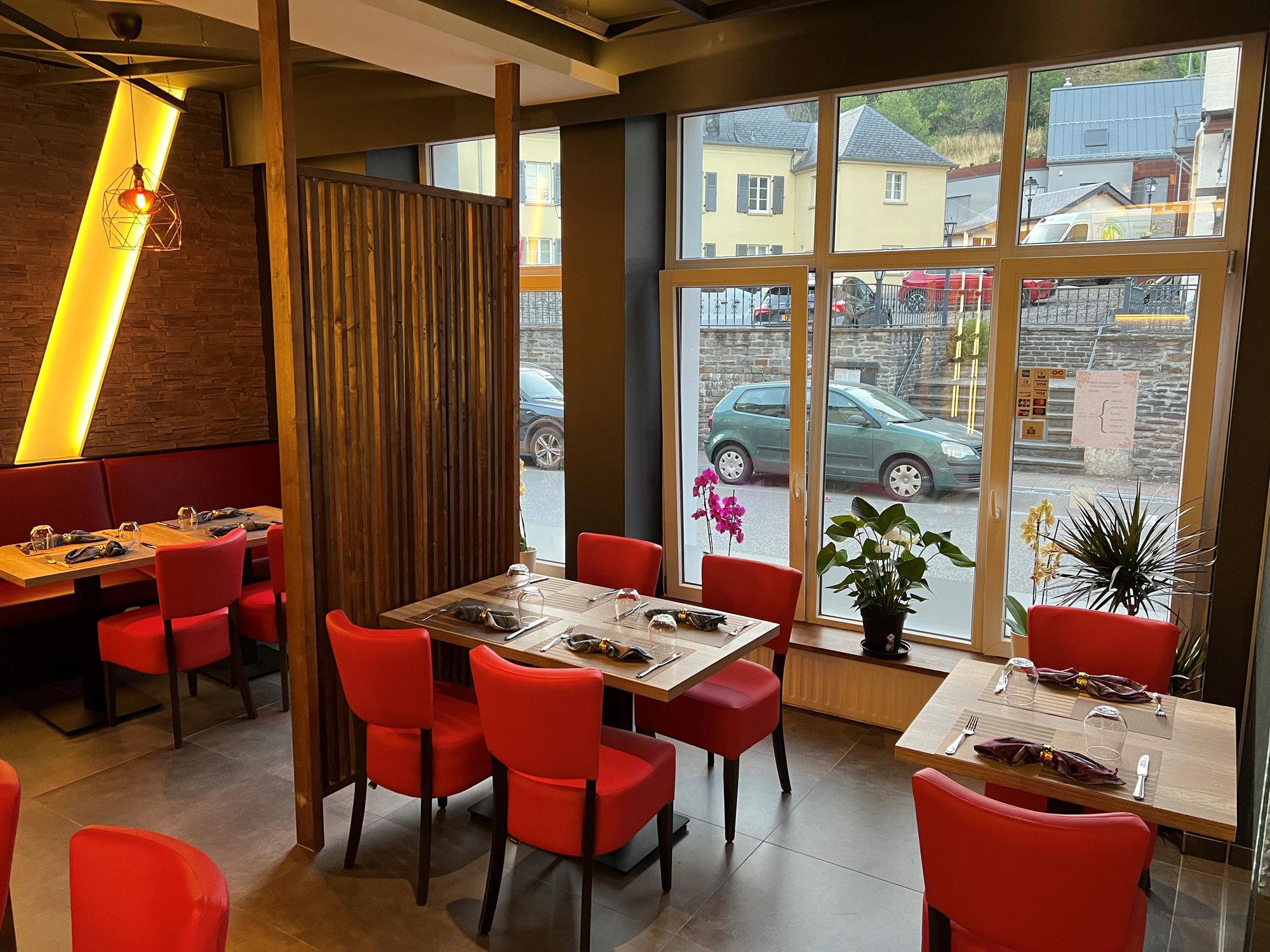
Vianden's Quiet Corner of the Table
The approach to Vianden sets expectations before you reach the door. The Our river runs below the castle ridge, the town's main street narrows past timber-framed houses, and the railway station — from which Rue de la Gare takes its name — sits at the edge of a settlement that moves at a pace entirely removed from Luxembourg City's financial district energy. Restaurants operating in this kind of setting face a different calculus than their urban counterparts: the foot traffic isn't there, the passing tourist is more likely to stop for a schnapps than a considered meal, and the kitchen has to earn its audience through reputation rather than location. Fuku at number nine earns that attention in a town where the dining scene is thin enough that every address carrying genuine ambition registers clearly.
Luxembourg's restaurant geography tends to concentrate critical mass in the capital and its immediate suburbs, with isolated outposts of serious cooking scattered through the Moselle valley and the Ardennes. For a broader map of where the country's kitchen talent is operating, see our full Veianen restaurants guide, which places Fuku in the context of the northern Luxembourg dining circuit. Venues like Beim Schlass in Wiltz and Der Napf in Wilwerdange occupy a similar position: serious cooking in small-town settings, drawing guests who are willing to build a visit around the meal rather than stumbling in from a busy street.
Sourcing in the Ardennes: What the Geography Allows
The northern Luxembourg Ardennes isn't a region that tends to appear in sourcing discussions the way Alsace or the Moselle does, but the raw material case is stronger than the press suggests. The area sits inside a broader agricultural belt that runs from Belgium's southern provinces into the Eifel: cattle country, game territory, woodland foraging ground, and a network of small producers who supply to kitchens across the region largely without the visibility that equivalent French or German suppliers would command.
Restaurants working in this geography face a genuine advantage when they choose to use it. The supply chain is short, the seasonal rhythm is pronounced, and the competition for the leading local product is less intense than in denser dining markets. Wild game from the Ardennes forests, freshwater fish from the Our and the Sûre, dairy from farms within a short drive, these are the inputs that define honest northern Luxembourg cooking when kitchens commit to them. The contrast with urban Luxembourg dining, where menus often reflect the same premium importers used across European capitals, is real. Léa Linster in Luxembourg operates at the formal end of the country's culinary register; the northern Ardennes tier operates differently, with geography rather than ceremony as the organising principle.
Vianden's position on the German border adds a further dimension. The kitchen culture of the Eifel and the Rhineland sits within reach, and the crossover in produce, technique, and dining habit between Luxembourg's north and its German neighbours shapes what is possible in a kitchen here in ways that don't apply in the capital. Becher Gare in Bech and Beim Bertchen in Wahlhausen operate in comparable border-country contexts, where the cooking reflects a hybrid of influences rather than a single national tradition.
Where Fuku Sits in the Luxembourg Dining Field
Luxembourg's restaurant scene has developed a reasonably clear tier structure. At the formal end, a handful of restaurants, including SENSA in Weiswampach and Auberge De La Gaichel in Eischen, hold Michelin recognition and operate with the tasting menu format and pricing that recognition implies. Below that, a mid-tier of serious but less ceremony-heavy restaurants operates across the country, often in rural or small-town settings where the kitchen can focus on produce and technique without the overhead of a city-centre address.
Fuku operates in Vianden, which already tells you something about its competitive positioning. It is not pitching against B13 in Bertrange or Beefbar Smets in Strassen for the Luxembourg City dinner crowd. The international frame is similarly instructive: compared to the tight-sourcing, region-defined cooking of Lazy Bear in San Francisco or the produce-first discipline of Le Bernardin in New York City, northern Luxembourg kitchens operate at a different scale but with a comparable logic when sourcing is their organising principle.
The creative mid-tier in Luxembourg, venues like Côté cour in Bourglinster and De Pefferkär in Fennange, suggests that there is an audience in this country for cooking that sits between the full tasting menu tier and the brasserie register, and that audience is increasingly willing to travel to find it. Domaine La Forêt in Remich and Kachatelier Manternach in Manternach occupy related positions in their respective regions. Chocolats du Cœur in Helmsange represents the artisan-produce end of the same national interest in ingredient quality.
Planning a Visit to Vianden
Vianden sits approximately 40 kilometres north of Luxembourg City, reachable by road through Diekirch or by the narrow-gauge railway that terminates at the station on Rue de la Gare. The town has limited accommodation for its size, so visitors combining a meal at Fuku with the castle visit or an Our valley walk are well advised to plan arrival times around restaurant hours, which we recommend confirming directly given the absence of published scheduling information for this address. As with many small-town Luxembourg restaurants, the kitchen tends to draw a local-and-returning clientele during the week, with heavier visitor traffic at weekends and during the Ardennes walking season from April through October. Given the limited public information currently available for Fuku, no published awards, pricing, or booking platform are listed, treating the address as a find-and-confirm rather than a plan-months-ahead destination is the practical approach. The Brasserie de La Gaichel in Arlon offers a comparable cross-border day-trip logic for travellers building a northern Luxembourg itinerary across multiple meals.
Frequently asked questions
Is Fuku child-friendly?
Vianden itself is a small town with a castle, a river walk, and a pace that suits families, which likely shapes the room's general tolerance. For groups with young children, it is worth contacting the venue directly before arrival to confirm seating arrangements.
Is Fuku better for a quiet night or a lively one?
Vianden is a town of under 2,000 residents set along the Our river, and the address at 9 Rue de la Gare places Fuku near the station end of a narrow main street. The setting points firmly toward quiet evenings rather than late-night energy. Expect a pace shaped by the town rather than by an urban bar scene.
Is Fuku a good dining option when visiting Vianden Castle?
Vianden Castle sits directly above the town on the ridge, and Fuku's address at 9 Rue de la Gare puts it a short walk from the base of the ascent. For travellers spending the day at the castle or along the Our river, Fuku represents one of the few sit-down dining options within the town itself rather than a drive to a larger centre like Diekirch or Ettelbruck.
What do people recommend at Fuku?
Given Fuku's position in the northern Luxembourg Ardennes, regional sourcing — game, foraged produce, and Moselle-adjacent ingredients — tends to define what kitchens in this area do well. Asking staff what is freshest on the day is the practical approach.
What's Fuku's location?
Fuku is located at 9 Rue de la Gare, 9420 Vianden, Luxembourg, Veianen.
Can I walk in to Fuku?
No booking policy is confirmed in Fuku's record. Vianden draws steady visitor traffic through summer and autumn, particularly from castle tourism and the Our valley hiking circuit, which can pressure smaller rooms on weekends. Contacting the venue before arrival is the cautious move, especially outside low season.
What's Fuku best at?
Fuku occupies a specific position in the Luxembourg dining field: a sit-down option in a town where the restaurant count is thin and the nearest formal alternatives are a drive south toward Diekirch or Luxembourg City. That scarcity puts a premium on execution over competition, and the Ardennes geography provides raw material — game, freshwater fish, forest produce — that kitchens elsewhere in Luxembourg have to source from a distance.
Side-by-Side Snapshot
Comparable venues nearby, for context on price, style, and recognition.
| Venue | Cuisine | Price | Notes |
|---|---|---|---|
| FukuThis venue — the venue you are viewing | Modern Asian Fusion | $20–30 | Not listed |
| Specto | Modern Fusion Small Plates | $20–30 | Bertrange |
| Laotse | Authentic Chinese | $20–30 | Moutfort |
| Beim Bertchen | Luxembourgish Grill | Not listed | Wahlhausen |
| Le Quai Steffen | French-European Brasserie and Rotisserie | $20–30 | Gare |
| Becher Gare | Traditional French-Luxembourgish | $20–30 | Bech |
Continue exploring
More in Veianen
Restaurants in Veianen
Browse all →
Bars in Veianen
Browse all →

Hotels in Veianen
Browse all →
Details
- Modern
- Trendy
- Casual Hangout
- Date Night
- Open Kitchen
- A La Carte
- Vegetarian Friendly
- Vegan Options
Current opening hours
- Monday
- Closed
- Tuesday
- 11:30 AM–2:30 PM, 5:30–10:30 PM
- Wednesday
- 11:30 AM–2:30 PM, 5:30–10:30 PM
- Thursday
- 11:30 AM–2:30 PM, 5:30–10:30 PM
- Friday
- 11:30 AM–2:30 PM, 5:30–10:30 PM
- Saturday
- 11:30 AM–2:30 PM, 5:30–10:30 PM
- Sunday
- 11:30 AM–2:30 PM, 5:30–10:30 PM
Hours can change for holidays and private events. Last verified .
Sleek, modern interior with a zen, quiet atmosphere conducive to conversation.