Curry 36 operates at the intersection of Berlin street food history and Kreuzberg's working-class identity. Positioned at Mehringdamm 36, it draws a cross-section of the city that few sit-down restaurants can claim, from night-shift workers to tourists comparing it against the city's other currywurst institutions. The queue is the reservation system, and the sausage is the point.
Pearl is the En Primeur Club membership app — saves, bookings, and concierge access live there. Same editors, same standards.
- Address
- Mehringdamm 36, 10961 Berlin, Germany
- Phone
- +49 30 2517368
- Website
- curry36.de
- Directions
- Get directions
 Saves & bookings on Pearl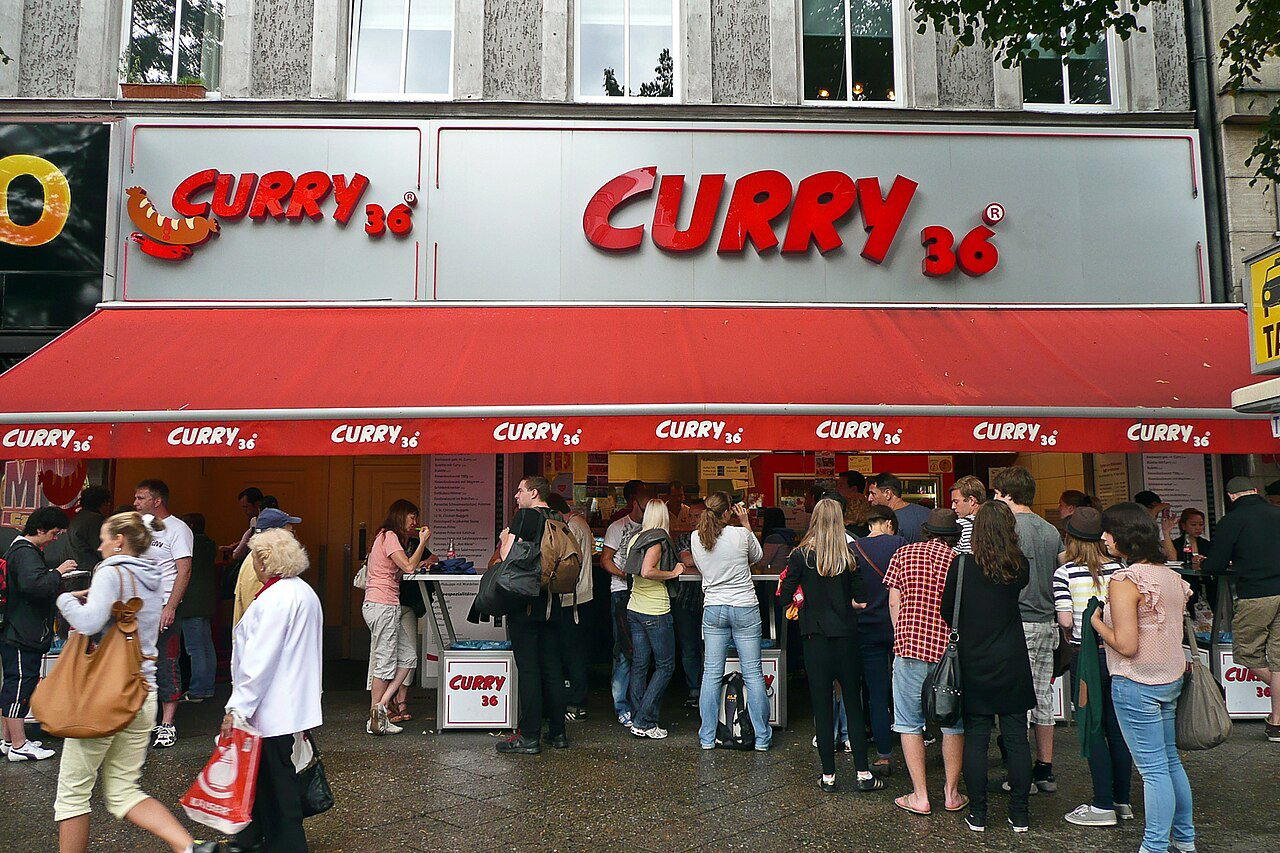
Mehringdamm and the Grammar of Berlin Street Eating
There is a particular kind of food stand that a city builds its identity around, not because it is refined, but because it is load-bearing. In Berlin, the currywurst stand occupies that structural role, and Mehringdamm 36 in Kreuzberg is one of the addresses that the city returns to most consistently when that argument is made. Curry 36 sits on a broad, unglamorous stretch of road in a neighbourhood that has absorbed waves of immigration, gentrification pressure, and political history without losing its working-class register. The stand itself is exposed to the street: you order, you wait at the counter, you eat standing or on a nearby ledge. There is no interior to soften the experience.
That directness is the point. Berlin's street food culture has always been less about atmosphere engineering and more about function, feeding people efficiently, cheaply, at hours when kitchens are closed. Curry 36 operates on that logic. It is open into the early hours, which positions it against not just other currywurst stands but against the broader late-night eating economy of a city that takes its nightlife seriously.
Kreuzberg as Context
Kreuzberg's food identity cannot be separated from its demographic history. The neighbourhood became a centre of Turkish migration in the 1960s and 1970s, and the resulting food culture, döner, börek, strong tea in glass cups, layered itself over an existing tradition of Berlin working-class eating. Currywurst, itself a post-war invention credited to Herta Heuwer in 1949, belongs to the older layer: a fried or grilled pork sausage, sliced and dressed with ketchup and curry powder, sold from stands that proliferated across West Berlin.
Curry 36 operates in that tradition while sitting geographically close to the newer food cultures of Kreuzberg. Walk five minutes in either direction from Mehringdamm and you pass köfte counters, falafel windows, and the kind of casual Vietnamese spots that have colonised much of inner Berlin. The stand does not compete with those, it occupies a different register entirely, but its location in Kreuzberg rather than, say, Charlottenburg or Mitte changes the social texture of who queues there. This is a genuinely mixed crowd in a way that Berlin's more polished food addresses are not.
The Queue and What It Tells You
The queue at the restaurant functions as its own social institution. At peak hours, Friday and Saturday nights, Sunday afternoons, it stretches along the pavement and includes a cross-section of the city that a tasting menu room cannot produce: construction workers eating lunch, tourists who have read the same travel lists, Kreuzberg residents running errands, people arriving from Mitte or Prenzlauer Berg specifically for this. The mix is not incidental; it reflects the stand's position in Berlin's collective food memory.
That positioning matters when comparing the restaurant to the city's other currywurst institutions. Konnopke's Imbiß in Prenzlauer Berg operates from a different neighbourhood tradition, serving under the refined U-Bahn tracks with a history going back to 1930. The restaurant and Konnopke's are the two addresses most frequently cited together when the city's currywurst canon is mapped, though their neighbourhood contexts produce different crowds and slightly different atmospheres. Neither is a tourist trap in the pejorative sense; both are embedded in real local use.
For visitors who are also tracking Berlin's high-end dining circuit, the Michelin-recognised rooms at Rutz, Nobelhart & Schmutzig, FACIL, Restaurant Tim Raue, or CODA Dessert Dining, the restaurant represents the opposite end of the formality axis without being the opposite of quality. The city's food identity depends on both ends of that spectrum functioning with integrity.
Germany's Broader Fine Dining Frame
Understanding where the restaurant sits in the German food conversation requires a sense of what the country's restaurant culture looks like at its formal apex. Germany's Michelin-starred circuit stretches well beyond Berlin: Schwarzwaldstube in Baiersbronn, Aqua in Wolfsburg, JAN in Munich, Vendôme in Bergisch Gladbach, Victor's Fine Dining by Christian Bau in Perl, ES:SENZ in Grassau, Schanz in Piesport, Waldhotel Sonnora in Dreis, and Restaurant Haerlin in Hamburg all represent the country's credentialed fine dining tier. Further afield, comparable precision-driven rooms include Bagatelle in Trier, Le Bernardin in New York City, and Lazy Bear in San Francisco.
None of that is the world the restaurant operates in, and that is not a criticism. The currywurst stand and the tasting menu room address entirely different needs, and a city that has only one or the other is a city with a partial food culture. Berlin's strength is that it maintains both with seriousness.
Practical Orientation
Mehringdamm is served directly by the U6 line, with Mehringdamm station placing you within a short walk of the stand. The address, Mehringdamm 36, is direct to locate, and the stand's visibility from the pavement means there is no searching involved. Payment is cash-forward at most Berlin Imbiss operations of this type; it is worth having small notes. Hours extend late, which makes the restaurant a realistic option after an evening at one of Kreuzberg's bars or clubs. Visitors combining a Berlin dining itinerary across price points should treat the stand as a daytime or late-night bracket rather than a dinner replacement, it works well when slotted around the city's other eating rhythms rather than forced into a meal slot. No reservation exists or is needed; the queue self-regulates.
For a broader map of where to eat across the city, the EP Club Berlin restaurants guide covers the full range from street level to formal tasting rooms.
Compact Comparison
Comparable venues nearby, for context on price, style, and recognition.
| Venue | Cuisine | Price | Notes |
|---|---|---|---|
| Curry 36This venue — the venue you are viewing | Kreuzberg, Berlin Currywurst | $ | Not listed |
| Curry Baude | Not listed | $ | Gesundbrunnen, Traditional Berlin Currywurst |
| Ebert | Wilmersdorf, Traditional German | $ | Not listed |
| Café Liebig | Grünau, Classic German Bistro | $$ | Not listed |
| Georgbraeu | Mitte, Traditional German Brewery | $$ | Not listed |
| Ei-12437-B Restaurant | Plänterwald, Modern German Beer Garden | $$ | Not listed |
At a Glance
- Lively
- Well Known
- Energetic
- Casual Hangout
- Late Night
- After Work
- Standalone
- Beer Program
- Street Scene
Current opening hours
- Monday
- 9 AM–5 AM
- Tuesday
- 9 AM–5 AM
- Wednesday
- 9 AM–5 AM
- Thursday
- 9 AM–5 AM
- Friday
- 9 AM–5 AM
- Saturday
- 9 AM–5 AM
- Sunday
- 9 AM–5 AM
Hours can change for holidays and private events. Last verified .