Our verdict
CONDESA occupies a position at Münchner Freiheit 6 that places it among the Schwabing neighbourhood's more considered dining addresses, where Mexican culinary tradition meets a city increasingly interested in cuisine rooted beyond Europe. The address signals something: Schwabing has long absorbed international influences with more intellectual curiosity than most Munich districts, making it a fitting context for a kitchen drawing on Latin American roots.

Pearl is the En Primeur Club membership app, where members save venues, book tables and use the concierge.
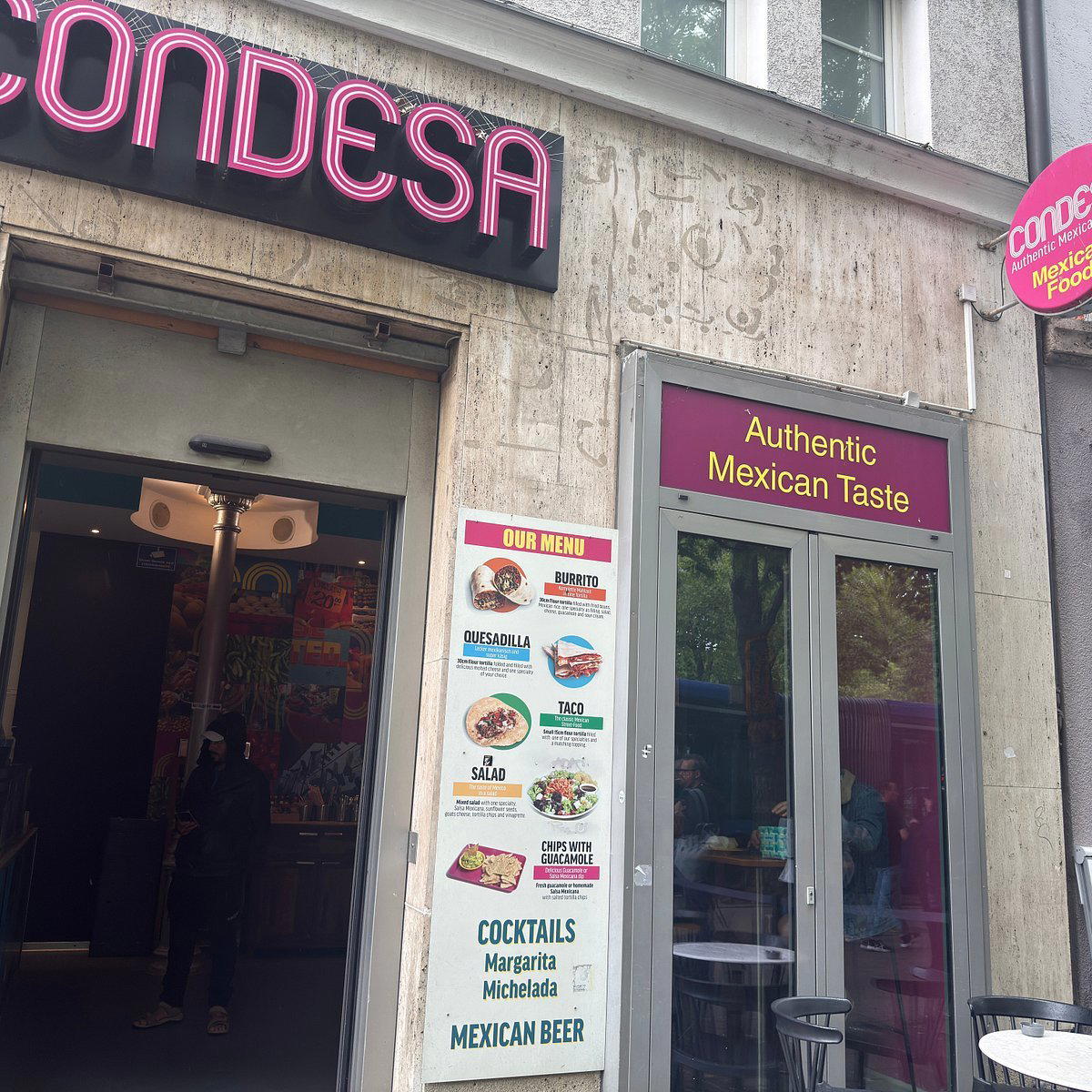
The menu
What to order
- Tacos al pastor
- Burritos
- Quesadilla tinga
Schwabing's Appetite for the Americas
Munich's fine dining conversation tends to anchor itself in French technique and German provenance. The city's most decorated tables, from Tantris and Atelier to Alois - Dallmayr Fine Dining, operate in a tradition that prizes classical foundations and seasonal restraint. Against that backdrop, a restaurant drawing on Mexican culinary culture occupies a genuinely different register. CONDESA, at Münchner Freiheit 6 in Schwabing, sits in that gap. The neighbourhood itself matters. Schwabing has historically been Munich's most cosmopolitan district, the part of the city where literary cafés and foreign-language bookshops have coexisted with good cooking since the early twentieth century. It is the logical address for a kitchen that takes its cues from somewhere other than Burgundy or Bavaria.
What Mexican Cuisine Actually Means at This Level
Mexican cooking is one of the most misrepresented food traditions in Europe. The popular version, filtered through Tex-Mex standardisation, bears little relationship to the regional depth of actual Mexican cuisine, which UNESCO recognised as an Intangible Cultural Heritage in 2010. That recognition acknowledged something that serious food writers had understood for decades: Mexican cooking encompasses dozens of distinct regional traditions, complex mole preparations that take days to develop, fermentation cultures older than most European wine regions, and ingredient specificity that rivals the terroir logic of French gastronomy. Corn, for instance, is not a generic ingredient in this tradition. Different masa preparations, nixtamalisation processes, and heirloom varieties carry the same cultural weight that grain variety carries in Japanese rice cookery or wheat heritage carries in Neapolitan pizza.
The German dining public has been slow to engage with this depth. Cities like Berlin have moved further toward serious Latin American cooking, but Munich's exposure remains limited. Germany's broader fine dining circuit, with reference points like CODA Dessert Dining in Berlin and Victor's Fine Dining by christian bau in Perl, has demonstrated appetite for formats that challenge categorical expectations. Mexican culinary tradition, applied with the same rigour, carries similar potential.
The Schwabing Address
Münchner Freiheit is one of Schwabing's anchor squares, a U-Bahn interchange surrounded by street-level commercial activity and a residential density that keeps the area active beyond conventional dining hours. The square functions as a neighbourhood hub rather than a tourist corridor, which tends to produce a different kind of restaurant audience: local, repeat, harder to impress with surface theatrics. Dining rooms in this zone typically earn loyalty through consistency rather than spectacle. That dynamic suits a kitchen drawing on a cuisine tradition where technique is embedded and incremental, not telegraphed through elaborate plating conventions.
For context on what Munich's neighbourhood dining scene looks like at its most technically ambitious, Tohru in der Schreiberei and JAN demonstrate how the city's serious cooking addresses operate outside the grand hotel tier. Both earn recognition through kitchen discipline rather than brand infrastructure. CONDESA's Schwabing positioning places it in a similar category of neighbourhood-anchored ambition.
Latin American Cooking in the German Context
The wider German fine dining circuit has shown that unconventional formats can achieve significant critical traction. Schwarzwaldstube in Baiersbronn, Aqua in Wolfsburg, and Vendôme in Bergisch Gladbach all demonstrate that top-tier recognition in Germany is not confined to French or German cuisine categories. What they share is technical rigour and a coherent point of view. The same logic applies across the country: Schanz in Piesport, Waldhotel Sonnora in Dreis, Restaurant Haerlin in Hamburg, Bagatelle in Trier, and ES:SENZ in Grassau all signal that Germany's dining geography rewards specificity and commitment over category conformity.
Mexican cuisine, taken seriously, has demonstrated the same capacity at the international level. Formats like the ambitious Mexican-influenced tasting menus that have emerged in New York and San Francisco, including at addresses like Le Bernardin in New York City and the communal-format kitchens such as Lazy Bear in San Francisco, show how non-European culinary traditions hold up in high-attention dining contexts when the kitchen treats the source material with genuine fidelity. The question Munich is slowly beginning to answer is whether its dining audience will extend that same attention to Latin American cooking as it has to Japanese and Nordic influence.
Know Before You Go
| Address | Münchner Freiheit 6, 80802 München, Germany |
| Neighbourhood | Schwabing, Munich |
| Transport | Münchner Freiheit U-Bahn station (U3/U6), directly adjacent to the address |
| Cuisine | Mexican culinary tradition |
| Booking | Contact details not currently listed; check directly via venue search |
| Further Reading | Our full Munich restaurants guide |
Frequently asked questions
What's CONDESA's location?
CONDESA is located at Münchner Freiheit 6, 80802 München, Germany, Munich.
How does CONDESA compare to other Latin American restaurants in Munich?
Munich's Latin American restaurant offer is thin relative to cities like Berlin or Hamburg, which makes CONDESA's Schwabing address at Münchner Freiheit 6 a reference point by default for the city. Mexican cooking in Germany is predominantly filtered through Tex-Mex standardisation, so a kitchen engaging with the actual tradition occupies a different category from the bulk of the local competition.
Is CONDESA reservation-only?
Münchner Freiheit is a high-footfall U-Bahn square in Schwabing, which means walk-in traffic is plausible, but kitchens operating at this format level in Munich typically reward advance planning. Contacting the venue directly before visiting is the practical approach.
What makes CONDESA worth seeking out?
Munich's serious restaurant circuit defaults heavily to French technique and German provenance. CONDESA's positioning in Schwabing, at Münchner Freiheit 6, places a Mexican culinary tradition inside a neighbourhood that sustains restaurants through repeat local custom rather than tourist volume. That combination, a structurally complex cuisine underrepresented in German fine dining, anchored in a residential district with an independent restaurant culture, is the specific case for making the trip.
Just the Basics
Comparable venues nearby, for context on price, style, and recognition.
| Venue | Cuisine | Price | Notes |
|---|---|---|---|
| CONDESAThis venue (the venue you are viewing) | Authentic Mexican Street Food | $10–20 | Not listed |
| Vino e Gusto | Modern Italian Enoteca | $30–50 | Lehel, Modern Italian Enoteca |
| Taverna Diyar | Kurdish-Turkish | $20–30 | Haidhausen, Kurdish-Turkish |
| Max's Beef Noodles | Handmade Chinese Beef Noodles | $10–20 | Isarvorstadt, Handmade Chinese Beef Noodles |
| Savanna | South African Steakhouse & Grill | $30–50 | Theresienwiese, South African Steakhouse & Grill |
| Restaurant Tyni | Authentic Vietnamese Streetfood | $20–30 | Theresienwiese, Authentic Vietnamese Streetfood |