Tabelog 100 #76
Our verdict
CHIKAMINE belongs to Tokyo’s small-counter tempura tier: nine counter seats, a Shibuya basement address, and a 2025 selection in Tabelog’s Tempura 100. The appeal is less about spectacle than control: a focused tempura format, sake in the frame, and booking logistics that reward planning rather than casual drop-ins.

Pearl is the En Primeur Club membership app, where members save venues, book tables and use the concierge.
The menu
What to order
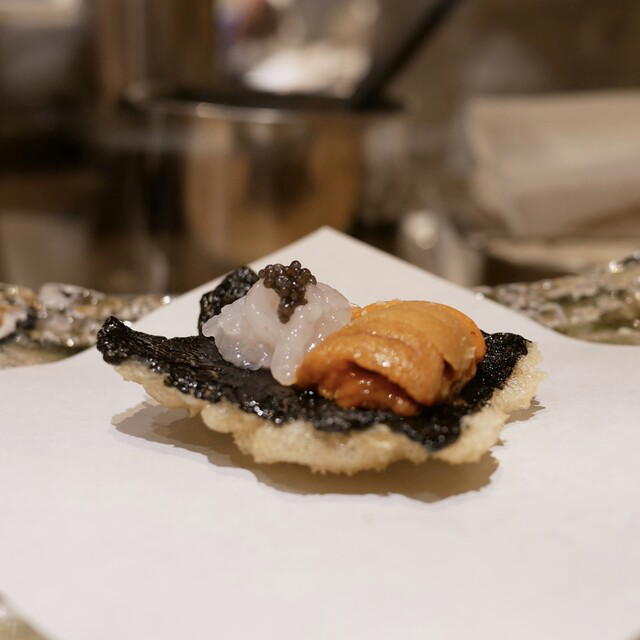
- Seasonal tempura omakase course
- Ramen to finish the course
- Steamed dishes
Shibuya’s restaurant energy usually announces itself at street level: neon, crossings, queues, and rooms built for velocity. Tempura at this level works in the opposite register. The descent to a basement counter changes the tempo before the first course arrives, replacing the district’s volume with the discipline of a nine-seat room. In Tokyo, that physical compression matters. Counter tempura is not simply a cooking style; it is a timing system, where batter, oil, pacing, and the handoff from fryer to guest define the meal more than décor or menu language.
CHIKAMINE sits inside that specialist bracket rather than the broad casual tempura market. Its 2025 selection in Tabelog’s Tempura 100 places it among a narrow field of restaurants judged within the same category, and its Tabelog score of 3.97 signals a level of local attention that matters in Tokyo, where domestic review culture often moves faster than international guidebook recognition. The restaurant opened in December 2022, which makes its award listing relatively early in its public life.
A nine-seat counter in Shibuya's specialist tempura tier
Tokyo’s premium tempura culture is built around restraint: small rooms, sequential service, and a cooking format where the margin for error is thin. The category rewards restaurants that can make a full dinner feel composed without turning it into theater. At CHIKAMINE, the objective signals are clear enough: nine counter seats, no private rooms, no private-use format, non-smoking service, and a dinner spend listed at JPY 15,000 to JPY 19,999. That price bracket puts it well above everyday tendon and set-meal tempura, but below the extreme end of Tokyo’s luxury counters.
The Shibuya location is part of the editorial interest. This is not Ginza’s ceremonial luxury circuit or Nihonbashi’s older merchant-district dining rhythm. Shibuya has become a more varied serious-dining zone, with compact counters, international formats, and polished casual rooms operating beside department-store dining and late-night drinking. Comparison within the immediate area is not neat: 12/10 Shinjuku ten pulls the decision toward Shinjuku, 124. KAGURAZAKA (Yakitori) belongs to a different grilled-skewer tradition, and 3 Chome no Curry Ya San speaks to Tokyo’s deep specialist-curry culture. CHIKAMINE is for the diner who wants the small-room tempura grammar rather than a broad Tokyo sampling menu.
That distinction matters because tempura is often misunderstood by visitors as a single dish rather than a full dining format. At the counter tier, the point is not abundance. It is sequencing. Fish, seasonal vegetables, and the sake list form the core vocabulary, with the restaurant’s public profile noting a focus on fish and nihonshu. That is enough to identify the lane without inventing a signature course. In a city where many premium meals now compete through luxury ingredients, counter tempura remains more exacting: the meal succeeds or fails on heat management and rhythm.
The booking logic is part of the experience
Small counters create their own economics. With nine seats, availability is naturally constrained, and CHIKAMINE’s reservation structure is unusually explicit for planning: reservations are available online, with two seatings listed at 17:00 and 20:30. That makes it a poor choice for loose, open-ended evenings and a stronger choice for diners willing to build the night around a fixed start time. It also suits solo dining, a category publicly associated with the restaurant, which is not always true at premium counters built around pairs and small groups.
The Tuesday-to-Saturday dinner schedule also shapes the decision. Closed Sundays and Mondays, the room fits a midweek or Friday-Saturday Shibuya plan better than a Sunday arrival meal. For visitors building a broader Tokyo itinerary, the practical move is to pair this with neighborhood-led planning rather than chasing every award list across the city. The broader edit is handled in our full Tokyo restaurants guide, while hotel positioning belongs in our full Tokyo hotels guide. For later in the evening, compare the dining choice with our full Tokyo bars guide; for non-restaurant planning, see our full Tokyo experiences guide and our full Tokyo wineries guide.
Tokyo rewards category clarity. A diner choosing tempura should not expect the social looseness of yakiniku, the pace of a curry counter, or the menu breadth of an izakaya. Nearby and citywide alternatives point to those differences:. 鮪と炭火焼き うお炭 秋葉原店 frames fish through charcoal, while Halal Wagyu Yakiniku Gyumon Shibuya, from the comparison set, represents a more group-friendly meat format. Sushi Inase belongs to the sushi-counter conversation; レザンファン ギャテ and Sorano Shibuya point to other Shibuya dining modes; Chirimulo sits at a far lower spend. None of those comparisons replace tempura. They clarify the choice.
Know Before You Go
- Format: Tempura counter dining with 9 seats.
- Recognition: Selected for Tabelog Tempura 100 in 2025; Tabelog score listed at 3.97.
- Spend: Dinner is listed at JPY 15,000 to JPY 19,999.
- Timing: Dinner service runs Tuesday to Saturday, with Sunday and Monday closed.
- Reservations: Online reservations are listed, with two seatings: 17:00 and 20:30.
- Setting: Basement address in Shibuya, all counter seating, non-smoking, no private rooms, no parking.
- Payment: Credit cards accepted: VISA, JCB, and AMEX. Electronic money and QR code payments are not accepted.
For a wider Japan itinerary, the useful comparisons are not only in Tokyo. -Grilled beef Sukiyaki- KAMAKURA TANUKIAN 鎌倉 たぬき庵 in Kamakura shifts the lens to beef sukiyaki, [ki:] in Kyoto belongs to a different city’s dining culture, and.cafe in Osaka.know in Kumamoto, (Shoku) Vietnam in Kawasaki, and [Curry Senmon Ten] Maruyama Kyoju. in Sapporo show how specific Japanese restaurant categories travel across cities. For readers tracking Japanese food culture abroad, Jōdo Saké Bar in Los Angeles and Onigiri Time in Pasadena sit in a different conversation altogether.
Frequently asked questions
Is CHIKAMINE open every day?
Hours at CHIKAMINE: Mon: Closed; Tue: 5 PM–12 AM; Wed: 5 PM–12 AM; Thu: 5 PM–12 AM; Fri: 5 PM–12 AM; Sat: 5 PM–12 AM; Sun: Closed.
What price level is CHIKAMINE?
Pricing at CHIKAMINE is listed as JPY 15,000 - JPY 19,999.
What part of town is CHIKAMINE in?
CHIKAMINE is located in Tokyo.
What's CHIKAMINE best at?
CHIKAMINE is a tempura counter in Shibuya, Tokyo, with 9 seats and Tabelog Tempura 100 2025 recognition. The format suits diners who want tight counter service rather than a large-room dining scene.
Can CHIKAMINE accommodate dietary restrictions?
The public record identifies CHIKAMINE as a tempura restaurant with an emphasis on fish, so dietary needs will need careful handling. With only 9 counter seats, any restriction should be discussed directly with the restaurant before making plans. Check the venue's official channels for the latest details.
Is CHIKAMINE okay with children?
CHIKAMINE is set up as a 9-seat counter in Shibuya, with evening service from Tuesday to Saturday. That makes it a better fit for adults or older children who can handle a quiet counter format.
Side-by-Side Snapshot
Comparable venues to anchor price and recognition.
| Venue | Cuisine | Price | Awards | Notes |
|---|---|---|---|---|
| CHIKAMINEThis venue (the venue you are viewing) | Seasonal Tempura Omakase | $100–150 | Tabelog 100 #76 | Not listed |
| Kabuto (天然鰻 かぶと) | Charcoal-Grilled Unagi | $500+ | Tabelog Silver #50 | Ikebukuro |
| Jukuseisushi Yorozu | Aged Sushi Omakase | $200–300 | 1 Michelin Star | Shibuya |
| 恵比寿えんどう | Modern Edomae Omakase | $300–500 | Tabelog Bronze | Shibuya |
| Higuchi | Modern Japanese Kappo Omakase | $300–500 | 2 Michelin Stars · Tabelog Bronze #109 | Shibuya |
| Roku Roku | Edo-mae Sushi & Kaiseki | $50–100 | Not listed | Minato |
Recognition history
Dated appearances from independent guides and award organizations, with the underlying list record or original source where available.
Tabelog 100 #76 · No. 76
Tabelog · Tabelog 100 - Tempura - 2025