Cannibale Royale Handboogstraat
Our verdict
Cannibale Royale Handboogstraat occupies a charged address just off Amsterdam's Spui square, where the city's relaxed-but-deliberate approach to late-night eating finds one of its more committed expressions. The format tilts toward meat, fire, and a wine program curated with more care than the industrial-cool room might suggest. It sits comfortably between casual neighbourhood spot and a place worth planning around.

Pearl is the En Primeur Club membership app, where members save venues, book tables and use the concierge.
The menu
What to order
- Flat iron steak
- Cannibale Royale burger
- Ribs
Where Spui's Street Grid Meets Open-Fire Cooking
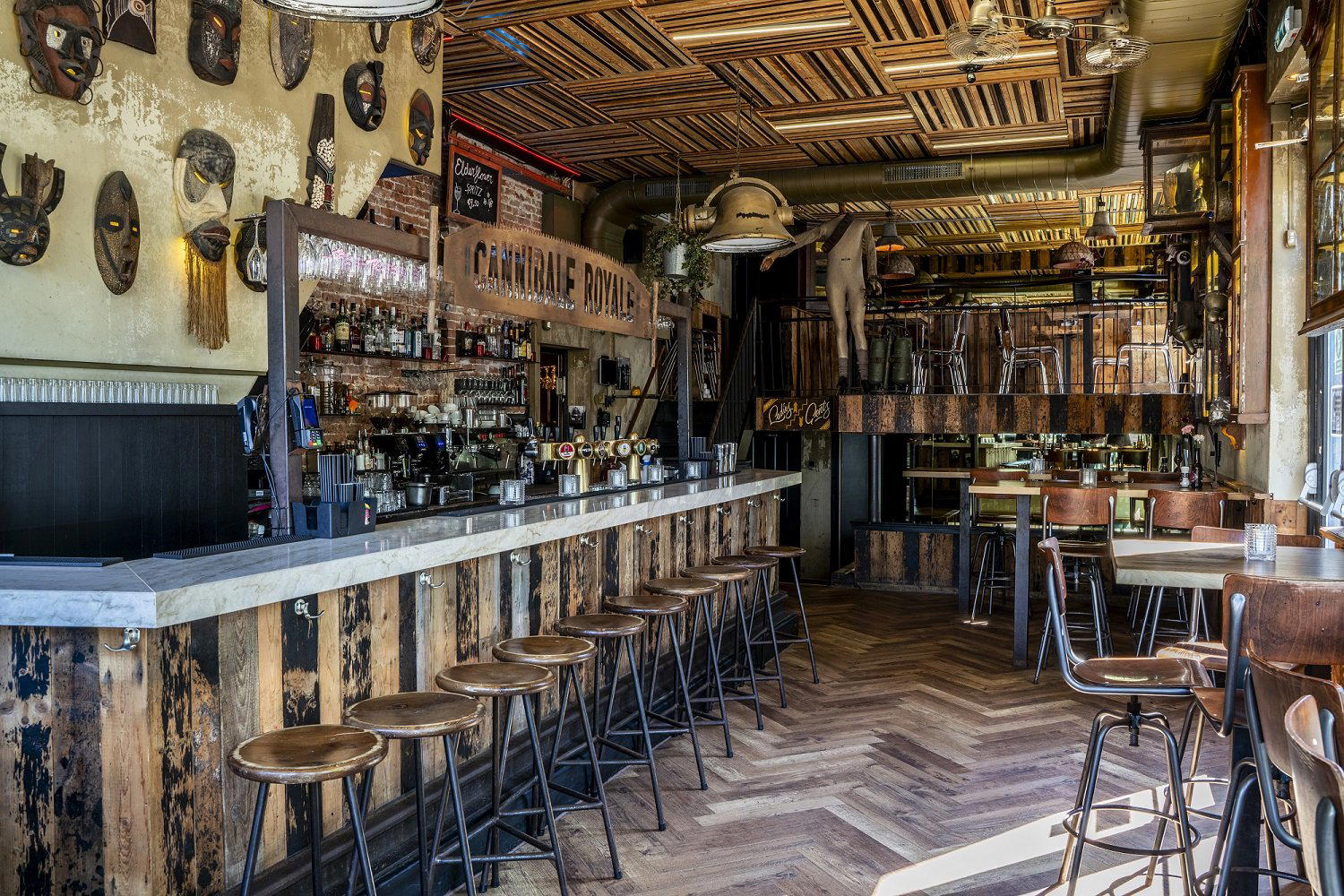
The block connecting Spui square to the Begijnhof is one of Amsterdam's better-compressed dining corridors: old city fabric, enough foot traffic to feel alive after 10 p.m. and a price range that spans everything from quick-turn lunch spots to considered evening dining. Handboogstraat 17a sits inside that corridor at a register that leans informal but doesn't apologise for it. The room reads as industrial-casual in the way that became a shorthand for a certain kind of confident European restaurant over the past decade, exposed surfaces, ambient noise, the kind of lighting that flatters without trying too hard. What anchors it more than the aesthetic is the smell: wood smoke and rendered fat reaching you before the door has fully swung open.
Amsterdam's casual dining scene has matured considerably since the mid-2010s. The city that once defaulted to Dutch brown-café staples or generic pan-European menus now sustains a full tier of mid-market restaurants where sourcing decisions, kitchen technique, and drink programs are taken seriously without the formality of the Michelin circuit. Cannibale Royale Handboogstraat occupies that middle register, in a city where that register has become genuinely interesting. For context on where the city's leading formal tier sits, Ciel Bleu, Flore, Spectrum, and Vinkeles represent the €€€€ creative end. Cannibale Royale operates several rungs below that in price and formality, but within a different competitive set where the comparison is other fire-forward, wine-serious casual rooms rather than tasting-menu houses.
The Wine Program as Editorial Statement
In Amsterdam's casual dining tier, the wine list is often where ambition either shows or collapses. A room that looks confident and prices confidently but pours from a short, uninspired list signals a kitchen-first operation with the cellar treated as afterthought. What separates Cannibale Royale Handboogstraat from that pattern is a wine approach that reads as curated rather than assembled. The list skews toward producers with a point of view, natural-leaning, lower-intervention, with a bias toward French and Southern European appellations that work alongside fat and char rather than against them. This is not accidental pairing logic. Open-fire cooking demands wines with structure and enough acidity to cut through smoke-rendered fat, and a list built around that premise tells you something about how seriously the kitchen and the floor communicate.
The broader context here matters. Amsterdam has developed a small but committed cohort of sommeliers and wine-minded restaurateurs who treat the glass program as a genuine editorial position. The city's natural wine culture, visible at wine bars across the Jordaan and De Pijp, has fed into casual restaurants willing to list growers that guests may not recognise from supermarket shelves. Cannibale Royale Handboogstraat benefits from that cultural momentum, it sits in a city where a guest asking for something from an obscure Jura producer is less surprising than it might have been fifteen years ago. For a point of comparison on wine-serious casual dining at a similar price point, Bistro de la Mer approaches the same mid-market tier from a seafood-focused angle with its own considered list.
Fire, Meat, and What the Kitchen Is Actually Doing
Open-fire cooking in Europe has passed through several phases of trend and counter-trend. What began as a Basque Country signal of seriousness became a global restaurant shorthand, then attracted justified scepticism when the aesthetic outpaced the technique. The restaurants that have held their position in this format are the ones where the fire is a cooking tool rather than a room concept. The Netherlands has its own butchery traditions, and Amsterdam's better casual meat restaurants have increasingly worked with Dutch and Belgian producers rather than defaulting to imported cuts, a shift visible across the market over the past five to eight years.
For readers tracking the wider Dutch fine-dining and serious-casual landscape beyond Amsterdam, the country's Michelin circuit offers useful calibration. De Librije in Zwolle and Inter Scaldes in Kruiningen represent the upper formal register. More accessible in format, De Nieuwe Winkel in Nijmegen and De Lindenhof in Giethoorn show how Dutch kitchens outside the capital handle serious sourcing with varying degrees of ceremony. Closer to the casual fire-cooking territory, Tribeca in Heeze and De Groene Lantaarn in Staphorst demonstrate the regional range of what Dutch kitchens do with quality protein. Brut172 in Reijmerstok, De Lindehof in Nuenen, De Bokkedoorns in Overveen, and De Treeswijkhoeve in Waalre extend that picture across the country's southern and coastal provinces. None of these are direct competitors to Cannibale Royale, they occupy different price tiers and formats, but mapping them clarifies where the Amsterdam address sits in the national picture: firmly in the city's confident casual tier, not reaching for the Michelin table.
Internationally, the fire-and-wine casual format has comparable expressions worth noting. Le Bernardin in New York City and Lazy Bear in San Francisco operate in entirely different registers, fine dining and ticketed tasting menus respectively, but both show how cities develop distinct vernaculars for serious eating at different price points. Amsterdam's version of that vernacular, in the mid-market casual tier, is what Cannibale Royale Handboogstraat contributes to.
Planning a Visit: What to Know
Handboogstraat is a short walk from the Dam square and directly adjacent to the Spui, making it accessible from most of Amsterdam's central hotel cluster without requiring transport. The Spui tram stop connects to the city's main lines. The room runs late by Dutch standards, and the crowd tends to arrive in waves, early for pre-theatre or early-evening meals, then again after 9 p.m. for the drinks-forward, grazing end of the evening. Walk-in is possible but uneven: weekends in particular reward a call ahead or a booking made a few days in advance. The full Amsterdam restaurants guide covers the broader city eating picture for those planning a longer stay.
Frequently asked questions
Where is Cannibale Royale Handboogstraat in Amsterdam?
Cannibale Royale Handboogstraat is located at Handboogstraat 17a, 1012 XM Amsterdam, Netherlands, Amsterdam.
How does Cannibale Royale Handboogstraat compare to other open-fire restaurants in Amsterdam?
Open-fire cooking has proliferated across European cities over the past decade, but Amsterdam's central dining core has comparatively few venues where the live grill is the genuine organising principle of the kitchen rather than a stylistic accent. Cannibale Royale on Handboogstraat sits within walking distance of the Dam and Spui, giving it a central Amsterdam address that most destination-grill venues in De Pijp or the Jordaan cannot match. That combination of format and location is what separates it from the broader casual dining field in the city.
What do regulars order at Cannibale Royale Handboogstraat?
The kitchen's open-fire grill is the clearest reason to visit, and the fire-cooked meat section is where most returning guests focus. Amsterdam's casual dining scene has plenty of competent burgers and shared plates, but a live-fire format on Handboogstraat, a compact corridor between Spui square and the Begijnhof, is a specific draw that shapes what most tables end up ordering. Come with an appetite calibrated to the grill.
Do I need a reservation for Cannibale Royale Handboogstraat?
Thursday through Saturday evenings see the strongest pressure in Amsterdam's mid-market casual tier, and Handboogstraat's position near Spui, one of the centre's more trafficked squares, means walk-in capacity can exhaust quickly on those nights. Booking ahead for weekend dinners is the practical call; earlier in the week and at lunch, the room tends to have more flexibility. Check availability directly through the venue.
A Quick Peer Check
Comparable venues nearby, for context on price, style, and recognition.
| Venue | Cuisine | Price | Notes |
|---|---|---|---|
| Cannibale Royale HandboogstraatThis venue (the venue you are viewing) | American Steakhouse & Grill | $30–50 | Not listed |
| Chop House | Premium Steakhouse & BBQ Grill | $50–100 | Schinkelbuurt Noord |
| Red | French Steakhouse with Lobster | $50–100 | Spiegelbuurt |
| BARBOUNIA | Mediterranean with Levantine Spices | Not listed | P.C. Hooftbuurt |
| Le Hollandais | Classic French Bistro | $50–100 | Hemonybuurt |
Continue exploring
More in Amsterdam
Restaurants in Amsterdam
All restaurants in Amsterdam →
Bars in Amsterdam
All bars in Amsterdam →
Hotels in Amsterdam
All hotels in Amsterdam →
Wineries in Amsterdam
All wineries in Amsterdam →
Details
- Lively
- Trendy
- Energetic
- Group Dining
- Late Night
- Casual Hangout
- Open Kitchen
- Craft Cocktails
- Beer Program
- Local Sourcing
- A La Carte
- Craft Beers
- Cocktails
- Gluten Free Options
Current opening hours
- Monday
- 12 PM–1 AM
- Tuesday
- 12 PM–1 AM
- Wednesday
- 12 PM–1 AM
- Thursday
- 12 PM–1 AM
- Friday
- 12 PM–2 AM
- Saturday
- 12 PM–2 AM
- Sunday
- 1 PM–1 AM
Hours can change for holidays and private events. Hours as of .
Eclectic and lively with quirky decor like old family photos and hanging dolls, creating a lively atmosphere well-suited for late-night dining.