
Few cafés in Madrid carry the institutional weight of Café Comercial, a Bilbao square fixture that has anchored Malasaña's social life since 1887. Where the city's tasting-menu circuit runs toward abstraction and ceremony, Café Comercial holds a different position: an all-hours gathering point where the espresso, the vermouth, and the conversation matter as much as anything on the plate. It sits apart from Madrid's €€€€ creative restaurant tier yet belongs to the same conversation about what Spanish dining culture actually is.
Pearl is the En Primeur Club membership app — saves, bookings, and concierge access live there. Same editors, same standards.
- Address
- Gta. de Bilbao, 7, Centro, 28004 Madrid, Spain
- Phone
- +34910882525
- Website
- cafecomercialmadrid.com
- Directions
- Get directions
 Saves & bookings on Pearl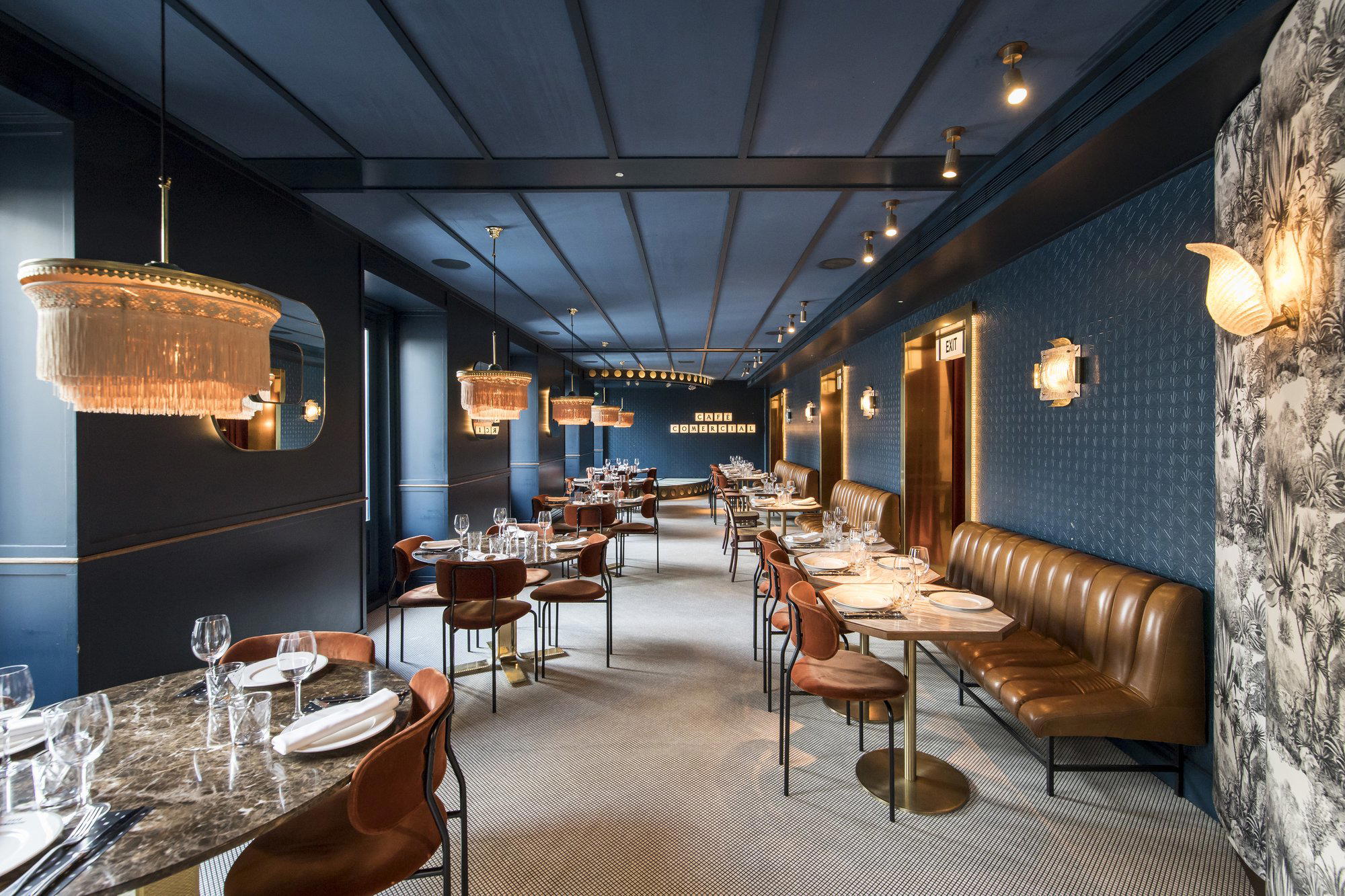
Café Comercial is a restaurant in Madrid serving Traditional Madrid Cuisine with Contemporary Touches, priced at about $33 per person. The approach to Glorieta de Bilbao is one of the more reliable orientation points in central Madrid. The square anchors the northern edge of Malasaña, and Café Comercial has occupied its corner at number 7 since 1887, long enough that locals stopped thinking of it as a café and started treating it as a fact of urban life. The marble-topped tables, the mirrored walls, and the slow ceiling fans belong to a visual grammar that the city developed across dozens of similar establishments, most of which have since closed. Café Comercial did not.
That survival places it in a specific and dwindling category: the Spanish gran café, a format that emerged in the late nineteenth century as a hybrid between French brasserie culture and the particular Madrileño habit of conducting all serious conversation in public. Where the gran café once competed with private clubs and literary salons, it now competes with third-wave coffee bars, hotel lobbies, and the ambient comfort of working from a screen. The ones that survive do so either through reinvention or through a kind of accumulated gravity that makes closing feel like a civic loss. The restaurant operates on the second principle.
Where the Room Does the Work
The interior is not decorative in the contemporary hospitality sense. The fittings are not curated; they are simply old and have been maintained. That distinction matters because it changes how the space reads. A contemporary room designed to evoke a historic café announces its intentions from the doorway. The restaurant does not announce anything. The worn wood, the brass fixtures, and the layered patina of decades of daily use exist because they were never replaced, not because they were preserved as an aesthetic strategy. The effect on a visitor is different from nostalgia, it is closer to the experience of using a tool that fits the hand because it was made long before ergonomic design became self-conscious.
The floor plan supports multiple simultaneous modes. At the bar, solo drinkers and newspaper readers occupy a different social register from the tables near the windows, where groups settle in for longer. The upper floor, historically used for tertulias, the structured intellectual discussions that Madrid's café culture institutionalised in the early twentieth century, adds a vertical dimension that most modern coffee operations have given up in favour of maximising covers on a single level. The spatial organisation is, in practice, a front-of-house philosophy: the room sorts itself.
The Service Logic of a Permanent Institution
Madrid's tasting-menu tier, DiverXO, Coque, Deessa, DSTAgE, Paco Roncero, operates on a logic of curated sequence, where the relationship between kitchen, sommelier, and front-of-house is choreographed and visible. The collaboration is the product. At the restaurant, that dynamic inverts: the staff have absorbed decades of institutional memory, and the service reads as unremarkable because it is so deeply practised. A waiter who has worked a room for fifteen years does not need to explain the menu or suggest a pairing, the knowledge is present and available without being performed.
This is a different model of hospitality expertise, less concerned with the guest experience as a designed arc and more interested in the guest as a regular, regardless of whether they have ever been before. The assumption of repeat custom is baked into how the room operates. That posture is common in the gran café format across Spain and France, but it requires a stable workforce over time, something that most contemporary hospitality operations struggle to maintain. The institutional knowledge at the restaurant is not located in any single position; it is distributed across the team and embedded in the rhythms of the room.
Spanish café culture of this type connects to a broader pattern visible in cities from San Sebastián to Barcelona and out to the Atlantic coast establishments like Aponiente: hospitality as civic infrastructure rather than commercial transaction. The gran café sits at the less rarified end of that spectrum alongside institutions like El Celler de Can Roca in Girona, Mugaritz in Errenteria, Azurmendi outside Bilbao, and Martin Berasategui in Lasarte-Oria, all of them, in different registers, treating the act of receiving a guest as something with cultural stakes beyond the meal itself.
What Gets Ordered and Why
The food and drink programme at the restaurant belongs to the traditional Spanish café register: coffee in its various Madrileño forms, vermouth at the pre-lunch hour that Madrid has defended against the encroachment of brunch more successfully than most European capitals, and a kitchen that supports rather than competes with the social function of the room. This is not the context for a tasting menu. It is the context for a cortado taken standing at the bar, or a caña and a plate of something small at a window table, or an afternoon coffee that extends into the early evening without anyone suggesting you might want to move along.
That programme connects the restaurant to a comparable set that has little to do with the city's creative restaurant circuit and more to do with what regulars actually use the city for on an ordinary day. For readers whose Madrid itinerary runs through Quique Dacosta, Ricard Camarena, Atrio, or the international reference points of Le Bernardin and Lazy Bear, the restaurant answers a different question, not where to eat a meal that requires a reservation three months ahead, but where to understand how the city actually operates between those meals.
Know Before You Go
| Address | Gta. de Bilbao, 7, Centro, 28004 Madrid, Spain |
|---|---|
| Neighbourhood | Malasaña / Glorieta de Bilbao |
| Getting There | Bilbao metro station (Lines 1 and 4) is directly on the square; the walk from Gran Vía takes around twelve minutes on foot |
| Booking | Reservations are recommended |
| When to Visit | The pre-lunch vermouth hour (roughly noon to 2pm) and the late-afternoon coffee window are particularly characteristically Madrileño moments to use the space |
| Dress Code | Business casual |
Compact Comparison
Comparable venues nearby, for context on price, style, and recognition.
| Venue | Cuisine | Price | Notes |
|---|---|---|---|
| Café ComercialThis venue — the venue you are viewing | Not listed | $$ | Not listed |
| Anda Jaleo | Palacio, Modern Spanish Tapas | $$ | Not listed |
| Maricastaña | Malasana, Modern Spanish Fusion | $$ | Not listed |
| LaLina Chueca | Chueca, Spanish Gluten-Free Tapas | $$ | Not listed |
| Cachopo & Go | Not listed | $$ | Vallehermoso, Traditional Spanish Cachopo |
| Portomarín | Lavapies, Galician Spanish | $$ | Not listed |
Recognition history
Dated appearances from independent guides and award organizations, with the underlying list record or original source where available.
Macarfi 6.8 Food Rating
Macarfi
Continue exploring
More in Madrid
Restaurants in Madrid
Browse all →
Bars in Madrid
Browse all →
Hotels in Madrid
Browse all →

At a Glance
- Well Known
- Classic
- Bohemian
- Lively
- Casual Hangout
- Group Dining
- Brunch
- After Work
- Business Dinner
- Historic Building
- Standalone
- Open Kitchen
- Extensive Wine List
- Craft Cocktails
- Local Sourcing
Current opening hours
- Monday
- 8:30 AM–1 AM
- Tuesday
- 8:30 AM–1 AM
- Wednesday
- 8:30 AM–1 AM
- Thursday
- 8:30 AM–2 AM
- Friday
- 8:30 AM–2 AM
- Saturday
- 8:30 AM–2 AM
- Sunday
- 8:30 AM–1 AM
Hours can change for holidays and private events. Last verified .
Sophisticated yet welcoming atmosphere with preserved original bar, floors, and mirrors creating a sense of timeless elegance; contemporary design elements pay homage to its storied past while maintaining the bohemian spirit of a historic café.