At the Landungsbrücken waterfront, BLOCKBRÄU occupies one of Hamburg's most recognisable industrial beer-hall settings, where the Elbe sets the frame for straightforward German brewing tradition and harbour-side cooking. The draw is the combination of working brewery scale, open water views, and a kitchen anchored in regional produce. For visitors mapping Hamburg's broader dining scene, it sits at the casual end of a city that also runs to three Michelin-starred tables.
Pearl is the En Primeur Club membership app — saves, bookings, and concierge access live there. Same editors, same standards.
- Address
- Bei den St. Pauli-Landungsbrücken 3, 20359 Hamburg, Germany
- Phone
- +494044405000
- Website
- block-braeu.de
- Directions
- Get directions
 Saves & bookings on Pearl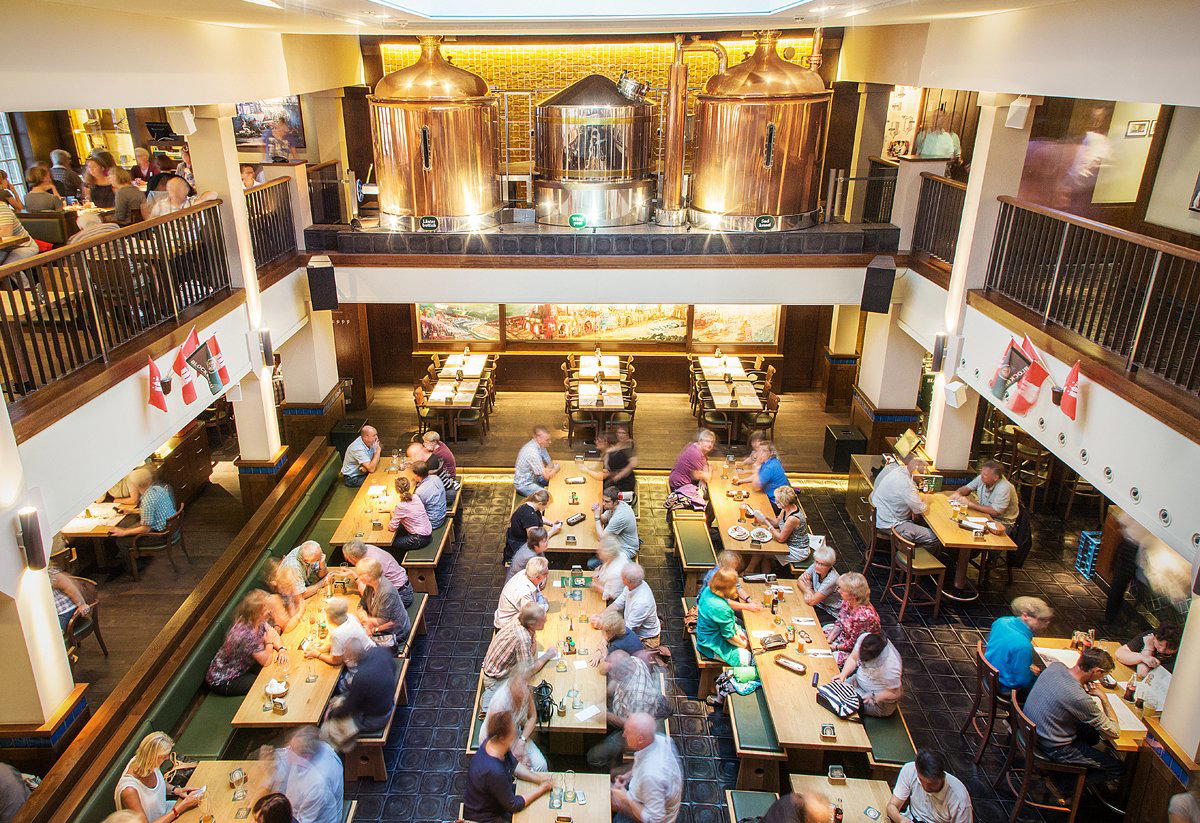
Where the Elbe Does the Work
The approach along Bei den St. Pauli-Landungsbrücken already tells you something. Hamburg's pontoon landing stages were built in 1909 to handle the city's transatlantic passenger trade, and the copper-domed clock tower at their centre remains one of the most legible pieces of port architecture in northern Germany. BLOCKBRÄU occupies a position directly within this complex, which means the first thing you encounter is not a menu or a host but a waterfront that still smells of tide and diesel and river traffic. The setting is not decorative — the Elbe is active, broad, and constantly moving, and the brewery has been positioned to make that view the central fact of eating and drinking here.
Inside, the hall reads as a working brewery that also serves food, rather than a restaurant that added a brewery for atmosphere. Fermentation vessels are present in the sightlines, copper and steel against the industrial bones of the building. German beer-hall tradition leans into volume and community seating, and this format follows that logic. It is a different register entirely from the tasting-menu rooms Hamburg also does well — from the chef-driven precision at Restaurant Haerlin or the three-Michelin-starred ambition of The Table Kevin Fehling, and that difference is the point.
The Sourcing Logic Behind Harbour-Side Cooking
German brewery kitchens operate within a specific sourcing logic. The cooking is not incidental to the beer programme; it is designed to support and extend it. Malt, grain, and fermentation chemistry set the parameters: the food tends toward protein and fat, with acid and salt used to reset the palate between pours. In Hamburg, that tradition intersects with a port city's historic access to North Sea fish, Schleswig-Holstein agricultural produce, and the kind of smoked and cured goods that travel well and keep well in a working harbour.
The Elbe estuary sits at the edge of some of northern Germany's most productive farmland. Schleswig-Holstein, immediately north of Hamburg, supplies beef and pork to the city's markets and has done so for centuries. What that means at a waterfront brewery is that the proteins on the plate have a short supply chain by geography, even when they are not marketed as such. The Hamburg fish market, a short walk along the waterfront, sets the standard for what arrives fresh by morning. A brewery kitchen in this position has access to ingredients that restaurants in less directly connected settings have to work harder to source.
This sourcing proximity matters because it shapes what brewery cooking here can reasonably claim. The smoked and cured element in northern German food culture is not a trend; it is a preservation tradition from before refrigeration, adapted now into a flavour preference. Rye bread, pickled vegetables, mustard-cured fish, these ingredients appear because they belong to the region, not because they have been imported into a concept. Visitors who approach BLOCKBRÄU through the lens of ingredient provenance will find that the kitchen is operating inside a coherent regional system, even when that system is not explicitly signposted.
For a different angle on where Hamburg's restaurant scene applies sourcing rigour at higher price points, 100/200 Kitchen and bianc both work within defined ingredient philosophies, though in entirely different formats and price brackets.
The Brewery Itself as Context
In Germany's major cities, the gap between industrial-scale brewery hospitality and the craft-focused smaller producers has widened over the past decade. BLOCKBRÄU operates at the larger, more established end of that spectrum, which means the beer programme is built for consistency and volume rather than small-batch experimentation. The house lagers and wheat beers are produced on-site, which gives them a freshness advantage over anything travelling from a distant facility, and the pairing logic with the food is relatively intuitive: lighter wheat beers against fish preparations, darker malt-forward lagers against heavier meat dishes.
Germany's brewing heritage carries a regulatory weight that shapes what breweries can and cannot do. The Reinheitsgebot, the purity law dating to 1516, restricted German beer production to water, hops, and barley malt for centuries and continues to influence the flavour profile expectations of German drinkers. A brewery positioning itself at a heritage site like the Landungsbrücken is, consciously or not, placing itself inside that tradition. The appeal is partly the beer and food, but it is also the accumulated weight of a port district that has been feeding and watering travellers since Hamburg was a Hanseatic trade hub.
Germany's wider fine dining network, from Schwarzwaldstube in Baiersbronn to Aqua in Wolfsburg and Vendôme in Bergisch Gladbach, operates in a separate register. Closer to Hamburg, Lakeside represents the city's formal lakeside dining tradition, and JAN in Munich shows how the German €€€€ tier functions in a different regional context. BLOCKBRÄU occupies neither end of that spectrum. It is a casual, high-capacity venue at one of the city's most-visited locations, and it functions as a first or last stop in a Hamburg itinerary rather than its centrepiece.
Planning a Visit
The Landungsbrücken is accessible directly by U-Bahn and S-Bahn from Hamburg Hauptbahnhof, with the Landungsbrücken station placing visitors at the waterfront within minutes of the city centre. The location within the passenger terminal complex means foot traffic is high throughout the day, particularly on weekends when the fish market crowds migrate east along the Elbe. For seated meals, arriving earlier in the service period or later in the afternoon reduces competition for waterfront-facing positions. Given the venue's scale, walk-in availability is more realistic here than at Hamburg's reservation-heavy tasting-menu rooms, though weekend evenings at peak season would benefit from advance contact. Specific opening hours and booking options are best confirmed directly with the venue ahead of travel.
Visitors building a wider Hamburg restaurant itinerary can use our full Hamburg restaurants guide to map BLOCKBRÄU against the city's other tiers, from waterfront casual through to the formal tables that position Hamburg alongside Le Bernardin in New York and Lazy Bear in San Francisco in international fine dining conversations. Elsewhere in Germany, CODA Dessert Dining in Berlin, ES:SENZ in Grassau, Schanz in Piesport, Waldhotel Sonnora in Dreis, Bagatelle in Trier, and Victor's Fine Dining by Christian Bau in Perl fill out the country's serious dining map for those combining Hamburg with a broader German itinerary.
How BLOCKBRÄU Hamburg compares with similar nearby venues.
| Venue | Cuisine | Price |
|---|---|---|
| UNDERDOCKS | Seafood | Not listed |
| Clouds - Heaven's Bar & Kitchen | International | €€€ |
| east | Fusion | €€€ |
Continue exploring
More in Hamburg
Restaurants in Hamburg
Browse all →
Bars in Hamburg
Browse all →
Hotels in Hamburg
Browse all →
Wineries in Hamburg
Browse all →
At a Glance
- Lively
- Rustic
- Scenic
- Well Known
- Group Dining
- Casual Hangout
- After Work
- Celebration
- Rooftop
- Waterfront
- Terrace
- Panoramic View
- Open Kitchen
- Historic Building
- Beer Program
- Waterfront
Current opening hours
- Monday
- 11:30 AM–11 PM
- Tuesday
- 11:30 AM–11 PM
- Wednesday
- 11:30 AM–11 PM
- Thursday
- 11:30 AM–11 PM
- Friday
- 11:30 AM–11 PM
- Saturday
- 11:30 AM–11 PM
- Sunday
- 11:30 AM–11 PM
Hours can change for holidays and private events. Last verified .
Bavarian-inspired beer hall with rustic charm, lively and welcoming atmosphere, bright natural light from expansive terrace views of bustling harbor activity.