At the Fischmarkt in Hamburg's Altona district, Alt Helgoländer Fischerstube occupies one of the waterfront addresses that defined the city's maritime eating culture long before the harbour redevelopment changed the neighbourhood's character. The restaurant sits within a tradition of North Sea fish cooking that Hamburg has sustained through successive waves of urban change, making it a reference point for visitors tracing the city's seafood heritage rather than its fine-dining circuit.
Pearl is the En Primeur Club membership app — saves, bookings, and concierge access live there. Same editors, same standards.
- Address
- Fischmarkt 4 a-c, 22767 Hamburg, Germany
- Phone
- +49 40 3194696
- Directions
- Get directions
 Saves & bookings on Pearl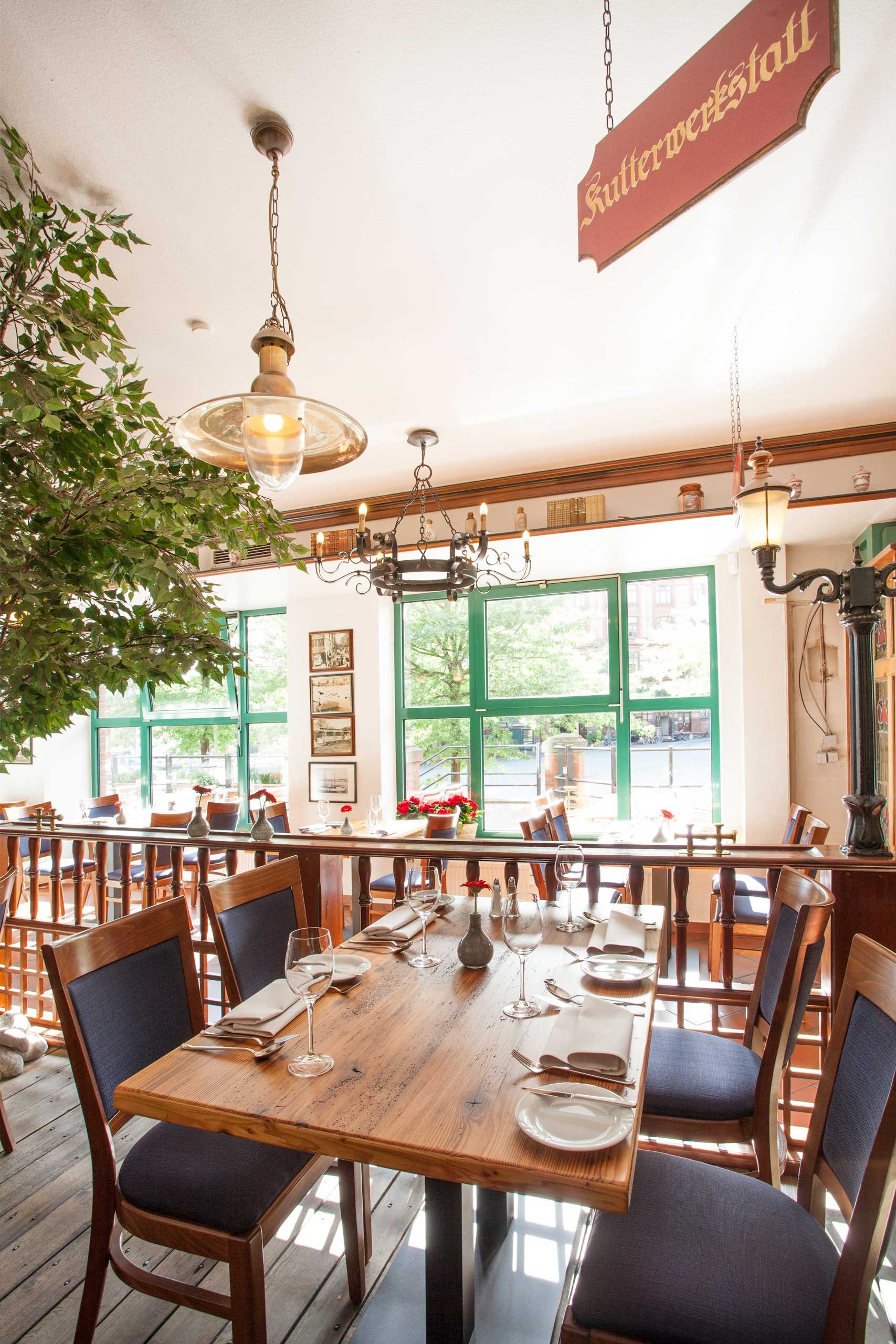
Fischmarkt 4: The Address Before the Reservation
The approach along Fischmarkt in Hamburg's Altona district does most of the editorial work before you reach the door. The Elbe sits on one side, broad and brown and working; the old warehouse facades press in on the other. This stretch of the waterfront predates the HafenCity redevelopment by several decades, and it reads that way. The stonework is worn, the signage is matter-of-fact, and the smell of the river is always present. Alt Helgoländer Fischerstube occupies a position at Fischmarkt 4 a-c that places it squarely within Hamburg's oldest fish-trade geography, the same stretch where fishermen from the North Frisian islands historically landed and sold their catch before the market formalized around them.
Hamburg's relationship with North Sea fish is structural rather than fashionable. The city's port identity, its trade routes to Scandinavia and the British Isles, and its working-class eating culture all converged around fish as a daily staple rather than a special-occasion ingredient. The Fischmarkt itself, running since 1703, is the institutional expression of that relationship. Restaurants in this immediate area inherit a context that newer venues in the HafenCity or Eppendorf cannot replicate: they are physically continuous with the tradition they serve.
Hamburg's Fish Tradition and Where This Venue Sits Within It
North German fish cookery operates on a different register from the high-technique seafood programs at Hamburg's top-tier restaurants. Where Restaurant Haerlin and The Table Kevin Fehling treat seafood as a canvas for contemporary technique, the Fischmarkt tradition is more direct: the ingredient is the point, and the cooking exists to get out of its way. Bismarckherring, geräucherter Aal, Scholle Finkenwerder Art, Matjes in its brief early-summer window — these are the markers of a regional repertoire that Hamburg has maintained with unusual consistency even as its restaurant scene has stratified considerably upward.
The name itself references Helgoland, the North Sea island roughly 70 kilometres off the Schleswig-Holstein coast, which supplied Hamburg's fish markets with crab, lobster, and demersal fish catches for generations. That supply relationship is part of Hamburg's culinary history, and a restaurant trading on that name is positioning itself within a specific lineage of harbour-adjacent, island-sourced seafood culture. Whether the current menu sustains that historical reference is a question of what you find on the day — the point is that the address and the name together carry significant contextual weight that the format is designed to honour.
Within Hamburg's current restaurant spectrum, the Fischmarkt fish houses occupy a mid-market tier that has become harder to sustain as the city's dining economics have polarised. The upper end of Hamburg's restaurant scene, represented by venues like bianc with its Mediterranean approach or Lakeside in its lakeside setting, operates at €€€€ price points with format discipline to match. The traditional fish house sits several tiers below that, serving a different function: accessible, geographically rooted, and identifiably local in a way that the fine-dining tier cannot claim with the same directness.
Compared to Hamburg's creative fine-dining tier, which includes 100/200 Kitchen at the more experimental end, the Fischmarkt tradition is deliberately unreconstructed. That is its value proposition, not a limitation. Visitors who have come from or are heading to Germany's higher-tier destinations, among them Schwarzwaldstube in Baiersbronn, Aqua in Wolfsburg, or Vendôme in Bergisch Gladbach, often find the contrast with a direct harbour fish meal the more memorable half of a Hamburg visit.
Planning the Visit: What the Booking Experience Actually Looks Like
The editorial angle that matters most for Alt Helgoländer Fischerstube is the one that applies to most of Hamburg's traditional waterfront restaurants: the booking experience is the opposite of Hamburg's headline fine-dining venues, and that distinction shapes the entire visit differently. At The Table Kevin Fehling, the ten-seat counter demands months of forward planning and a fixed tasting format. At the Fischmarkt end of the market, the friction runs in a different direction: the challenge is less about securing a reservation and more about knowing when to arrive, understanding the rhythm of a venue embedded in a working waterfront, and aligning your visit with the practical realities of the neighbourhood.
The Fischmarkt area operates on early-morning logic for anyone attending the famous Sunday fish auction (which runs from roughly 5am to 9:30am year-round), but restaurant hours along the stretch are more conventional. The Sunday market dynamic means the neighbourhood absorbs significant foot traffic in the early hours, tapering through the late morning. For a sit-down meal rather than a market visit, the more productive windows are typically midday onwards on weekdays, when the tourist-market overlap is lower and the waterfront recovers its quieter working character.
That positions it differently from Hamburg's reservation-intensive fine-dining addresses but aligns it with how most traditional Fischmarkt restaurants in this stretch have historically operated. Visitors travelling specifically for this meal rather than incorporating it into a broader Hamburg itinerary should verify current hours and contact details directly before travel.
Those building a Hamburg itinerary around multiple dining stops can cross-reference the EP Club's broader Hamburg recommendations, from the Michelin-tracked creative kitchens to the neighbourhood bistros, in our full Hamburg restaurants guide. For German seafood cooking at the formal end of the spectrum, JAN in Munich and ES:SENZ in Grassau represent what the country's kitchens do when technique takes over from tradition. At the Fischmarkt, the balance runs the other way, and that is precisely why the address remains in circulation as a Hamburg reference point.
For context on how Hamburg's fish culture compares internationally, the comparison with Le Bernardin in New York City is instructive in its distance: what Le Bernardin does with French technique and Atlantic seafood in a grand-dining register, the Fischmarkt tradition does with North Sea product and minimal intervention at a fraction of the ceremony. Both positions are legitimate. They simply describe different aspects of what serious fish eating can look like. Readers interested in how different cities encode their seafood heritage into specific restaurant formats will also find the Lazy Bear in San Francisco and CODA Dessert Dining in Berlin useful counterpoints on format philosophy, even if neither works in the same culinary register.
The broader German fine-dining map, which includes Victor's Fine Dining by Christian Bau in Perl, Schanz in Piesport, Waldhotel Sonnora in Dreis, and Bagatelle in Trier, operates on a different set of assumptions about what restaurant cooking should achieve. The Fischmarkt tradition is not in conversation with those venues in competitive terms. It answers a different question: what does Hamburg taste like when you strip the ambition back to the harbour and the catch?
Fast Comparison
A quick peer reference to anchor this venue in its category.
| Venue | Cuisine | Price | Awards |
|---|---|---|---|
| Alt Helgoländer FischerstubeThis venue — the venue you are viewing | Not listed | Not listed | Not listed |
| The Table Kevin Fehling | Creative | €€€€ | Michelin 3 Star |
| bianc | Modern Mediterranean, Mediterranean Cuisine | €€€€ | Michelin 2 Star |
| Lakeside | German Lakeside | €€€€ | Michelin 2 Star |
| Heimatjuwel | German, Creative | €€€ | Michelin 1 Star |
| Landhaus Scherrer | Modern European, Classic Cuisine | €€€€ | Michelin 1 Star |
Continue exploring
More in Hamburg
Restaurants in Hamburg
Browse all →
Bars in Hamburg
Browse all →
Hotels in Hamburg
Browse all →
Wineries in Hamburg
Browse all →
At a Glance
- Rustic
- Cozy
- Classic
- Casual Hangout
- Group Dining
- Waterfront
- Terrace
- Historic Building
- Beer Program
- Local Sourcing
- Waterfront
Current opening hours
- Monday
- 12 PM–12 AM
- Tuesday
- 12 PM–12 AM
- Wednesday
- 12 PM–12 AM
- Thursday
- 12 PM–12 AM
- Friday
- 12 PM–12 AM
- Saturday
- 12 PM–12 AM
- Sunday
- 12 PM–12 AM
Hours can change for holidays and private events. Last verified .
Maritime atmosphere with dark furniture, light walls, nautical decorations, and harbor views from the terrace.
Know Before You Go
- Getting there
- Fischmarkt 4 a-c, 22767 Hamburg, Germany