On HaTvuna Street in Beersheba, רווה קולינריה נוזלית occupies a niche that the city's dining scene is still defining: serious liquid-focused cookery in a desert city better known for grilled meat and hummus counters. The name itself signals intent, pointing toward a culinary approach built around liquid forms, from broths and reductions to emulsions and poured sauces. A focused destination for anyone tracking Israel's regional restaurant conversation.
Pearl is the En Primeur Club membership app — saves, bookings, and concierge access live there. Same editors, same standards.
- Address
- HaTvuna St 8, Be'er Sheva, 8470920, Israel
- Website
- rave-cc.com
- Directions
- Get directions
 Saves & bookings on Pearl
Beersheba's Dining Register and Where Liquid Cookery Fits
Beersheba has spent the better part of two decades quietly building a restaurant scene that punches above what its population size would predict. The city sits at the northern edge of the Negev, and its dining culture has historically skewed toward the communal and the protein-forward: charcoal grills, hummus counters open from early morning, and neighbourhood spots sustained by Ben-Gurion University's academic community. Against that backdrop, a venue whose name translates roughly to "liquid culinary satiation" represents a deliberate departure from the mainstream register. The name alone, רווה קולינריה נוזלית, signals a kitchen oriented around technique and form rather than the familiar markers of Negev hospitality.
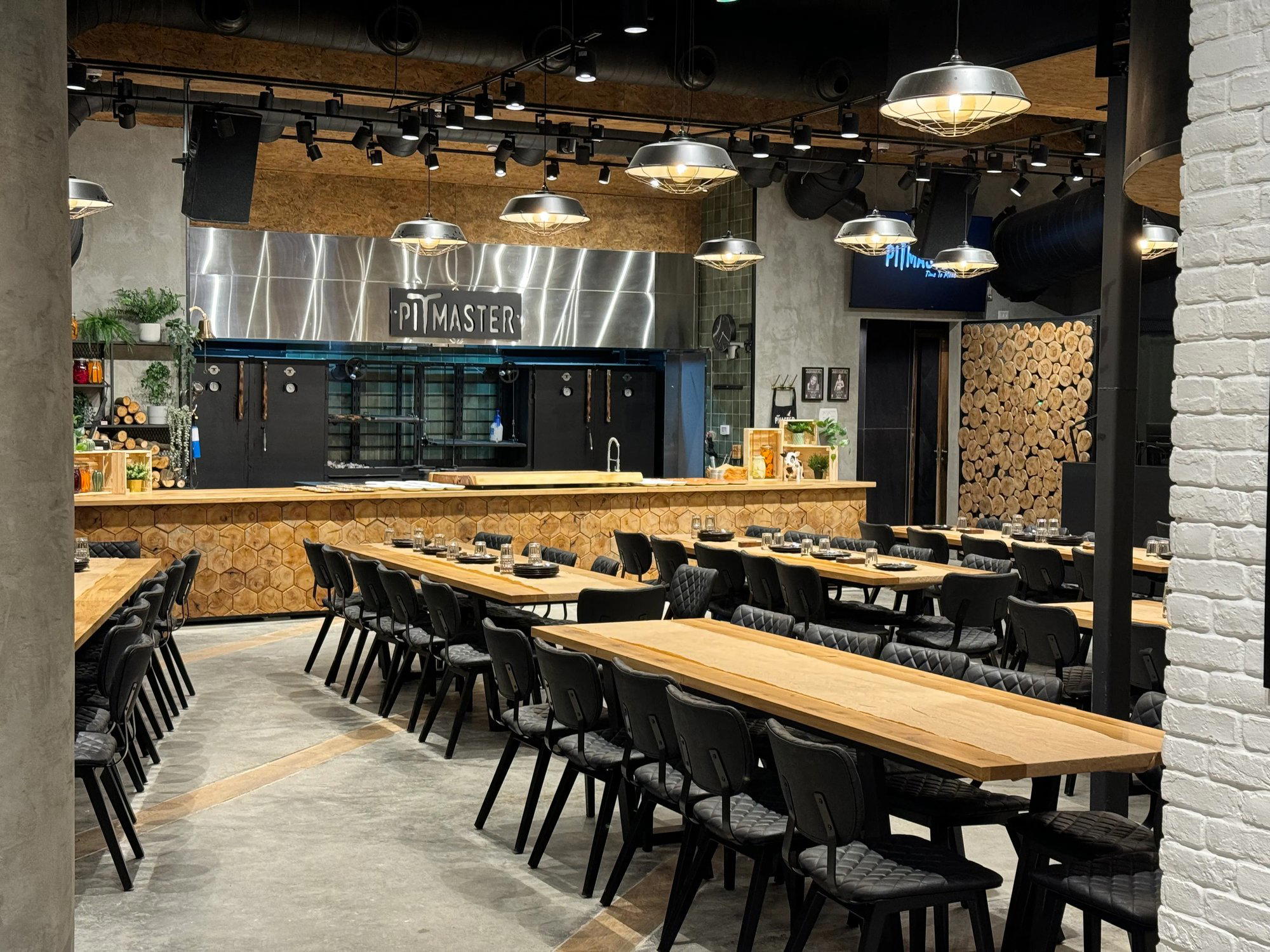
Pitmaster Beer-Sheva anchors the city's serious meat tradition, while בית הבירה של באר שבע B7 Beer House serves the craft-drink crowd. Neither occupies the same register as a kitchen that frames its identity around liquid culinary forms.
The Address and the Approach
HaTvuna Street 8 places the venue in a commercial stretch of the city rather than the tourist-facing zones near the Old City market. That address is telling: this is not a restaurant positioning itself for passing trade or heritage tourism. The street-level location in a working part of Beersheba suggests a kitchen that relies on intention rather than foot traffic, drawing guests who have already decided before arriving.
The name's emphasis on liquid forms, "נוזלית" meaning liquid or fluid in Hebrew, points toward a culinary philosophy that Israel's more technically ambitious restaurants have explored over the past decade. Across the country, from Herbert Samuel Herzliya on the coast to Menza in Jerusalem, kitchens with serious technical ambitions tend to signal that ambition through their relationship with sauces, broths, and emulsions. These are the elements that reveal much about a cook's training and discipline, because they cannot be masked by good produce or a hot grill.
The Dining Ritual: Pacing, Form, and What Liquid Cookery Demands of the Table
Meals built around liquid forms impose a different rhythm on the table than the more familiar formats that dominate Israeli casual dining. A bowl of hummus or a plate of grilled meat arrives with immediate clarity: you know what it is and how to eat it. A progression of broths, reductions, emulsions, and poured preparations asks more of the diner. Attention is required. Temperature matters in a way it rarely does at a grill counter. The order in which things arrive shapes how each element lands.
This is the dining ritual that the venue's name implies, and it places it in a category that Israeli diners have increasingly engaged with over the past several years. The evolution visible at places like Uri Buri in Acre, where seafood broths and poured sauces have long been central rather than peripheral, or at Majda, where Arab-Israeli culinary traditions are reframed through technique, shows that the appetite for this kind of cooking exists well beyond Tel Aviv's central dining corridor.
Outside Israel's borders, the same shift toward liquid-centred cookery has defined serious restaurants for years. At Le Bernardin in New York City, sauces have been the primary argument for decades. At Atomix, also in New York, each course arrives with its own paced logic, demanding the same attentiveness that liquid-forward menus require. This register is now being explored in Beersheba rather than just in metropolitan centres.
Israel's Regional Restaurant Moment and Beersheba's Place in It
For most of the country's modern dining history, serious restaurant conversation in Israel centred on Tel Aviv, with occasional acknowledgements of Jaffa institutions like Abu Hassan and Haifa's Arab-Israeli kitchen tradition. That geography has been shifting. Diana in Nazareth drew national attention to the north. Helena in Caesarea proved that serious cooking could anchor an archaeological site. Pescado in Ashdod and Michael Local Bistro in Liman represent the northern coastal towns finding their own dining voice.
Beersheba's position as Israel's fourth-largest city, combined with its university presence and a population that skews younger and more internationally mobile than many regional cities, creates the conditions for exactly this kind of restaurant. The city has the demand base. What it has historically lacked is the supply of kitchens willing to operate at this register. A venue whose identity is built around liquid culinary technique represents a signal that the supply side is catching up.
For comparison, Tel Aviv's Kab Kem and Ali Karawan Abu Hassan both operate in a city where the dining infrastructure, the critical attention, the supply chains, and the diner sophistication have been built over decades. Translating ambition of this kind to Beersheba is a different project, and the address on HaTvuna Street is where that project takes a concrete form.
Planning a Visit
Advance booking is recommended. Reservations are recommended. Hours are Mon to Thu and Sun, 9 AM to 5 PM; Fri and Sat are closed. Those travelling from the Negev region might also consider pairing a visit with stops at Burger 232 in Maggen or Pitmaster in Petah Tikva for a broader sense of the Israeli regional restaurant circuit.
Cuisine and Recognition
Comparable venues nearby, for context on price, style, and recognition.
| Venue | Cuisine | Price | Notes |
|---|---|---|---|
| רווה קולינריה נוזליתThis venue — the venue you are viewing | Liquid Culinary | Not listed | Not listed |
| בית הבירה של באר שבע B7 Beer House | Craft Beer Hall | $$ | Old Quarter |
| Pitmaster Beer-Sheva - פיטמאסטר באר-שבע | Live Fire Smoked Meats | $$$ | Herzl Street |
| Cafe Europa | Tel Avivian Fusion with Spanish-French-Mexican-Asian influences | $$ | Newe Ẕedeq |
| Menza | Mediterranean Bistro | $$ | Bezalel Street, Downtown Jerusalem |
| M25 | Israeli Steakhouse & Grill | $$ | Carmel Market |
Continue exploring
More in Beersheba
At a Glance
Current opening hours
- Monday
- 9 AM–5 PM
- Tuesday
- 9 AM–5 PM
- Wednesday
- 9 AM–5 PM
- Thursday
- 9 AM–5 PM
- Friday
- Closed
- Saturday
- Closed
- Sunday
- 9 AM–5 PM
Hours can change for holidays and private events. Last verified .
Cozy daytime atmosphere