

A Michelin Bib Gourmand yakitori-ya in Osaka's Fukushima Ward, Ayamuya has held its place in the neighbourhood for twenty-five years through a single, disciplined focus: two breeds of free-range chicken grilled over kishu-binchotan charcoal by a father-and-son team. Skewers arrive one at a time on antique dishes, and the omakase format keeps the menu strictly chicken throughout.
Pearl is the En Primeur Club membership app — saves, bookings, and concierge access live there. Same editors, same standards.
- Address
- Japan, 〒553-0003 Osaka, Fukushima Ward, Fukushima, 5 Chome−17−39 楠ビル
- Phone
- +81 6-6455-7270
- Website
- ayamuya.myconciergejapan.net
- Directions
- Get directions
 Saves & bookings on Pearl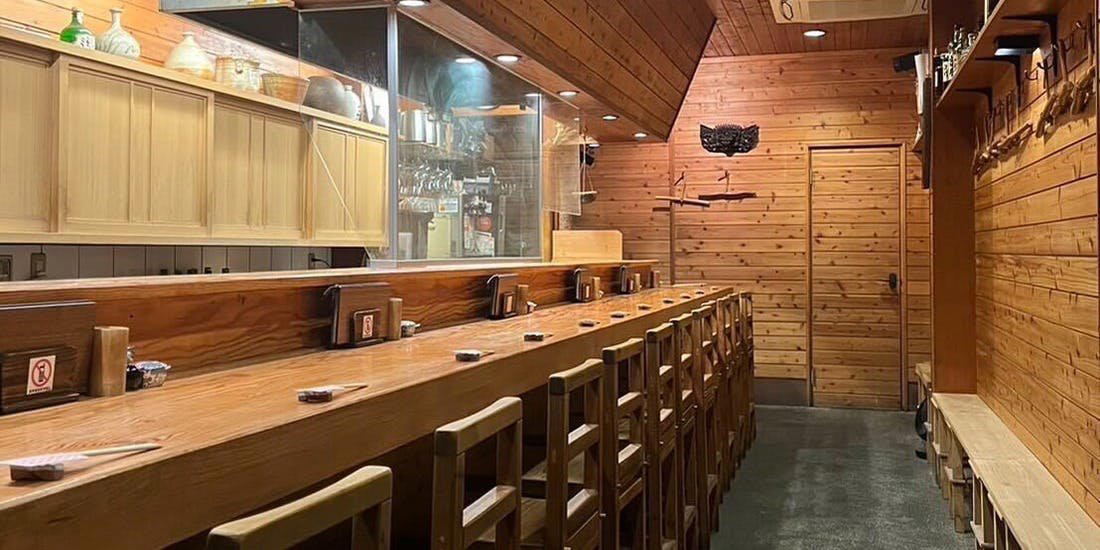
Smoke, Charcoal, and the Ritual of the Skewer
Walk into a serious yakitori-ya and the sensory cues arrive before the food does. The air carries that particular density of binchotan smoke, cleaner and more mineral than wood charcoal, with almost no visible haze, just a pervasive warmth that settles into clothing. At Ayamuya, in the Fukushima Ward of Osaka, this is the context before any skewer arrives: a counter environment built around a charcoal brazier, the quiet rhythms of tending heat, and a format that has not changed in any essential way across twenty-five years of service.
That kind of duration in a neighbourhood restaurant is notable. Osaka's dining scene spans everything from the three-Michelin-starred kaiseki formalism of Taian to the high-wire innovation of Hajime, but the city also sustains a quieter tier of specialist restaurants that have accumulated their authority through repetition rather than reinvention. Ayamuya belongs firmly to that category, and its consecutive Michelin Bib Gourmand awards in 2024 and 2025 confirm what local regulars have known for decades.
Two Breeds, One Discipline
The structural logic of yakitori at its most considered level depends on sourcing. The category is fundamentally about a single ingredient, chicken, and the quality ceiling is set before the charcoal is even lit. Ayamuya sources two breeds of free-range chicken, each selected for its suitability to specific cuts. This is not an unusual practice among specialist yakitori houses, but it represents a considered position: different parts of the bird have different fat distributions, muscle densities, and moisture levels, and a single breed cannot optimally serve every skewer on a menu built to cover the full range of cuts.
The charcoal in use is kishu-binchotan, a white charcoal produced in the Wakayama region that burns at a consistent, high temperature with minimal smoke and virtually no flame. It is the standard reference point for serious yakitori grilling across Japan, and its properties, long burn time, far-infrared heat radiation, low odour, allow the natural flavour of the chicken to come through without interference. Where lesser charcoals might impart bitterness or uneven heat, binchotan gives the griller precise control, which is why the pairing of quality sourcing with quality charcoal forms the baseline expectation at this level.
Brazier at Ayamuya is tended by a father and son working together, a model of transmission that echoes through Japanese craft traditions more broadly. The knowledge being passed down here is technical and tactile: reading heat, timing turns, managing fat drip, understanding the difference between a thigh skewer and a tsukune at the moment each is ready. This is the kind of operational continuity that makes a twenty-five-year restaurant feel coherent rather than merely old.
Format and the Omakase Structure
Skewers at Ayamuya arrive one at a time, served on antique dishes. The sequencing matters: this is not a format where a plate of skewers lands simultaneously and cools at different rates. Each piece comes off the grill at the moment it is ready, and the pacing creates a rhythm closer to a multi-course meal than to the casual, self-directed yakitori experience common at izakaya-style operations. The antique dishware adds a visual register that signals the kitchen's approach without announcing it: these are objects chosen for their age and character, not for matching uniformity.
The omakase format is notable for one deliberate absence: no vegetable skewers. This is a position, not an oversight. Many yakitori counters balance the menu with asparagus, shishito, or mushroom skewers as palate breaks between richer chicken cuts. Ayamuya's decision to exclude them means every skewer in the sequence is chicken, and the progression through different cuts becomes the sole architecture of the meal. For diners who have eaten their way through a conventional yakitori menu, this restriction can recalibrate attention, there is nothing to retreat to when a cut is challenging or rich.
In the broader Osaka yakitori scene, this approach places Ayamuya at the specialist end of the spectrum. Comparison venues like Torisho Ishii, Ichimatsu, and Yakitori Torisen each represent different points on the spectrum from casual to considered, and Ishii anchors another tier of the city's grill-focused dining. For a broader view of where Ayamuya sits within the city's full restaurant range, the Osaka restaurants guide maps the relevant comparable set across categories and price points.
Fukushima Ward and the Neighbourhood Context
Ayamuya sits in Fukushima Ward, one of Osaka's most concentrated dining districts. The neighbourhood runs along the south bank of the Dojima River, separated from Umeda's commercial density by just enough distance to have developed its own texture: narrower streets, smaller storefronts, a higher proportion of specialist restaurants relative to chains. Fukushima has accumulated serious dining credentials over the past decade across multiple categories, but the ward has long been home to exactly the kind of long-running neighbourhood specialist that Ayamuya represents.
For visitors planning an evening around this part of the city, the Osaka bars guide covers the drinking options in the surrounding area, and the Osaka hotels guide addresses accommodation for those using this as a base.
Yakitori Beyond Osaka
The specialist yakitori format Ayamuya represents has counterparts across Japan. Yakitori Omino in Tokyo and Torisaki in Kyoto operate within a similar philosophy of charcoal discipline and cut-focused sourcing, though each city's grill culture has its own inflections. For travellers moving through the Kansai and wider Honshu circuit, the broader dining references include Gion Sasaki in Kyoto and akordu in Nara, while those ranging further will find context in Harutaka in Tokyo, Goh in Fukuoka, 1000 in Yokohama, and 6 in Okinawa.
Planning Your Visit
Ayamuya is located at 5 Chome-17-39 Fukushima, Fukushima Ward, Osaka. The price range sits at ¥¥, positioning it well below the ¥¥¥¥ tier occupied by Osaka's leading French and kaiseki rooms, this is accessible specialist dining, and the Bib Gourmand recognition reflects exactly that value-to-quality relationship. The omakase format means the kitchen sets the pace and the sequence; arriving with dietary restrictions that exclude chicken would not be compatible with how the menu is structured. Given the restaurant's twenty-five-year presence and consistent recognition, reservations in advance are advisable. Specific booking details, current hours, and contact information should be confirmed directly before you go. Kitashinchi Shien is among the nearby dining options worth considering when planning an evening in this part of the city.
Peers Worth Knowing
Comparable venues nearby, for context on price, style, and recognition.
| Venue | Cuisine | Price | Notes |
|---|---|---|---|
| AyamuyaThis venue — the venue you are viewing | Michelin Yakitori | $$$ | Not listed |
| Oryori Amenimomakezu | Japanese Izakaya with Sake Pairing | $$$ | Kita |
| Benikurage | Modern Izakaya with Sake Pairings | $$$ | Chūō |
| Shokudo Akari | Seasonal Wakayama Izakaya Omakase | $$ | Kita |
| Yoshokuya Fujiya | Classic Yoshoku (Japanese Western Cuisine) | $$ | Chūō |
| Naniwa Okina | Traditional Hand-Rolled Soba | $$ | Kita |
Recognition history
Dated appearances from independent guides and award organizations, with the underlying list record or original source where available.
Michelin Bib Gourmand
Michelin
Michelin Bib Gourmand
Michelin
Tabelog 100 #81 · No. 81
Tabelog · Tabelog 100 - Yakitori - WEST - 2025
Michelin Bib Gourmand
Michelin
Continue exploring
More in Osaka
Restaurants in Osaka
Browse all →




Bars in Osaka
Browse all →



Hotels in Osaka
Browse all →



Wineries in Osaka
Browse all →
At a Glance
- Intimate
- Cozy
- Date Night
- Special Occasion
- Chefs Counter
- Open Kitchen
- Sake Program
- Local Sourcing
Current opening hours
- Monday
- 5:30–10 PM
- Tuesday
- 5:30–10 PM
- Wednesday
- 5:30–10 PM
- Thursday
- 5:30–10 PM
- Friday
- 5:30–10 PM
- Saturday
- 5:30–10 PM
- Sunday
- Closed
Hours can change for holidays and private events. Last verified .
Relaxing counter seating in a narrow, hole-in-the-wall space with an open kitchen and professional service.