


A ten-seat yakitori counter in Osaka's Nishitenma district, Torisho Ishii holds a Michelin star and consecutive Tabelog Silver Awards from 2022 through 2026, with a 4.48 score placing it among the highest-rated yakitori in western Japan. The omakase course runs ¥16,500, built around Takasaka chicken and shaped by a kaiseki sensibility that separates it from the city's more casual grill tradition.
Pearl is the En Primeur Club membership app — saves, bookings, and concierge access live there. Same editors, same standards.
- Address
- Japan, 〒530-0047 Osaka, Kita Ward, Nishitenma, 3 Chome−11−4 1F
- Phone
- +81 70-5214-1129
- Directions
- Get directions
 Saves & bookings on Pearl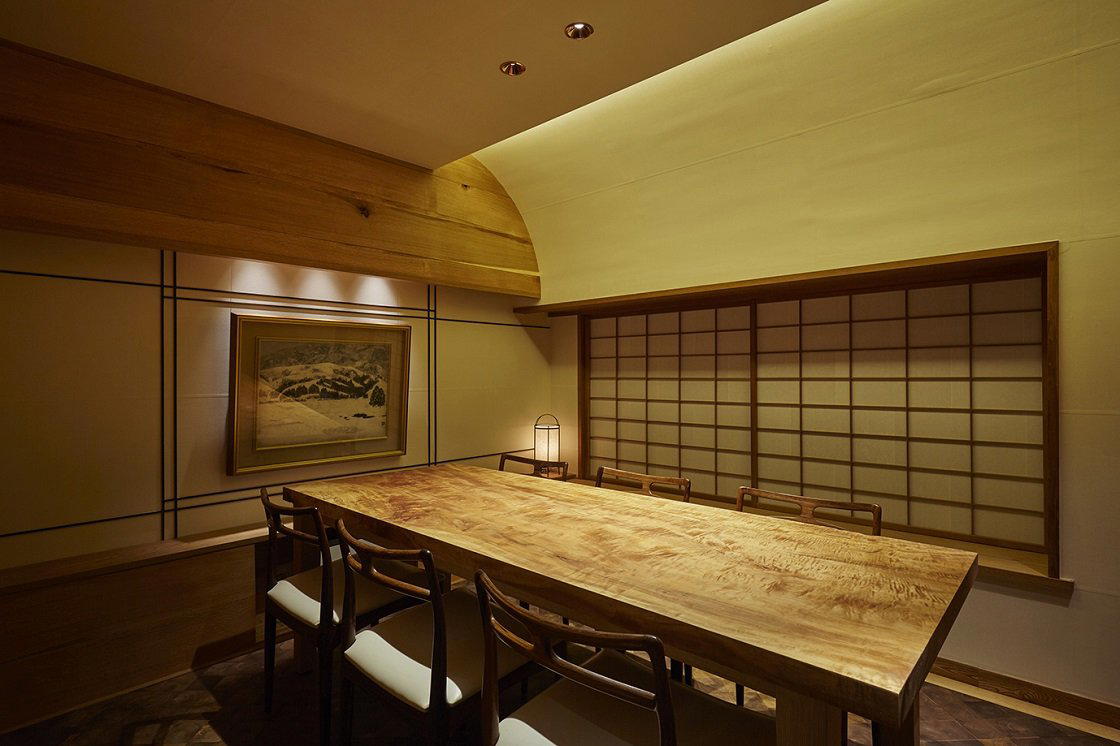
Where Yakitori Meets Kaiseki Discipline
Japan's yakitori tradition sits at an interesting crossroads. In Tokyo, the category has long operated on volume and speed, izakaya counters, smoke-filled basements, rapid-fire skewers eaten standing or perched on low stools. Kyoto pushed the format in a quieter, more composed direction, where provenance and presentation matter as much as the grill itself. Osaka, positioned between those two poles, has developed a third register: a more personal, craft-first interpretation that borrows from the city's deep kaiseki heritage without abandoning the directness that defines Kansai cooking. Torisho Ishii, in the Nishitenma neighbourhood of Kita Ward, sits squarely in that Osaka mode.
The room is ten counter seats arranged around a lacquer-tray service format more typically associated with kappo dining than a chicken grill house. That framing is deliberate. The kaiseki influence here is not decorative, it shapes the structure of the meal, the sourcing logic, and the restraint with which seasoning is applied. Salt appears with economy; a light dipping sauce does the work of amplifying the chicken's native character rather than overwriting it. The name Torisho translates loosely as 'chicken artisan', and the kitchen earns that designation through the specificity of its ingredient choices as much as its technique.
Takasaka Chicken and the Logic of Single-Source Protein
The decision to anchor an entire omakase around a named chicken breed is more pointed than it might appear. Premium yakitori restaurants across Japan have moved toward breed-specific sourcing as a way of differentiating within a format that, at the entry level, is defined almost entirely by technique. Takasaka chicken, raised in Japan with attention to texture and fat distribution, delivers the kind of tenderness and depth of flavour that holds up across multiple preparations without requiring heavy seasoning to carry each skewer. That ingredient fidelity is the editorial argument the kitchen is making with every course.
Omakase course is priced at ¥16,500 (tax included), with an optional add-on of Takasaka chicken sashimi at ¥3,500 (reservation required). That sashimi addition is worth noting: raw chicken service remains a regulated and specialist practice in Japan, and its presence here signals a kitchen operating with a level of certification and confidence that goes well beyond the standard yakitori counter. For comparison, Osaka's ¥¥¥¥ restaurants, Hajime, La Cime, Fujiya 1935, operate in the ¥30,000-plus register. Torisho Ishii, at three stars on the price scale (¥¥¥), sits in the tier that also includes kaiseki counters like Kashiwaya Osaka Senriyama and Taian, which gives some sense of where the kitchen positions itself within the wider Osaka dining hierarchy.
The Osaka Yakitori Scene in Context
Yakitori in Osaka does not have the same volume of high-recognition counters as Tokyo, where specialist grill restaurants have accumulated Michelin stars and 50 Best adjacency with some regularity. The Kansai yakitori scene is smaller, more distributed, and more integrated into the city's broader izakaya and informal dining culture. That makes the sustained recognition attached to Torisho Ishii more pointed: a Michelin star (2024) and consecutive Tabelog Silver Awards from 2022 through 2026, alongside five consecutive selections for the Tabelog Yakitori WEST 100, place it in a short list of grilled chicken counters in western Japan that have broken through into the same critical tier as the city's kaiseki and French restaurants.
For readers building an Osaka itinerary around serious cooking, the comparable set extends across formats. Ichimatsu, Ayamuya, Kitashinchi Shien, and Ishii each represent distinct points on the Osaka dining compass. Yakitori Torisen offers a useful comparison within the yakitori category itself. The picture that emerges is a city whose premium dining scene is more varied at the mid-¥¥¥ level than its reputation as a street-food capital suggests.
Across Japan, the yakitori format has divided into two recognisable camps over the past decade. Counters like Yakitori Omino in Tokyo operate with the high-tempo, high-volume energy that the Tokyo tradition prizes. At the other end, counters like Torisaki in Kyoto draw on Kyoto's preference for quieter service and seasonal ingredient framing. The restaurant's approach, kappo aesthetics, kaiseki construction logic, and Kansai directness, is Osaka's own synthesis of those poles. The restaurant's.
Nishitenma and the Business District Dinner Circuit
Nishitenma is a Kita Ward neighbourhood bordered to the south by the Nakanoshima island district and to the north by the dense bar and restaurant streets of Kitashinchi. It functions as a transitional zone between Osaka's financial and legal district and its entertainment belt, which means evenings here tend toward the composed and unhurried rather than the convivial chaos of Dotonbori or Namba. A restaurant operating as a 'house restaurant', the venue's own classification, fits that context well. The ten-seat counter, the two fixed seatings, and the omakase-only format collectively signal that the experience is structured around the kitchen's timing rather than the diner's flexibility.
Transport access is practical: a five-minute walk from Keihan Naniwabashi Station, ten minutes from Subway Keihan Kitahama Station, and approximately fifteen minutes from Subway Namboku-Morimachi Station.
For readers moving between cities, the wider Kansai and western Japan circuit includes Gion Sasaki in Kyoto, akordu in Nara, and Goh in Fukuoka. Further afield, Harutaka in Tokyo, 1000 in Yokohama, and 6 in Okinawa represent comparable ambition across different formats and geographies.
Planning Your Visit
Recognition Snapshot
Comparable venues nearby, for context on price, style, and recognition.
| Venue | Cuisine | Price | Awards | Notes |
|---|---|---|---|---|
| Torisho IshiiThis venue — the venue you are viewing | Michelin-Starred Yakitori Omakase | $$$ | Michelin 1 Star | Not listed |
| Terada | Modern Kaiseki | $$$ | Michelin 1 Star | Tennōji |
| Yunagibashi Takoyasu | Traditional Fugu (Pufferfish) | $$$ | Michelin 1 Star | Minato |
| Ono | Awaji Island Kaiseki | $$$$ | Michelin 1 Star | Kita |
| Shinchi Yamamoto | Modern Japanese Kaiseki Omakase | $$$$ | Michelin 1 Star | Kita |
| Matsuzushi | Edomae Sushi Omakase | $$$$ | Michelin 1 Star | Abeno |
Recognition history
Dated appearances from independent guides and award organizations, with the underlying list record or original source where available.
Michelin 1 Star
Michelin
Opinionated About Dining Top Restaurants in Japan Ranked #118
Opinionated About Dining
Tabelog Bronze #476
Tabelog
Tabelog Silver #147
Tabelog
Opinionated About Dining Top Restaurants in Japan Ranked #169
Opinionated About Dining
Tabelog Bronze
Tabelog
Tabelog 100 #76 · No. 76
Tabelog · Tabelog 100 - Yakitori - WEST - 2025
Tabelog 100 #91 · No. 91
Tabelog · Tabelog 100 - Yakitori - EAST - 2025
Tabelog Silver
Tabelog
Michelin 1 Star
Michelin
Michelin Bib Gourmand
Michelin
Opinionated About Dining Top Restaurants in Japan Ranked #251
Opinionated About Dining
Opinionated About Dining Top Restaurants in Japan Highly Recommended
Opinionated About Dining
Continue exploring
More in Osaka
Restaurants in Osaka
Browse all →




Bars in Osaka
Browse all →




Hotels in Osaka
Browse all →




Wineries in Osaka
Browse all →
At a Glance
- Intimate
- Elegant
- Sophisticated
- Cozy
- Special Occasion
- Date Night
- Solo
- Chefs Counter
- Open Kitchen
- Sake Program
- Local Sourcing
Current opening hours
- Monday
- 6–11 PM
- Tuesday
- 6–11 PM
- Wednesday
- 6–11 PM
- Thursday
- 6–11 PM
- Friday
- 6–11 PM
- Saturday
- 6–11 PM
- Sunday
- 6–11 PM
Hours can change for holidays and private events. Last verified .
Calm, relaxing wooden counter atmosphere with focus on the grilling process and charcoal scents.