Alma Gaucha
Our verdict
Alma Gaucha brings the Brazilian churrascaria tradition to Boston's Seaport district at 401 D Street, where the format centers on meat carved tableside from long skewers in the gaucho style. The wine program draws from South American and international producers, making it a reference point for Argentine and Brazilian bottles in the city. It occupies a distinct niche in Boston's steakhouse and grill category.

Pearl is the En Primeur Club membership app — saves, bookings, and concierge access live there. Same editors, same standards.
- Address
- 401 D St, Boston, MA 02210
- Phone
- (617) 420-4900
- Hours
- Mon–Thu 11:30 AM–10 PMFri–Sat 11:30 AM–10:30 PMSun 11:30 AM–9 PM
- Website
- almagauchausa.com
- Directions
- Get directions
- Booking
- Book on OpenTable
The Churrascaria Format in an American City
Boston's dining scene has long leaned toward seafood and New England tradition, which makes the Brazilian churrascaria format something of a structural outlier in the city's restaurant map. The rodízio model, in which servers circulate the room carrying skewers of wood-fire-grilled meats and carve portions tableside until a guest signals otherwise, originates in the gaucho culture of Rio Grande do Sul in southern Brazil. It is a format built around abundance and rhythm rather than a fixed menu, and it sits in a different category from the conventional American steakhouse, where protein arrives plated and pre-portioned. For a broader read on how Boston restaurants divide across formats and price tiers, our full Boston restaurants guide maps the city's dining structure in detail.
Alma Gaucha, located at 401 D Street in the Seaport district, operates inside this churrascaria tradition. The address places it in a neighborhood that has shifted dramatically over the past decade, moving from light industrial to a dense cluster of hotels, convention space, and restaurants that range from casual to table-service formal. The Seaport's dining cohort now includes venues pressing into the upper-middle and fine-dining tiers, which means Alma Gaucha competes not just against other Brazilian operations in the region but against the broader category of event-capable, meat-forward full-service restaurants.
The Room and the Ritual
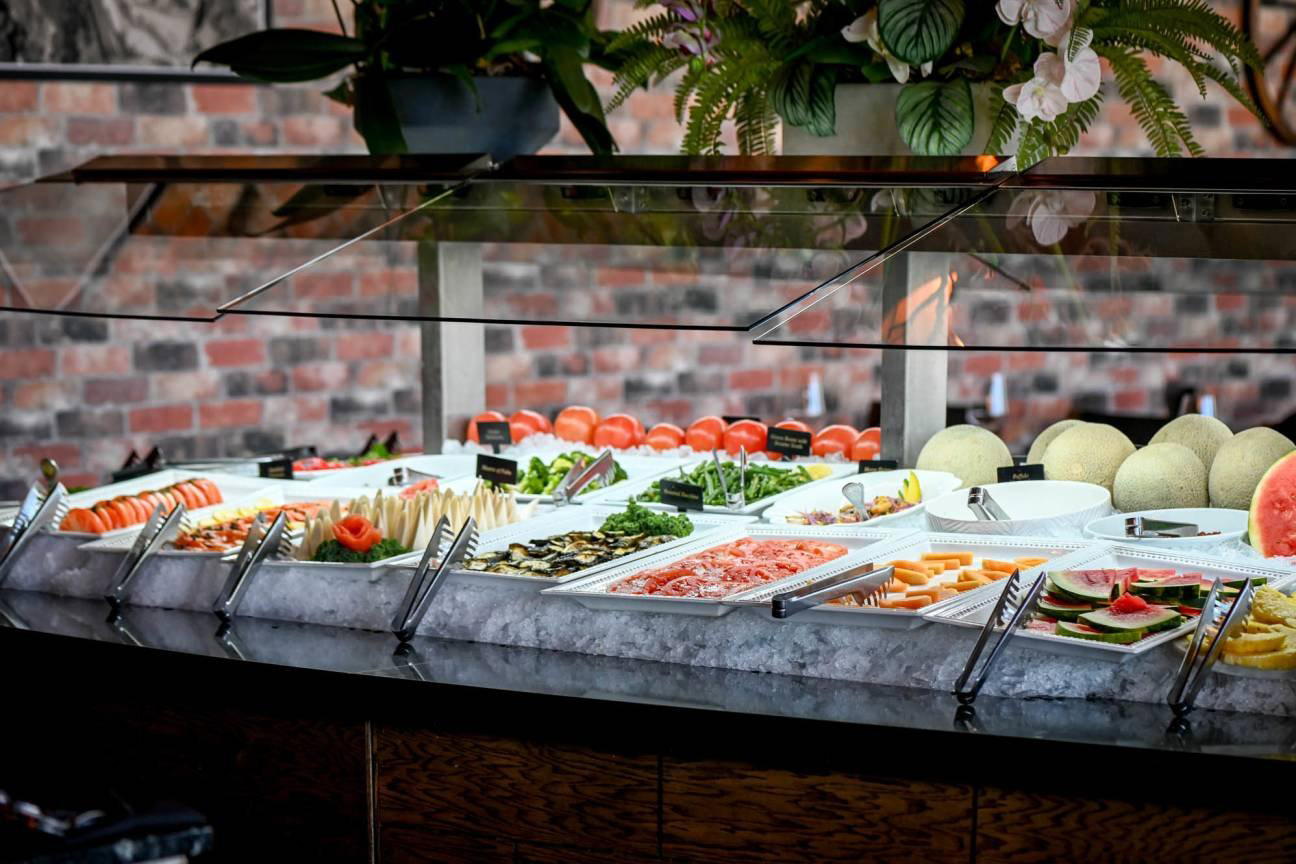
The physical experience of a rodízio restaurant is inseparable from its format. The room must accommodate the constant movement of passadores, the servers who carry the skewers, which means generous aisle widths, tables spaced for circulation, and a dining floor designed as a working environment rather than a backdrop. The salad and sides station, a standard fixture in the format, functions as a buffet of cold preparations, grains, and vegetables that a diner builds before the meat service begins. This sequencing is deliberate: the sides course sets pace, and the meat service continues until the guest is finished.
At Alma Gaucha, the Seaport location brings a room with the scale this format requires. The neighborhood itself carries a corporate and event-night character that suits the churrascaria model, which handles large parties and celebratory occasions more naturally than most tasting-menu or à la carte formats. Where venues like 311 Omakase or Agosto operate at low capacity with a defined counter-seat experience, the churrascaria model scales in the opposite direction, and that distinction shapes everything from the noise level to the booking logic.
The Wine Program: South American Bottles in a Northern City
The editorial angle worth spending time on at Alma Gaucha is the wine list, and specifically what it represents in a city where South American producers have historically received limited shelf space on restaurant lists. Argentine Malbec and Torrontés, Brazilian Serra Gaúcha sparkling wine, Uruguayan Tannat, and Chilean Carménère are categories that rarely appear with any depth at Boston tables. The churrascaria format, which is structurally built around red meat and communal dining, creates genuine demand for wine by the bottle rather than by the glass, which in turn justifies a wine program with some lateral range.
This is the point at which a wine-forward Brazilian restaurant can distinguish itself from the standard American steakhouse model. Operations like Abe and Louie's build their lists around Napa Cabernet and Bordeaux, which is the default grammar of the American steakhouse cellar. A churrascaria that takes its wine program seriously has the opportunity to build a different vocabulary, one anchored in the Mendoza and Patagonia regions for Argentine production, the Colchagua and Maipo valleys for Chile, and the Serra Gaúcha and Campanha Gaúcha regions for Brazilian bottles. Whether Alma Gaucha's list reaches that depth is a question of curatorial intent, but the format creates the structural argument for doing so.
Globally, the restaurants where wine programs have become as much of the conversation as the food tend to share one characteristic: the cellar is edited with a point of view rather than assembled to cover standard expectations. At venues like The French Laundry in Napa or Blue Hill at Stone Barns in Tarrytown, the wine program signals a deliberate curatorial stance that aligns with the kitchen's sourcing philosophy. The opportunity for a South American grill house is analogous: to use the cellar to say something about where the food comes from and what tradition it belongs to.
Positioning Within Boston's Meat-Forward Category
Boston's steakhouse and grill category is populated at multiple price points and formats. The conventional white-tablecloth American steakhouse, where a bone-in ribeye arrives on a plate with optional sides, represents one tier. The churrascaria occupies a parallel tier where the pricing model, typically a fixed per-person rate for the full meat service, reads as comparable in total spend but different in structure. Where 75 on Liberty Wharf and 1928 Rowes Wharf both operate with waterfront positioning and broad menu formats, Alma Gaucha's 401 D Street location and rodízio format place it in a different use-case category: group dining, celebration occasions, and guests who want meat-led abundance rather than a single precision-portioned main.
The Seaport's convention and hotel density also means that Alma Gaucha draws from a traveler and business-dinner pool that is structurally different from the neighborhood restaurant audience. This is not a criticism; it is a market reality that shapes what the venue needs to deliver. Execution consistency across large covers, a wine list that can support a two-hour table, and staff who can run the passador circuit without service gaps are the operational requirements the format demands.
Planning Your Visit
Alma Gaucha is located at 401 D Street in Boston's Seaport district, accessible by the Silver Line SL2 at Courthouse station or by rideshare from downtown. The rodízio format works well when approached without time pressure: the meat service is designed to run through multiple circuits, and guests who arrive for a fixed window miss the rhythm of the format. The wine list is the natural starting point for structuring the meal; selecting a bottle before the meat service begins, rather than after, allows the pairing to develop across the full sequence of proteins rather than arriving mid-meal as an afterthought.
Frequently asked questions
Is Alma Gaucha suitable for children?
The rodízio format at Alma Gaucha can work well for families with older children who eat heartily — the continuous tableside carving keeps the meal active and engaging. Younger children may find the pacing and portion logic harder to follow. The Seaport location at 401 D Street is accessible and not a cramped dining room, which helps with larger groups.
What's the vibe at Alma Gaucha?
Alma Gaucha runs on the churrascaria rhythm: passadores circulate the room continuously, the energy stays high, and the format itself drives the pace rather than a traditional course sequence. It sits in Boston's Seaport district, which draws a mix of after-work groups, hotel guests, and event-adjacent diners. Expect a lively, communal atmosphere rather than a quiet, white-tablecloth setting.
How does Alma Gaucha's churrascaria format differ from a conventional Boston steakhouse?
Where a traditional Boston steakhouse delivers individual cuts to order at fixed prices, Alma Gaucha operates on the Brazilian rodízio model: a set price covers continuous tableside service of multiple grilled meats carved by passadores. The South American wine program also distinguishes it within Boston's meat-forward dining category, where Argentine and Brazilian bottles are rarely the focus. The restaurant is located at 401 D Street in the Seaport, separating it geographically from the Financial District steakhouse cluster.
What should I order at Alma Gaucha?
At a rodízio restaurant like Alma Gaucha, the structure is the order — the all-you-can-eat format means passadores bring rotating cuts of grilled meat tableside until you signal otherwise. The editorial case for Alma Gaucha specifically involves its South American wine list, which offers bottles less commonly seen in Boston's generally European-leaning wine programs. Prioritize exploring that list alongside the meat service.
Comparable Spots, Quickly
Comparable venues nearby, for context on price, style, and recognition.
| Venue | Cuisine | Price | Awards | Notes |
|---|---|---|---|---|
| Alma GauchaThis venue — the venue you are viewing | Authentic Brazilian Steakhouse Rodízio | $50–100 | Not listed | Not listed |
| Nautilus Pier 4 | Global Seafood Fusion with Asian & Spanish Influences | $50–100 | Wine Spectator Best of Award of Excellence | Inner Harbor |
| No.9 Park | Regionally-inspired French-Italian Fine Dining | Not listed | Not listed | Downtown |
| Legal Harborside | New England Seafood | $50–100 | Not listed | Inner Harbor |
| Limani Grille Seaport | Upscale Greek Mediterranean | $50–100 | Not listed | Inner Harbor |
| Common Craft | Modern American Gastropub | Not listed | Star Wine List | South Boston |
Continue exploring
More in Boston
Restaurants in Boston
Browse all →
Bars in Boston
Browse all →
Hotels in Boston
Browse all →
Wineries in Boston
Browse all →
Details
- Lively
- Elegant
- Energetic
- Date Night
- Business Dinner
- Celebration
- Group Dining
- Open Kitchen
- Extensive Wine List
- A La Carte
- Buffet
Current opening hours
- Monday
- 11:30 AM–10 PM
- Tuesday
- 11:30 AM–10 PM
- Wednesday
- 11:30 AM–10 PM
- Thursday
- 11:30 AM–10 PM
- Friday
- 11:30 AM–10:30 PM
- Saturday
- 11:30 AM–10:30 PM
- Sunday
- 11:30 AM–9 PM
Hours can change for holidays and private events. Last verified .
Lively and festive atmosphere with the excitement of gaucho servers circulating hot meat skewers, paired with elegant dining spaces in a modern hotel setting.