

1 Michelin Star · Tabelog Bronze #15
Our verdict
Alarde has held Tabelog Bronze recognition in 2021, 2025, and 2026, and appears in the Tabelog Spanish Cuisine Top 100 for 2024, positioning it as one of Osaka's most consistently rated Spanish restaurants. The 14-seat room in Nishi Ward focuses on Spanish Basque cooking, with wagyu cooked over charcoal, firewood, and grapevines as the centrepiece. Dinner runs JPY 20,000–29,999 and the kitchen operates on reservations only.

Pearl is the En Primeur Club membership app, where members save venues, book tables and use the concierge.
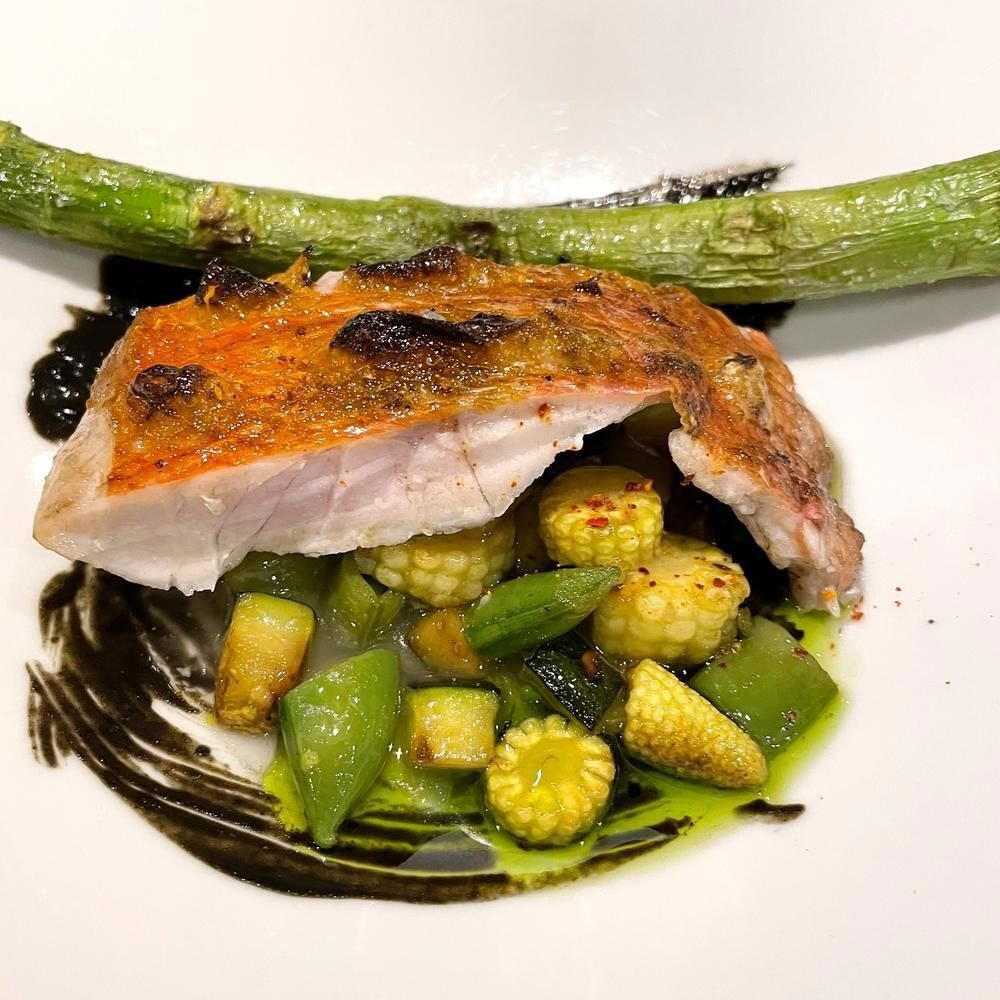
The menu
What to order
- Foie gras bonbon with hazelnut chocolate
- Miyazaki black beef rib roast
- Basque cheesecake
- Pintxos
- Paella with bamboo shoots and firefly squid
Where Basque Fire Meets Osaka's Dining Discipline
The Nishi Ward address is not where most visitors to Osaka think to look for their most interesting meal. The neighbourhood around Awaza sits west of the Honmachi business corridor, quiet enough that the restaurant operates without the ambient noise of a tourist-dense street. That deliberate remove is part of what Alarde's regulars seem to value: a room of 14 seats, a counter running eight of them, and a kitchen approach drawn from Spanish Basque tradition rather than from the dominant kaiseki or French fine-dining codes that govern much of Osaka's award-table conversation.
Opened in February 2016, Alarde has spent nearly a decade building a track record that Tabelog's review community has now codified three separate times. The restaurant received Tabelog Bronze Awards in 2021, 2025, and 2026, and was selected for the Tabelog Spanish Cuisine Top 100 in 2024. A Tabelog score of 4.00 places it in a tier where peer competition across all categories is severe, and within the narrow Spanish cuisine field in Japan, that consistency carries proportionally more weight. Tabelog's scoring system compresses quickly above 3.80; reaching 4.00 and maintaining it across multiple award cycles is a signal worth taking seriously.
The Basque Argument in a Japanese Context
Spanish Basque cooking occupies an interesting position inside Japan's broader European-restaurant scene. Osaka supports world-class French programs at venues like HAJIME (three Michelin stars) and La Cime (two Michelin stars), and its Japanese fine-dining tier runs deep, from Taian to Kashiwaya. Within that context, committed Basque cooking is a narrower discipline, one that carries a different set of priorities: the primacy of fire and smoke, the centrality of good produce treated with restraint, and a social architecture built around the bar counter and pinchos rather than the tasting-menu procession.
Alarde's premise, as Tabelog's editorial description frames it, is Basque cuisine expressed through Japanese ingredients. The structural centrepiece is wagyu beef cooked in a stone oven, the heat built from charcoal and firewood before grapevines are added to layer aromatic smoke into the cooking environment. That technique is not a novelty addition; it reflects how wood-fire cooking functions in Basque tradition, where the choice of fuel is part of the flavour argument. Using grapevines in particular connects to a long Basque and broader Iberian practice of burning pruned vine cuttings for their aromatic properties during grilling. Applying that logic to wagyu is a genuine translation exercise, not a fusion shortcut.
Pinchos and mixed rice serve as the counter program while the beef cooks, a pacing decision that reflects Basque bar culture more than the linear flow of a kaiseki progression. For visitors who know the pintxos culture of San Sebastián or Bilbao, that rhythm will read as intentional. For those coming from Osaka's kaiseki context, it presents a different hospitality logic, one where the bar and its small bites are part of the experience rather than a preliminary formality. Comparable Basque-influenced programs operating elsewhere in Japan include akordu in Nara, which offers another reference point for how Spanish cooking adapts to Japanese ingredient sourcing and dining culture.
What the Award Record Tells You
Three Tabelog Bronze awards across different years, paired with Top 100 selection in a specific cuisine category, represents a different kind of credibility than a single high-profile citation. It suggests a kitchen that has maintained its standard over time rather than peaking once for a panel. The gap between the 2021 award and the 2025–2026 consecutive recognitions implies Alarde was producing consistent results across a period that included the disruption of the early 2020s, when many restaurants reset their format or closed entirely.
The price positioning reinforces where this sits in the market. Dinner averages JPY 20,000–29,999 per person (with a 10% service charge included in the course fee), placing Alarde in a tier below Osaka's three-Michelin-star French rooms but above the mid-range Spanish bistro category. That bracket is inhabited by restaurants taking their cooking seriously without the infrastructure cost of a larger luxury operation. It is also where Tabelog's scoring tends to be most competitive, since the review pool is wider and less dominated by occasion-driven dining.
Across Japan, the Basque-influenced dining tier operates at a similar premium in other cities. Harutaka in Tokyo and Gion Sasaki in Kyoto represent the kind of single-minded culinary commitment, in different traditions, that earns sustained recognition in Japan's hyper-competitive review environment. Alarde's record places it in that company of focused, non-trend-chasing kitchens. Further afield, programs like Goh in Fukuoka, 1000 in Yokohama, and 6 in Okinawa illustrate how Japan's regional restaurant culture has developed pockets of deep, category-specific expertise outside the Tokyo-Kyoto axis. For European-trained comparison, the kind of rigorous French technique that informs how Spanish cuisine is read by Japanese critics also shapes acclaimed restaurants internationally; Le Bernardin in New York City and Atomix in New York City offer points of reference for how non-Japanese cuisines earn sustained prestige in demanding urban markets.
Planning a Visit
The room seats 14 across an eight-seat counter and a six-seat table section, with a semi-private area at the back accommodating up to seven guests. Private use of the full space is available for parties of up to 20. Reservations are mandatory, and the restaurant's own notes make clear that individual reservations are currently limited; the kitchen primarily accommodates groups from around 18:30. Friday service starts at 19:00 rather than the standard 18:30 opening. The restaurant closes on Sundays and public holidays. Reaching the restaurant by subway is direct: Honmachi Station (Yotsubashi Line, Exit 23) is a three-minute walk west, and Awaza Station (Chuo Line, Exit 2) is an eight-minute walk east. The restaurant recommends a taxi from Osaka Station as a faster alternative to the Midosuji Line connection. Major credit cards are accepted (Visa, Mastercard, JCB, Amex, Diners); electronic money and QR code payments are not.
A children's plate is available at JPY 2,500 on weekdays, with smaller portion options on request by phone reservation. The dress code asks only that guests avoid tank tops and flip-flops, and specifically requests that visitors forgo strong fragrances, as the kitchen's use of aromatic smoke is a deliberate element of the experience. Phone contact during service hours (18:00–22:00) can be difficult; direct messages via Instagram are a noted alternative for inquiries.
For broader planning around Osaka's dining and hospitality options, EP Club's full guides cover the city's restaurant, hotel, bar, and experience offerings: Osaka restaurants, Osaka hotels, Osaka bars, Osaka wineries, and Osaka experiences. For those building a broader Kansai itinerary, Fujiya 1935 represents another Osaka restaurant with a sustained award record and a similarly focused culinary argument.
Frequently asked questions
What's the address for Alarde?
Alarde is located at 1 Chome-14-4 Awaza, Nishi Ward, Osaka, 550-0011, Japan, Osaka.
What are Alarde's hours?
Hours at Alarde: Mon, Tue, Wed, Thu, Fri, Sat, Day before public holiday, Day after public holiday 18:30 - 22:30.
Does Alarde have a Michelin star or similar recognition?
Alarde has received recognition including:
What's the signature dish at Alarde?
The stone-oven wagyu is the centrepiece: beef cooked over charcoal and firewood, with grapevines added to layer in a smoky aromatic finish. It is the dish Tabelog's editorial description singles out as representative of what Alarde does differently from other European restaurants in Osaka.
What's the defining dish or idea at Alarde?
The kitchen's stated premise is Basque recipes studied in Spain, applied to Japanese ingredients. That means the grapevine-smoked wagyu functions as both a technical argument and a philosophical one, it is the point where two culinary traditions are made to occupy the same fire. Pinchos and mixed rice serve as the supporting acts while the main course cooks.
Can Alarde handle vegetarian requests?
Alarde's documented concept centres on Basque cooking with wagyu beef as the kitchen's primary focus, making the menu inherently meat-forward. The restaurant offers a children's plate at JPY 2,500 and smaller portions on request for weekday reservations, but there is no published vegetarian course option. check the venue's official channels before booking if dietary restrictions apply.
Fast Comparison
Comparable venues nearby, for context on price, style, and recognition.
| Venue | Cuisine | Price | Awards | Notes |
|---|---|---|---|---|
| AlardeThis venue (the venue you are viewing) | Modern Basque Cuisine | $150–200 | 1 Michelin Star · Tabelog Bronze #15 | Not listed |
| Ñ | Modern Spanish Fine Dining | $150–200 | 1 Michelin Star · Tabelog Bronze | Kita |
| Ajikitcho Horieten | Traditional Kaiseki | $150–200 | 1 Michelin Star | Nishi |
| Konoha | Traditional Tempura Kaiseki | $150–200 | 1 Michelin Star | Chūō |
| Sushi Murakami Jiro | Michelin 1-Star Omakase Sushi | $300–500 | 1 Michelin Star · Tabelog Bronze #294 | Kita |
| a canto | Modern Italian Tasting Menu | $150–200 | 1 Michelin Star · Tabelog 100 #51 | Chūō |
Recognition history
Dated appearances from independent guides and award organizations, with the underlying list record or original source where available.
Michelin 1 Star
Michelin
Tabelog Bronze #15
Tabelog
Full recognition history (3 entries)
Tabelog 100 #94 · No. 94
Tabelog · Tabelog 100 - Spanish cuisine - 2026
Continue exploring
More in Osaka
Restaurants in Osaka
All restaurants in Osaka →



Bars in Osaka
All bars in Osaka →

Hotels in Osaka
All hotels in Osaka →




Wineries in Osaka
Browse all →
Details
- Intimate
- Elegant
- Sophisticated
- Date Night
- Celebration
- Special Occasion
- Open Kitchen
- Chefs Counter
- Extensive Wine List
- Sommelier Led
- Local Sourcing
- Tasting Menu
- Counter Dining
- Spanish Wine
- Basque Beer
- Rioja Wine
Current opening hours
- Monday
- 6:30–11 PM
- Tuesday
- 6:30–11 PM
- Wednesday
- 6:30–11 PM
- Thursday
- 6:30–11 PM
- Friday
- 6:30–11 PM
- Saturday
- 6:30–11 PM
- Sunday
- Closed
Hours can change for holidays and private events. Hours as of .
Warm, welcoming interior with open kitchen counter and intimate seating; wooden finishes create a cozy yet refined atmosphere where guests can watch the chef work.