
Tabelog 100 #40
Our verdict
Acala naatha brings Sri Lankan curry into Tokyo’s compact neighbourhood dining culture, with Nakano giving it a less ceremonial frame than central tasting-menu districts. Its Tabelog Asian cuisine and Ethnic cuisine TOKYO 100 selections in 2022, 2023, and 2024 place it among the city’s better documented non-Japanese specialist rooms, where spice work, rice, curry, and bar-adjacent drinking culture share the same small footprint.

Pearl is the En Primeur Club membership app, where members save venues, book tables and use the concierge.
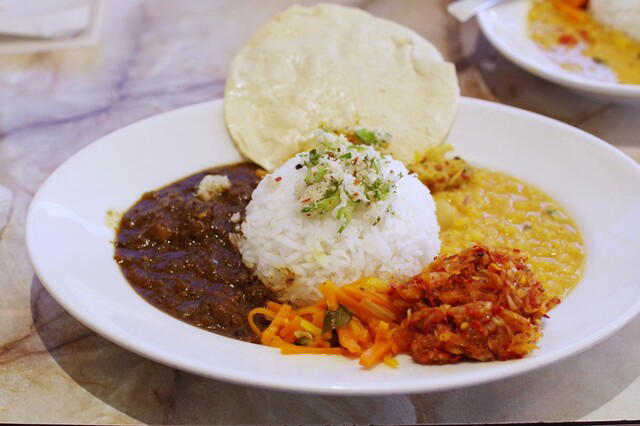
Once Nakano station traffic thins, department-store brightness gives way to smaller buildings, upper-floor signs, and Tokyo’s rhythm of restaurants reached by stairs rather than street theatre. Here, Sri Lankan curry reads less as spectacle than compression: rice, curry, spice, alcohol, and the casual grammar of a dining bar folded into a room shaped by Tokyo’s small-tenant food culture and the island traditions behind the cooking.
That intersection matters. Tokyo has long absorbed foreign foodways through specialist formats: ramen shops with regional obsessions, curry counters split into Japanese, South Asian, and hybrid branches, and compact bars where drinks are part of the meal. Acala naatha fits that pattern. Its public classification, Sri Lankan, curry, dining bar, says more than cuisine label: imported technique and spice logic meet Japanese expectations around pace, portion, and repeat neighbourhood use.
Sri Lankan curry in Tokyo's small-room grammar
Sri Lankan cooking brings a different curry architecture from the thick, sweet-leaning Japanese curry many travellers meet first. Its structure often depends on contrast: rice at the centre, multiple preparations around it, layered heat, and acidity, coconut, or bitterness to keep richness from turning heavy. Tokyo’s specialist curry scene has made room for that precision, especially in neighbourhoods where small operators can build regulars without Ginza-level theatre.
Acala naatha does not treat Sri Lankan food as imported novelty. In Nakano, the category feels lived-in: closer to routine than rarefied destination meal. Here, spice systems from outside Japan are handled inside a Japanese urban dining format that prizes compactness, punctual service windows, and clear category identity. In a city where curry ranges from office-lunch katsu plates to long-queued spice counters, this room sits at the specialist end.
The Tabelog Asian cuisine and Ethnic cuisine TOKYO 100 selections in 2022, 2023, and 2024 provide a useful external marker. Tabelog’s Hyakumeiten lists are not Michelin stars, but in Japan they matter differently: they reflect sustained local attention within a defined category. For an ethnic-cuisine specialist outside the central luxury corridors, repeated inclusion signals that diners read the room against peer venues, not merely as neighbourhood convenience.
Why Nakano suits this kind of specialist curry
Nakano is a useful lens for Tokyo dining beyond the familiar luxury map. It supports restaurants that can be serious without dressing in occasion language, with rail access, steady local demand, and enough after-work traffic for small formats that might feel too narrow in a hotel district. That explains why a Sri Lankan curry and dining-bar hybrid works here: the food can be specific while the usage stays flexible.
Tokyo’s premium dining conversation often overweights reservation-only counters and long tasting menus. Much of the city’s range, though, sits in rooms where specialization replaces ceremony. A ramen shop such as Kagari, a meat-focused room such as Horumon Jinsei Taro Chan, or a compact Japanese restaurant such as Oka Joki may not share a cuisine lane, but they show the same urban principle: tightly defined formats create identity faster than broad menus. Acala naatha belongs to that habit, with Sri Lankan curry as the spine.
For a broader food itinerary, the contrast is useful. A Tokyo day can move from curry to yakitori, coffee, or a drinking-led dinner without changing the urban scale. EP Club’s city pages help frame that range: start with Our full Tokyo restaurants guide, then cross-check hotel geography through Our full Tokyo hotels guide and later-evening planning through Our full Tokyo bars guide. For a wider Japan and Pacific food map, useful adjacent references include 3 Chome no Curry Ya San, [Curry Senmon Ten] Maruyama Kyoju. in Sapporo, (Shoku) Vietnam in Kawasaki, and [ki:] in Kyoto.
How to read the experience against Tokyo's wider table culture
The dining-bar tag matters. In Tokyo, it often softens the border between meal and drink without making the kitchen an accessory. Curry suits that especially well: spice, rice, and alcohol create a rhythm distinct from course-by-course dining. The attention is less formal; diners are not asked to decode a chef’s biography or submit to a long menu arc, but to see how a specific cuisine adapts to Tokyo’s compact social rooms.
That makes Acala naatha a sharp counterpoint to common visitor assumptions. Sushi counters and kaiseki rooms remain central to Tokyo’s reputation, but the capital’s depth also depends on imported cuisines practiced with local discipline. Sri Lankan curry here is not a side note to Japanese dining; it belongs to the same ecosystem of narrow specialization, repeat custom, and category fluency. The lack of grand format is part of the argument.
Build the rest of the itinerary by contrast rather than similarity. For Japanese grilled and casual formats, compare with 124. KAGURAZAKA (Yakitori). 鮪と炭火焼き うお炭 秋葉原店, and 12/10 Shinjuku ten. For lighter daytime or visual-culture stops, 2D Cafe sits in another lane. Further afield, -Grilled beef Sukiyaki- KAMAKURA TANUKIAN 鎌倉 たぬき庵 in Kamakura.cafe in Osaka.know in Kumamoto, Jōdo Saké Bar in Los Angeles, and Onigiri Time in Pasadena show how Japanese and Asian food categories travel across cities. For non-restaurant planning around the same trip, keep Our full Tokyo wineries guide and Our full Tokyo experiences guide in the research loop.
The editorial read is simple: Acala naatha shows Tokyo dining at a scale where global cuisine is not flattened into hotel internationalism. It is a small specialist room in a repeat-use neighbourhood, backed by repeated Tabelog 100 recognition in its category. For travellers who know the city through sushi, tempura, and ramen, this is another proof of Tokyo’s seriousness: not luxury, not ceremony, but curry treated as precise urban craft.
Frequently asked questions
How do I find Acala naatha?
Acala naatha is located in Tokyo.
When is Acala naatha open?
Hours at Acala naatha: Mon: 11:30 AM–2:30 PM, 6–8 PM; Tue: Closed; Wed: Closed; Thu: 11:30 AM–2:30 PM, 6–8 PM; Fri: 11:30 AM–2:30 PM, 6–8 PM; Sat: 11:30 AM–2:30 PM, 6–8 PM; Sun: 11:30 AM–2:30 PM, 6–8 PM.
How much does it cost to eat at Acala naatha?
Pricing at Acala naatha is listed as JPY 3,000 - JPY 3,999 - JPY 999.
What do critics highlight about Acala naatha?
Critics single out Acala naatha’s place in Tabelog 100 for Asian cuisine / ethnic cuisine in Tokyo, selected in 2024 after repeated inclusion in 2023 and 2022. The detail that matters is the format: 8 seats, Sri Lankan and curry categories, and a dining-bar setup in Nakano, where a small room changes the pace of service.
Booking and Cost Snapshot
Comparable venues to calibrate price, style, and recognition.
| Venue | Cuisine | Price | Awards | Notes |
|---|---|---|---|---|
| Acala naathaThis venue (the venue you are viewing) | Sri Lankan curry restaurant | $10–20 | Tabelog 100 #40 | Not listed |
| Pork Vindaloo Taberu Fukudaitoryo | Pork vindaloo curry shop | $10–20 | Tabelog 100 #56 | Shibuya, Pork vindaloo curry shop |
| Silk Road | Indian curry counter | $1–10 | Tabelog 100 #38 | Arakawa, Indian curry counter |
| ERICK SOUTH Yaesu ten | Authentic South Indian Curry & Meals | $10–20 | Tabelog 100 #1 | Chūō, Authentic South Indian Curry & Meals |
| Anjuna | Traditional Indian curry house | Not listed | Tabelog 100 #65 | Hino, Traditional Indian curry house |
| West India Spice Gayabaji | West Indian Curry & Marathi Cuisine | $10–20 | Tabelog 100 #41 | Taitō, West Indian Curry & Marathi Cuisine |
Recognition history
Dated appearances from independent guides and award organizations, with the underlying list record or original source where available.
Tabelog 100 #40 · No. 40
Tabelog · Tabelog 100 - Asian cuisine / Ethnic cuisine - TOKYO - 2024
Continue exploring
More in Tokyo
Restaurants in Tokyo
All restaurants in Tokyo →



Bars in Tokyo
All bars in Tokyo →







Details
- Cozy
- Casual Hangout
- Group Dining
- Solo
- After Work
- Standalone
- A La Carte
Current opening hours
- Monday
- 11:30 AM–2:30 PM, 6–8 PM
- Tuesday
- Closed
- Wednesday
- Closed
- Thursday
- 11:30 AM–2:30 PM, 6–8 PM
- Friday
- 11:30 AM–2:30 PM, 6–8 PM
- Saturday
- 11:30 AM–2:30 PM, 6–8 PM
- Sunday
- 11:30 AM–2:30 PM, 6–8 PM
Hours can change for holidays and private events. Hours as of .
Simple, casual third-floor space with a cozy, unfussy feel where guests come mainly for hearty Sri Lankan curries rather than design or decor.