

Michelin Plate
Our verdict
Inside Santiago Bernabéu's walls, 99 Sushi Bar occupies a space where Modern Spanish instinct meets Japanese technique. The kitchen, led by Chef Iván Muñoz, holds a Michelin Plate and an Opinionated About Dining ranking among Europe's top restaurants. Service runs lunch and dinner six days a week, with Sunday lunch only, book ahead for evening sittings.

Pearl is the En Primeur Club membership app, where members save venues, book tables and use the concierge.
The menu
What to order
- Scallop nigiri
- Alaskan king crab gunkan
- Toro tuna maki
Where the Stadium Ends and the Counter Begins
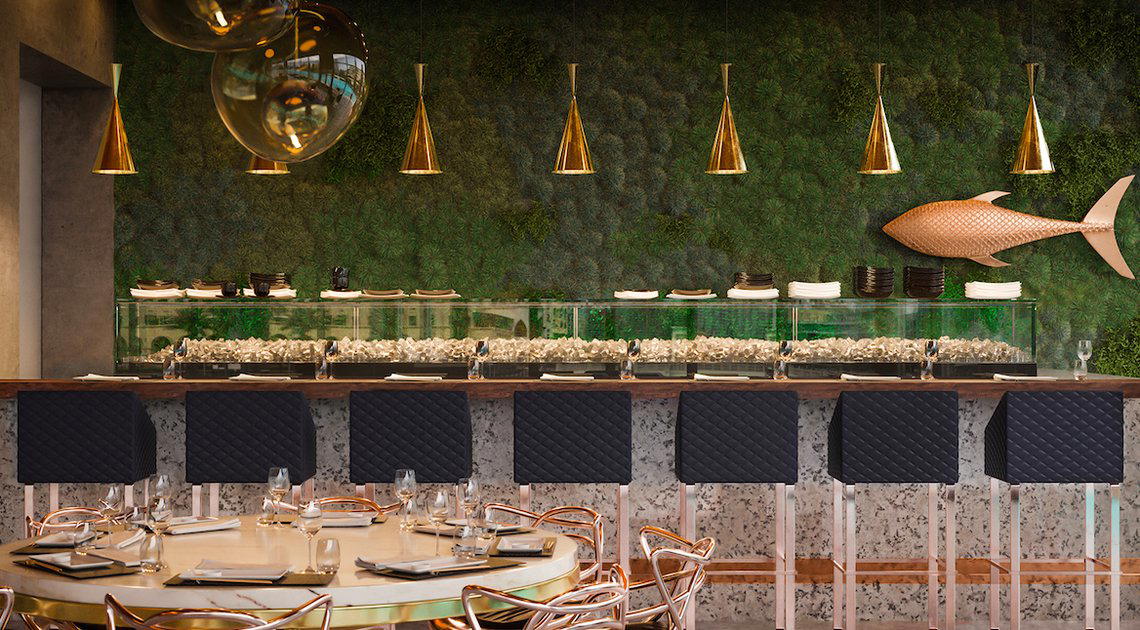
The approach to 99 Sushi Bar involves a negotiation most Madrid diners rarely make: entering Santiago Bernabéu through Gate 39, moving past the architecture of mass spectacle, and arriving at a dining room that operates on entirely different terms. The contrast is deliberate and, on non-match nights, surprisingly effective. What you encounter inside is a space defined by stillness, a cascade of water forming the backdrop behind the sushi counter, the chef working in plain view of the room, the rhythm of preparation visible from nearly every seat. In a city where Spanish kitchens are largely sealed away from their guests, this open-counter format signals the Japanese influence that runs through the menu.
The Logic of the Hybrid Counter
Madrid's Japanese restaurant scene has developed along two tracks. The first follows purist omakase and washoku traditions, with seasonal kaiseki-adjacent formats that treat sourcing and restraint as the governing principles. The second, more commercially confident track takes Japanese technique, knife work, temperature control, the structural logic of a multi-course progression, and applies it to local Spanish ingredients and palates. 99 Sushi Bar operates firmly within that second tradition. Its Michelin Plate recognition, awarded in both 2024 and 2025, and its placement on the Opinionated About Dining ranking of Europe's leading restaurants (ranked 540th in 2025, recommended among new restaurants in 2023) position it within a specific niche: accessible Japanese-inflected dining that makes fewer demands on the guest than a strict kaiseki format, while still requiring the kitchen to demonstrate genuine technical fluency.
That distinction matters when placing the restaurant against Madrid's broader high-end dining tier. At the €€€€ price point, the Spanish capital offers a dense concentration of creative tasting menus: DiverXO operates at the Michelin three-star level with a pan-Asian progressive format that deliberately destabilises expectation. Coque and Deessa each hold two Michelin stars, working within a Modern Spanish creative tradition. Paco Roncero occupies a similarly technically driven position. Against these peers, 99 Sushi Bar reads less as a competitor and more as a complement, a different register within the same price bracket, where the pleasure is in craft at the counter rather than in conceptual ambition across twenty courses.
Chef Iván Muñoz and the Kitchen's Point of View
The kitchen is led by Chef Iván Muñoz, and the approach described by Michelin's own assessors is telling: the cuisine does not follow Japanese doctrine strictly, but instead produces dishes that translate Japanese structural logic into forms that a broad audience will find readable. That is a more considered editorial position than it first appears. True kaiseki places the seasonal ingredient and its minimal transformation at the centre of each course, demanding that the diner meet the kitchen on its own aesthetic terms. The approach here inverts that slightly, the kitchen moves toward the guest, using Japanese form to frame Spanish flavour in ways that feel resolved rather than compromised. The tiger prawn tempura, specifically highlighted in Michelin's assessment, serves as an illustration: a preparation with Japanese technical roots, executed with attention to the quality of the primary ingredient.
In the broader Spanish context, this approach has strong precedents. The country's most decorated kitchens, from Arzak in San Sebastián to El Celler de Can Roca in Girona, have long absorbed global technique as raw material for distinctly Iberian output. Azurmendi in the Basque Country and Martín Berasategui in Lasarte-Oria operate on similar terms at higher Michelin levels. Aponiente and Cocina Hermanos Torres each demonstrate how Spanish kitchens absorb international forms without losing their own character. 99 Sushi Bar belongs to the same national conversation, just at a different altitude.
For international comparison, the question of how Japanese precision maps onto non-Japanese culinary cultures has produced some of the most interesting modern restaurant formats globally. Le Bernardin in New York has long used Japanese-inflected restraint within a French seafood framework. Atomix, also in New York, represents the reverse: Korean technique filtered through kaiseki-length precision. The Madrid restaurant occupies a middle ground that is arguably more commercially agile than either of those models.
Format, Hours, and the Practicalities of Booking
Understanding the format helps set expectations. The sushi bar element, the counter where the chef prepares dishes in front of guests, is the focal point, not a supplementary option. The water cascade behind the chef creates visual separation from the dining room proper, giving the counter experience a framing that a standard open kitchen does not provide. For guests for whom the counter is the priority, securing those seats specifically when booking is worth the additional step.
The restaurant runs lunch service from 1:30 to 3:30 pm and dinner from 9:00 to 11:30 pm, Monday through Saturday, with Sunday lunch only. That Sunday-only restriction on evenings is a practical note for visitors planning weekend dinners: Saturday is the last full-day option. The address, Calle Padre Damián 3, Gate 39 of Santiago Bernabéu, 28036 Madrid, is specific enough to require mapping before arrival; the stadium's scale means that arriving at the wrong entrance adds meaningful time. The €€€€ price positioning places it at the upper end of Madrid dining, in line with the city's Michelin-recognised tasting menus.
For visitors building a broader Madrid itinerary around food, the full Madrid restaurants guide covers the city's current range. The Madrid hotels guide, bars guide, wineries guide, and experiences guide offer the surrounding infrastructure for a complete stay.
What Regulars Order
Michelin's own assessment points directly to the tiger prawn tempura as the dish worth seeking out, a recommendation grounded in the kitchen's ability to handle a classic Japanese preparation with genuine attention to texture and sourcing rather than as a default crowd-pleaser. The broader appeal of the menu sits in its Spanish-Japanese synthesis: dishes that use the structural logic of Japanese courses, clean flavour sequencing, visual precision, temperature as a compositional element, without requiring the guest to hold a reference point in traditional washoku. For anyone coming from the Spanish creative tasting-menu tradition represented by DSTAgE, the format here will feel more focused on ingredient and technique than on conceptual narrative, which for many guests is precisely the point.
Frequently asked questions
Which chef is 99 sushi bar associated with?
The chef associated with 99 sushi bar is Iván Muñoz.
What price level is 99 sushi bar?
Pricing at 99 sushi bar is listed as €€€€.
What do regulars order at 99 sushi bar?
Michelin's own assessors single out the tiger prawn tempura as the dish worth seeking out, reflecting the kitchen's strength in reinterpreting Japanese technique rather than replicating it. Chef Iván Muñoz's approach, building popular formats through a Spanish-Japanese lens rather than adhering to washoku doctrine, means the counter dishes prepared in front of guests at the sushi bar carry the most narrative weight. The Michelin Plate recognition in both 2024 and 2025 supports the consistency behind those choices.
How It Stacks Up
| Venue | Cuisine | Price | Awards | Notes |
|---|---|---|---|---|
| 99 sushi barThis venue (the venue you are viewing) | Japanese Sushi with Fusion | Not listed | Michelin Plate | Not listed |
| DiverXO | Avant-Garde Spanish Tasting Menu | $300–500 | 3 Michelin Stars · World's 50 Best #4 | Progressive - Asian, Creative |
| Deessa | Modern Valencian Fine Dining | $150–200 | 2 Michelin Stars · La Liste Top Restaurants | Modern Spanish, Creative |
| Smoked Room | Modern Japanese Fire Omakase | $200–300 | 2 Michelin Stars · La Liste Top Restaurants | Progressive Asador, Contemporary |
| Coque | Modern Spanish Fine Dining | $300–500 | 2 Michelin Stars · La Liste Top Restaurants | Spanish, Creative |
| Paco Roncero | Avant-Garde Spanish Fine Dining | $150–200 | 2 Michelin Stars · La Liste Top Restaurants | Creative |
Recognition history
Dated appearances from independent guides and award organizations, with the underlying list record or original source where available.
Michelin Plate
Michelin
Opinionated About Dining Top Restaurants in Europe Recommended
Opinionated About Dining
Full recognition history (6 entries)
Michelin Plate
Michelin
Opinionated About Dining Top Restaurants in Europe Ranked #540
Opinionated About Dining
Michelin Plate
Michelin
Opinionated About Dining Top New Restaurants in Europe Recommended
Opinionated About Dining
Continue exploring
More in Madrid
Restaurants in Madrid
All restaurants in Madrid →
Bars in Madrid
All bars in Madrid →


Details
- Intimate
- Elegant
- Modern
- Date Night
- Business Dinner
- Special Occasion
- Open Kitchen
- Sake Program
- A La Carte
- Small Plates
- Vegetarian Friendly
- Gluten Free Options
Current opening hours
- Monday
- 1:30–4:30 PM, 8:30 PM–12 AM
- Tuesday
- 1:30–4:30 PM, 8:30 PM–12 AM
- Wednesday
- 1:30–4:30 PM, 8:30 PM–12 AM
- Thursday
- 1:30–4:30 PM, 8:30 PM–12 AM
- Friday
- 1:30–4:30 PM, 8:30 PM–12 AM
- Saturday
- 1:30–4:30 PM, 8:30 PM–12 AM
- Sunday
- 1:30–4:30 PM, 8:30 PM–12 AM
Hours can change for holidays and private events. Hours as of .
Intimate salon with bonsais, red tones, and exclusive decoration creating a sophisticated Japanese atmosphere.