


In Nusa Dua's guarded resort enclave, The St. Regis Bali spreads across nearly 20 acres of beachfront land, with 81 suites and 42 villas connected by garden pathways that lead to a 40,000-square-foot salt lagoon pool and a private Indian Ocean beach. Butler service runs around the clock regardless of room category, and the Iridium Spa's eight treatment rooms sit beside koi ponds in a setting that takes the property well beyond standard five-star resort formulas. Google reviewers rate it 4.8 from over 2,600 responses.
 Discover on Pearl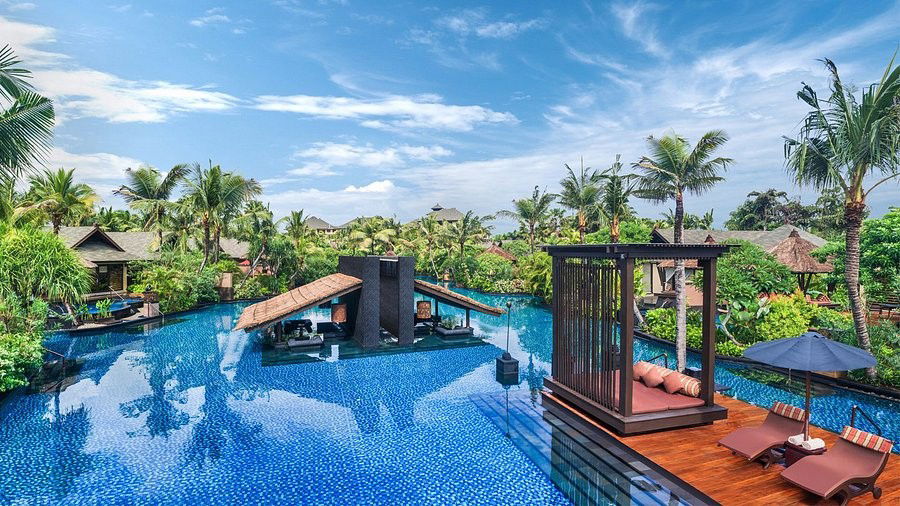
Arriving in Nusa Dua: What the Enclave Signals Before You Unpack
Nusa Dua occupies a specific position in Bali's accommodation hierarchy. The peninsula is a planned resort zone — manicured, gated, and traffic-controlled in ways that the rest of south Bali's hotel corridors are not. That structure draws a particular cluster of properties: international brands operating at the upper end of the five-star tier, where the offer is less about neighbourhood discovery and more about contained excellence. The full Nusa Dua hotels guide maps the competitive set in detail, but the short version is that this enclave hosts some of the most consistent large-resort experiences in Indonesia. The St. Regis Bali Resort sits firmly inside that tier, with scale (nearly 20 acres, 123 total accommodations), international brand backing through Marriott International, and a Google rating of 4.8 from 2,628 reviews that places it at the reliable end of guest satisfaction for a property of this size.
The Bali Mandara toll road, which spans the Gulf of Benoa, has materially changed how accessible Nusa Dua feels from Ngurah Rai International Airport and from Seminyak or Kuta. What was previously a slow southern crawl is now a faster, more predictable transfer — a logistical detail worth factoring into any Bali itinerary that combines a Nusa Dua base with day excursions north.
The Approach and the Property After Dark
The arrival sequence at many large Bali resorts follows a predictable script: porte-cochère, lobby pavilion, distant ocean view. The St. Regis approach differs in register. The entrance road passes through dense tropical foliage, and the misting systems along the driveway create a disorienting, atmospheric density that makes the transition from Bali's roads to the resort grounds feel genuinely abrupt. Night arrivals are particularly well-staged: blue lighting runs the length of the approach path, and the effect , dramatic rather than understated , sets a specific tone for the stay. This is not a resort that defaults to restraint as its primary design language.
That theatrical quality carries through to the physical scale of the property. The 81 suites and 42 villas spread across almost 20 acres, connected by garden pathways that pass decorative fountains and partially hidden gazebos. The resort also contains its own retail zone , a shopping complex selling local crafts and food , which means the property functions more like a self-contained precinct than a single building. For guests who prefer to minimise excursions, this compression of services works well. For those expecting the stripped-back quietude of a smaller design property, the scale is something to weigh against alternatives like Aman Villas at Nusa Dua, which operates in a markedly different register.
Inside the Rooms: Suites, Villas, and What Separates Them
The room categories at the St. Regis Bali operate along a clear hierarchy, and the distinction between suite and villa matters more here than at properties where the categories blur. The suites incorporate tropical hardwood floors and art that references Balinese visual traditions; the spaces are large and well-appointed in the way that a flagship international brand manages large and well-appointed. But the villas carry a specific detail that doesn't appear in the suites: crystal chandeliers positioned above private plunge pools, and refined cabanas at the pool edges that create a layered sense of private outdoor space. That combination , formal interior elegance meeting outdoor Balinese resort architecture , defines the property's aesthetic position.
Two villa configurations merit particular attention from guests making category decisions. The Lagoon Villas connect directly to the resort's 40,000-square-foot salt lagoon pool via private terrace access, collapsing the boundary between accommodation and the resort's largest water feature. The Strand Villas face a different orientation: direct, unobstructed sightlines over the Indian Ocean and the white sand beach below, with no lagoon infrastructure in the foreground. The choice between these two is genuinely one of preference rather than hierarchy , those who want the expansiveness of the ocean vista will favour the Strand configuration; those who want seamless lagoon access will favour the other.
Regardless of category, every guest at the St. Regis Bali receives 24-hour butler service. This is a brand-level commitment rather than a suite-only perk, which distinguishes the property from competitors where dedicated service is tiered by spend. The gym, officially open from 7 a.m. to 11 p.m., operates around this same logic: overnight guests can access it at any hour through their butler, which removes the constraint for early risers or guests with disrupted schedules from long-haul travel.
The Iridium Spa: Architecture and Treatment Format
Spa programming at large Bali resorts tends to oscillate between two formats: the sprawling wellness village with multiple pools and movement studios, and the more contained, high-finish treatment-focused facility. The Iridium Spa at the St. Regis Bali belongs to the latter type. Eight private treatment rooms , including two suites configured specifically for couples , sit within a butterfly-themed design scheme, surrounded by koi ponds that serve both as visual architecture and ambient sound management. The separation of each treatment room from the main facility corridors, combined with the koi pond placement, creates acoustic and spatial privacy that larger spa formats often sacrifice for volume.
Supporting infrastructure includes a Finnish sauna, an aromatherapy steam room with daily-changing scent programming, a beauty salon, and a dedicated yoga room separated from the main fitness centre. The yoga room separation is a minor but telling detail: at properties where wellness has been taken seriously rather than treated as a checkbox amenity, the movement and recovery spaces tend to be architecturally distinct rather than partitioned corners of a single room.
Dining on the Property
The resort runs four dining outlets, with the Pan-Asian fine-dining restaurant positioned as the flagship option. That restaurant's orientation toward the Indian Ocean places it in a category that Nusa Dua does well: formally served meals where the view does structural narrative work. The property also runs an international buffet format alongside options covering local Indonesian fare, which gives the dining programme a range that accommodates different moods across a multi-night stay without requiring guests to leave the resort. For guests who do venture out, the Nusa Dua restaurants guide covers the wider dining picture across the enclave.
The St. Regis Bali in Its Competitive Context
Within Nusa Dua's five-star tier, the St. Regis competes directly with properties like the Conrad Bali, the Sofitel Bali Nusa Dua Beach Resort, Mulia Villas, The Mulia, and The Ritz-Carlton, Bali. What separates the St. Regis from several of those alternatives is the universal butler service commitment and the architectural drama of the villa category, particularly the crystal chandelier and refined cabana detailing. Guests who prioritise design-led smaller properties over large-resort completeness might look instead at Alila Villas Uluwatu in Uluwatu or Alila Seminyak for a different spatial register, while those building a wider Indonesian itinerary might consider Mandapa, a Ritz-Carlton Reserve in Ubud, Nihi Sumba in Sumba, or Amanwana on Moyo Island for more remote formats. The AYANA Resort Bali in Jimbaran and Desa Potato Head in Denpasar represent stylistically different Bali options at different ends of the formality spectrum.
For broader regional context, Amanjiwo in Magelang and Amankila in Manggis offer points of comparison from the Aman network's Indonesian portfolio, while international equivalents in the brand-led luxury tier include Aman New York and The Fifth Avenue Hotel for travellers benchmarking against global city properties. Also in the Nusa Dua area: the Nusa Dua bars guide, experiences guide, and wineries guide provide the wider picture for those building a complete itinerary.
Frequently Asked Questions
In Context: Similar Options
Comparable venues for orientation, based on our database fields.
| Venue | Cuisine | Price | Awards | Notes |
|---|---|---|---|---|
| The St. Regis Bali Resort | Approaching the entrance of The St. Regis Bali Resort feels a bit like entering… | This venue | ||
| Conrad Bali | ||||
| Sofitel Bali Nusa Dua Beach Resort | ||||
| The Ritz-Carlton, Bali | ||||
| Mulia Villas - Nusa Dua, Bali | ||||
| The Mulia - Nusa Dua, Bali |
Preferential Rates?
Our members enjoy concierge-led booking support and priority upgrades at the world's finest hotels.
Get Exclusive Access