Oakwood Lagoon Town Gangneung
Oakwood Lagoon Town Gangneung sits at the intersection of Korea's East Sea coast and the branded serviced-apartment format that has reshaped mid-to-premium accommodation across East Asia. Gangneung itself has become one of South Korea's most closely watched regional destinations, drawing visitors from Seoul for its coffee culture, beach access, and proximity to Seoraksan National Park. For travellers planning a Gangwon-do circuit, the property warrants consideration alongside the area's wider hospitality offer.
Pearl is the En Primeur Club membership app — saves, bookings, and concierge access live there. Same editors, same standards.
- Address
- Gangneung, South Korea
- Directions
- Get directions
 Saves & bookings on Pearl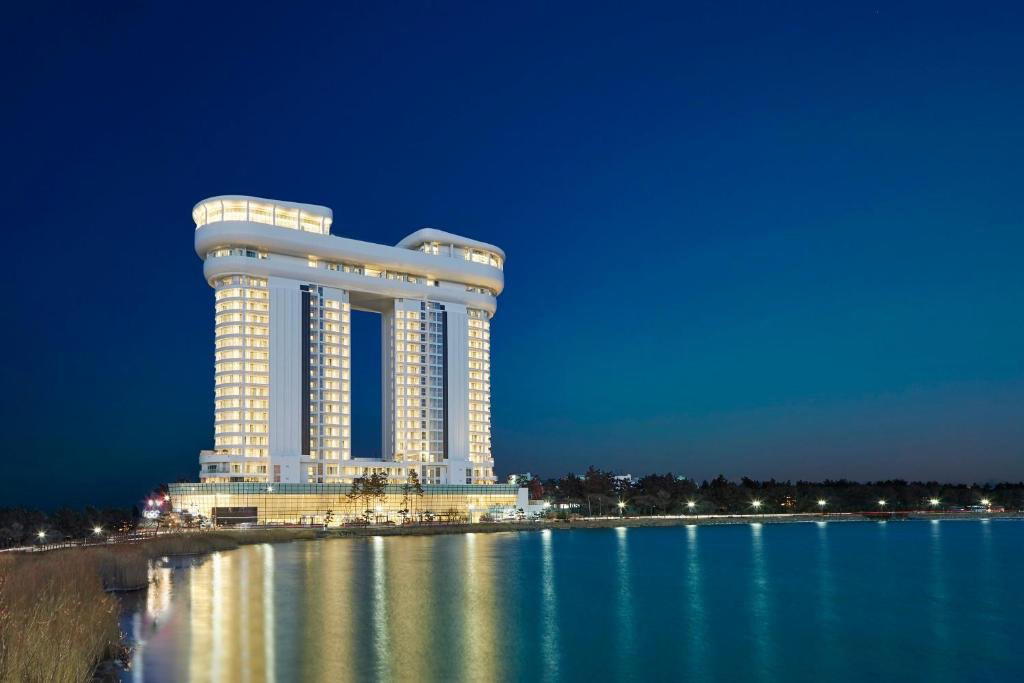
Where the East Sea Meets the Serviced-Residence Format
Gangneung occupies a particular position in South Korea's domestic travel geography. It sits on the Yeongdong corridor, a stretch of Gangwon-do coastline that draws Seoulites for long weekends, surf-adjacent leisure, and a coffee culture so concentrated along Anmok Beach that it has become something of a regional export identity. The drive from Seoul via the Gyeonggang Expressway takes roughly two hours, and the KTX high-speed rail line, extended ahead of the 2018 PyeongChang Winter Olympics, now brings the city within an hour and a half of Seoul Station. That infrastructure shift changed the visitor profile substantially: the destination moved from a primarily summer beach market toward a year-round short-break destination for urban professionals.
It is within that context that the branded serviced-residence format, which Oakwood has refined across Asia over several decades, makes structural sense in Gangneung. The Oakwood Lagoon Town positioning places it at the intersection of hotel-grade amenity and apartment-scale living space, a format that appeals specifically to the family groups and extended-stay travellers the Gangneung market increasingly attracts. Across East Asia, Oakwood properties have tended to occupy the upper-middle to premium bracket of the serviced apartment category, sitting above economy extended-stay options while operating outside the full-service luxury hotel tier occupied by properties like Grand Hyatt Jeju or JW Marriott Jeju Resort and Spa.
The Architecture of a Lagoon Town Concept
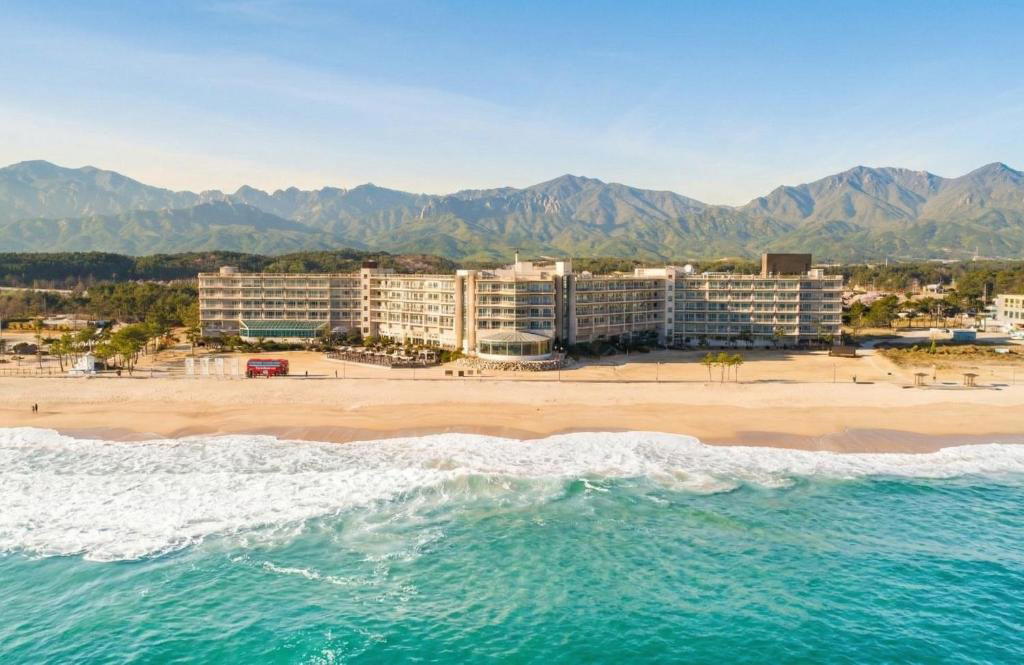
The "Lagoon Town" designation in the property's name signals something beyond a standard branded residence block. Across the regional hospitality market, lagoon-concept developments have emerged as a design-led response to beachfront real estate: they internalize water features, create controlled leisure environments, and attempt to extend the coastal experience beyond what natural shoreline access alone can provide. In Gangneung's case, where the public beach at Gyeongpo is a significant draw but also a shared resource, a property that builds its own aquatic leisure infrastructure operates with a different value proposition than those relying purely on proximity to the sea.
This model has clear precedents across Korean resort development. Haevichi Hotel and Resort Jeju in Seogwipo and Ananti at Busan Cove both demonstrate how integrated resort design, combining accommodation, F&B; and controlled recreational spaces, has become the dominant formula for premium regional leisure properties in South Korea. The Oakwood Lagoon Town format in Gangneung appears to draw from the same logic: the physical environment itself becomes the primary amenity, and the accommodation format is built around it rather than incidentally placed beside it.
For travellers calibrating where this sits relative to other regional properties, it is useful to note that Gangwon-do's accommodation offer spans a wide range. At the quieter, design-forward end of the provincial spectrum, properties like Camptong Forest in Gapyeong and Gangwon-do in Hongcheon operate with a forest-retreat identity, while the Sokcho market is anchored by more conventional leisure hotels like Kensington Hotel Seorak. Oakwood Lagoon Town in Gangneung occupies a distinct niche within this spread, offering branded consistency and apartment-scale space within a resort-concept physical setting.
Gangneung as a Destination Context
Understanding the property requires understanding Gangneung's dual character. The city has a functioning downtown with a strong independent coffee and food culture, particularly around the Jungang Market area and the Namtaeryeong road corridor. It also has a coastal leisure belt, centred on Gyeongpo Lake and Gyeongpo Beach, that operates on a different rhythm, peaking in summer and during the autumn foliage window. The two zones attract overlapping but not identical visitor types, and a property positioned under the Lagoon Town concept sits more naturally within the coastal leisure belt than the urban dining circuit.
For the editorial reader planning a Gangwon-do itinerary, it is worth noting that Gangneung now functions as a credible base for day trips: Sokcho and the Seoraksan approaches are within an hour by road, and the Odaesan National Park temple complex at Woljeongsa is roughly forty minutes south. A property offering apartment-format accommodation makes that kind of multi-day, multi-excursion structure more practical than a hotel room would. This is the logistical argument the Oakwood serviced-residence format makes most effectively in regional leisure markets. For comparison, travellers choosing between a Gangneung base and a Jeju circuit might also consider Grand Hyatt Jeju or the more compact design properties at Seogwipo, but the mainland coastal experience Gangneung offers is substantively different from an island leisure model.
Those approaching from Seoul should note the KTX option from Seoul Station to Gangneung Station, with journey times averaging around ninety minutes on direct services. Driving remains the dominant choice for family groups with luggage or those planning to use a car for regional exploration, but the rail connection has materially changed the property's accessibility for solo and couple travellers.
Positioning Within the Branded Serviced-Residence Category
Across South Korea's major cities, the serviced-residence category has consolidated around a handful of international operators. In Seoul, properties like Dormy Inn Seoul Gangnam represent the mid-market end of extended-stay accommodation, while the upper bracket includes properties that approach full-service hotel territory. Oakwood, as a brand, has historically occupied the space between those poles, competing on apartment size and amenity consistency rather than on F&B; programming or event infrastructure. In a regional leisure market like Gangneung, that positioning is more coherent than in Seoul, where business travel and MICE demand shape expectations differently.
For travellers whose reference points are international branded properties, it is useful to calibrate: the Gangneung property operates in a different register from full-resort developments like South Cape Owners Club in Namhae or the design-hotel tier represented globally by Amangiri or Aman Venice. The Oakwood Lagoon Town proposition is more practical than experiential in its core promise: consistent space, reliable amenity, and a physical environment that supports leisure without requiring the guest to organise it entirely from scratch.
Planning a Stay
Gangneung's peak periods run from late July through mid-August, when the coastal beaches draw large domestic crowds, and again during the autumn colour window in October. Outside those windows, the city operates at a slower rhythm, and the Gyeongpo area in particular is significantly quieter from November through March. Travellers who can visit in May or early June, or in September, typically find the coastal environment more accessible and the wider regional attractions less congested. For those considering a broader East Sea coastal route, KOSMOS ULLEUNGDO on Ulleungdo island offers a more remote alternative for part of an extended itinerary.
Side-by-Side Snapshot
Comparable venues nearby, for context on price, style, and recognition.
| Venue | Cuisine | Price | Notes |
|---|---|---|---|
| Oakwood Lagoon Town GangneungThis venue — the venue you are viewing | resort-led development | $$$ | Not listed |
| Gangwon-do | family resort with golf focus | $$ | Seo-myeon |
| South Cape Owners Club | Modern luxury resort with dynamic wave-inspired architecture | $$$$ | Changseon-myeon |
| YOUONEJAE | Modern Korean hot-spring hotel inspired by traditional inns with village-like landscape design | $$$$ | Suanbo-myeon |
| KOSMOS ULLEUNGDO | Cliffside healing resort with villa accommodations | $$$ | Buk-myeon |
| Lexington Busan | Hotel | Not listed | Busan |
Continue exploring
More in Gangneung
Hotels in Gangneung
Browse all →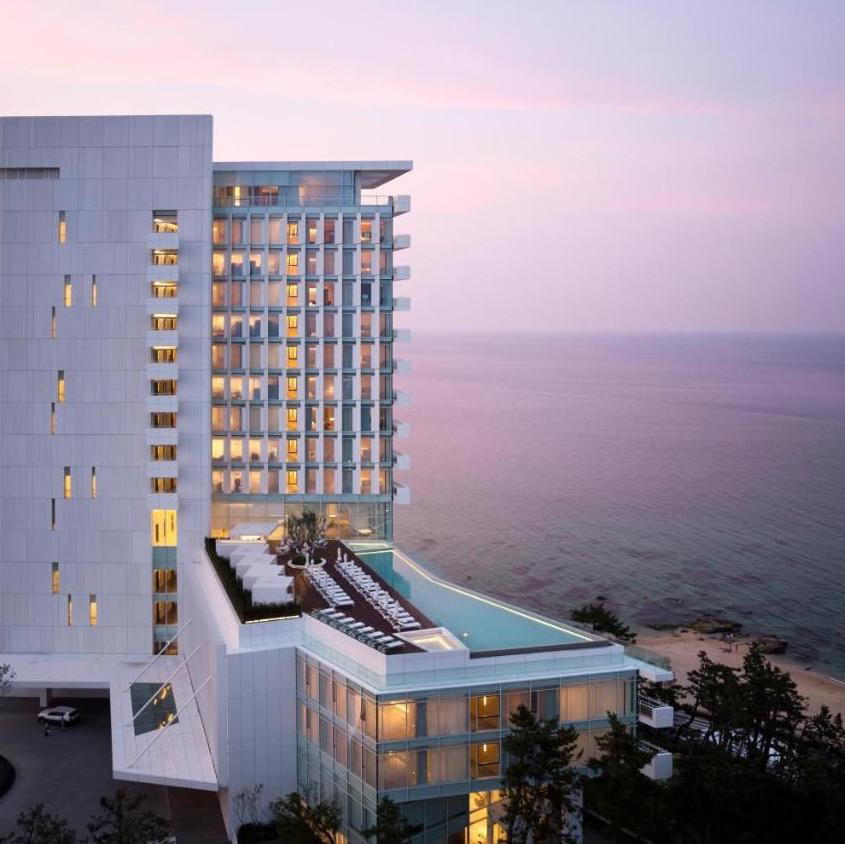
Restaurants in Gangneung
Browse all →
At a Glance
- Weekend Escape
- Waterfront
Resort-style atmosphere in a coastal landmark development.