




Kappo dining in Hong Kong sits in a narrow tier between izakaya informality and the rigidity of full kaiseki, and Zuicho occupies that space with considerable precision. Chef Yoshinori Kinomoto's daily-changing omakase menus draw on nearly three decades in high-end Japanese kitchens, with ingredients flown directly from Japan. The wine list runs to 1,780 selections, and the restaurant holds an Opinionated About Dining Top Restaurants in Asia ranking for 2025.
Pearl is the En Primeur Club membership app — saves, bookings, and concierge access live there. Same editors, same standards.
- Address
- G/F, The Mercer Central, 29 Jervois Street, Sheung Wan, Hong Kong
- Phone
- +852 2156 1883
- Website
- zuicho-kappo.com
- Directions
- Get directions
 Saves & bookings on Pearl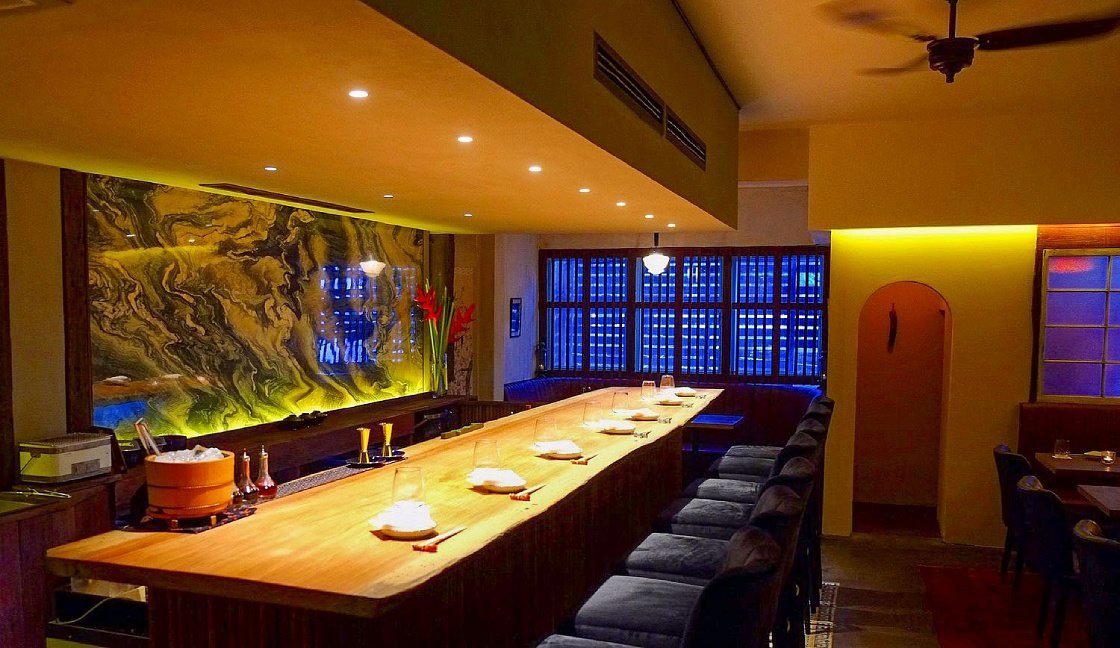
A Counter Built for Occasions That Deserve More Than Dinner
There is a particular quality to rooms designed around a single piece of material. At Zuicho, located on the ground floor of The Mercer Central in Sheung Wan, the visual anchor is a thirty-foot hinoki wood counter, ancient cypress, transported from Japan intact, shaped by artisans who have worked within the Japanese imperial household. The grain runs the length of the room. The rest of the space recedes into minimalism by design: washi-paper menus, antique sake glassware, handcrafted ceramic tableware that changes course by course. The effect is not theatrical in the way that many Hong Kong special-occasion restaurants lean theatrical. It is ceremonial without announcement, which is a harder thing to achieve.
Kappo, as a dining format, occupies a specific position in the hierarchy of Japanese cooking traditions. Unlike kaiseki, with its rigid sequence and spatial separation between kitchen and guest, kappo places the chef in open view at the counter, the name itself derives from the verbs for cutting and cooking. Unlike izakaya, the format carries precision and formality. The interaction is the point: guests watch the kitchen work, courses arrive in direct dialogue with the counter, and the meal unfolds as something closer to performance than service. Hong Kong has a small but serious cohort of kappo practitioners; Zuicho sits in the upper register of that group.
Why Milestone Meals Land Differently Here
The case for Zuicho as an occasion venue is structural, not just atmospheric. Chef Fumio Suzuki leads the kitchen in a high-end omakase context, a significant portion of that time based in coastal Ishikawa Prefecture, which built an intuitive relationship with seasonal seafood that runs through every menu he composes. The omakase format means no ordering decisions, no menu fatigue, guests arrive and the kitchen makes every call, calibrated to what is leading from Japan that week. Ingredients are flown in directly: Hokkaido bafun uni, tuna belly for hand rolls, Satsuma A5 Wagyu from Kagoshima. The tenderloin is deep-fried; the sirloin appears in sukiyaki. These are not menu constants, they shift with season and supply, but the sourcing logic is consistent.
Three omakase menus are available, creating flexibility across group compositions and appetite levels without undermining the format's integrity. For groups who want genuine privacy, a separate dining room accommodates up to six guests, a configuration well-suited to corporate occasions or family gatherings that warrant seclusion without losing the counter experience entirely. Children under twelve are permitted in that private room, though not at the main counter, which keeps the primary dining environment calibrated for a specific kind of focused attention.
For comparison, the kappo format elsewhere in Hong Kong, Kappo Rin and Ryota Kappou Modern each represent distinct expressions of the tradition, tends to emphasize either modernist reinterpretation or tighter seasonal sequencing. Zuicho's approach is more classically grounded, with the counter and the chef's biography acting as the continuity thread across an ever-changing daily menu. For those whose occasion calls for a sense of tradition rather than novelty, that distinction matters.
The Food: Structure, Sourcing, and a Few Reliable Landmarks
Because the menu changes daily, fixed dish descriptions would misrepresent how Zuicho actually works. What can be said with confidence: a structural signature runs through the sequence. Chilled somen appears in most iterations, offering a cool, clean mid-meal punctuation. A5 wagyu from Kagoshima recurs in some form, tenderloin prepared as a cutlet, sirloin folded into sukiyaki. A takikomi rice course, cooked with seasonal seafood in a method that produces something closer to a Japanese risotto in texture, typically closes the savoury sequence. Sushi and sashimi range according to Japan's fishing seasons; black throat seaperch has appeared alongside sea urchin and toro hand rolls. Dessert involves mochi prepared at the counter, the dough worked in view of guests, filled with housemade ice cream, finished with a crispy wafer element that keeps the close from feeling heavy.
The seasonal logic is tighter than it might appear. Kinomoto's years on the Ishikawa coast, a region whose fishing culture is among the more technically demanding in Japan, shaped a reading of seafood seasons that goes beyond the rotation most omakase menus apply. That regional intelligence is part of what makes the sourcing feel specific rather than formulaic. For guests celebrating a milestone on a specific date, the menu will reflect what Japan's waters and farms are doing at precisely that moment, which is a different proposition from a static tasting menu.
Sake pairings are available at dinner, and the list's depth warrants attention. Wine Director Winnie Chen oversees a cellar of 1,780 selections and 35,000 bottles, with noted strength across Champagne, Burgundy, Bordeaux, Portugal, and Italy. The wine pricing sits at the $$$ tier, with many bottles above the $100 threshold. Corkage is $50 for those who prefer to bring their own. For guests whose occasion calls for a specific bottle, that policy matters. The inspector notes that sake lovers should pursue the Désir et Sauvage selections from Kuheiji, a producer known for expressions that read closer to French white wine than to the more austere styles, either as a pairing or by individual selection. Sake vessel choice is offered from a rotating collection of crystal, ceramic, and glass, a small but considered detail that affects the sensory quality of the drink.
Where Zuicho Sits in Hong Kong's Japanese Dining Scene
Hong Kong's Japanese restaurant tier at the leading end is unusually competitive for a city outside Japan. Godenya has built a sake-forward omakase identity with a global following; Nagamoto occupies a quieter niche with Kyoto-influenced kaiseki precision. Hanabi offers a more accessible point of entry into the same culinary tradition. Zuicho's Opinionated About Dining ranking, #261 in Asia for 2025, having placed at #245 in 2024, positions it within a defined peer group of serious Japanese counters across the region, including establishments like Myojaku and Azabu Kadowaki in Tokyo, Kagurazaka Ishikawa, and Isshisoden Nakamura in Kyoto. The Macau location of Zuicho carries a Michelin star (2024) and a separate OAD Highly Recommended citation, giving the wider brand a recognisable credential base. The Hong Kong location holds one Michelin star.
Internationally, the kappo format has found serious practitioners in cities far from Japan. Hayato in Los Angeles and Ginza Fukuju in Tokyo each represent the format's range. Within Kyoto's tradition-heavy scene, Gion Matayoshi and Kashiwaya Osaka Senriyama show how deeply the kappo and kaiseki traditions intertwine when the sourcing and seasonal logic are applied with rigour. Zuicho's Hong Kong counter belongs in that wider conversation.
The Sheung Wan Address and What It Means for Planning
Sheung Wan occupies a specific position in Hong Kong's dining geography, west of Central's density, with a slightly more residential and gallery-oriented character that suits an evening that begins with a drink and a walk rather than a taxi to a hotel lobby. The Mercer Central address gives Zuicho a discreet street presence; the entrance on Jervois Street does not signal itself aggressively. For guests who associate occasion dining with visual spectacle on arrival, the restraint may read as understatement. That is accurate.
The dress code is smart casual with specifics: ankle-length trousers for men, no open-toed shoes, sandals, or sleeveless tops. For guests planning a milestone meal, this is the kind of detail that prevents an avoidable problem. Service runs Tuesday through Friday evenings from 6 PM to 10:30 PM; Saturday and Sunday add a lunch service from 12:30 PM to 2:30 PM. Monday is closed. Reservations are required, walk-in is not a realistic option at a counter of this format and reputation.
Cuisine and Credentials
Comparable venues nearby, for context on price, style, and recognition.
| Venue | Cuisine | Price | Awards | Notes |
|---|---|---|---|---|
| ZuichoThis venue — the venue you are viewing | Kappo Omakase | $$$$ | Michelin 1 Star | Not listed |
| Godenya | Seasonal Japanese Kappo with Sake Pairing | $$$$ | Michelin 1 Star | Central |
| The Legacy House | Michelin-Starred Cantonese & Shunde Cuisine | $$$$ | Michelin 1 Star | Yau Tsim Mong South |
| Man Wah | Michelin-Starred Cantonese | $$$$ | Michelin 1 Star | Central |
| Épure | Contemporary French Fine Dining | $$$$ | Michelin 1 Star | Yau Tsim Mong South |
| Gaddi's | Modern-Classic French Fine Dining | $$$$ | Michelin 1 Star | Yau Tsim Mong South |
Recognition history
Dated appearances from independent guides and award organizations, with the underlying list record or original source where available.
Opinionated About Dining Top Restaurants in Asia Recommended
Opinionated About Dining
Forbes 5-Star
Forbes
Michelin 1 Star
Michelin
Opinionated About Dining Top Restaurants in Asia Ranked #261
Opinionated About Dining
Wine Spectator Best of Award of Excellence
Wine Spectator
World's Best Wine Lists Awards WBWL 3-Star
World's Best Wine Lists Awards
Michelin 1 Star
Michelin
Opinionated About Dining Top Restaurants in Asia Ranked #245
Opinionated About Dining
World's Best Wine Lists Awards WBWL 3-Star
World's Best Wine Lists Awards
Opinionated About Dining Top Restaurants in Asia Highly Recommended
Opinionated About Dining
World's Best Wine Lists Awards WBWL 3-Star
World's Best Wine Lists Awards
Continue exploring
More in Hong Kong
Restaurants in Hong Kong
Browse all →
Bars in Hong Kong
Browse all →
At a Glance
- Intimate
- Elegant
- Sophisticated
- Date Night
- Special Occasion
- Chefs Counter
- Open Kitchen
- Sake Program
Traditional Japanese setting with open kitchen counter seating fostering close chef-diner interaction in a refined, authentic atmosphere.