
Yokohama Tonton belongs to the everyday end of Yokohama dining: a compact Hoshikawa gyoza shop where the ritual is quick, local, and built around dumplings rather than ceremony. Its selection for Tabelog 100 - Dumplings - 2024 gives it a clear trust signal, while the small room and no-reservation format keep the experience closer to neighbourhood routine than destination dining theatre.
Pearl is the En Primeur Club membership app — saves, bookings, and concierge access live there. Same editors, same standards.
- Address
- 1 Chome-15-27 Hoshikawa, Hodogaya Ward, Yokohama, Kanagawa 240-0006, Japan
- Phone
- +81 45-331-8735
- Website
- yokohama-tonton.com
 Saves & bookings on Pearl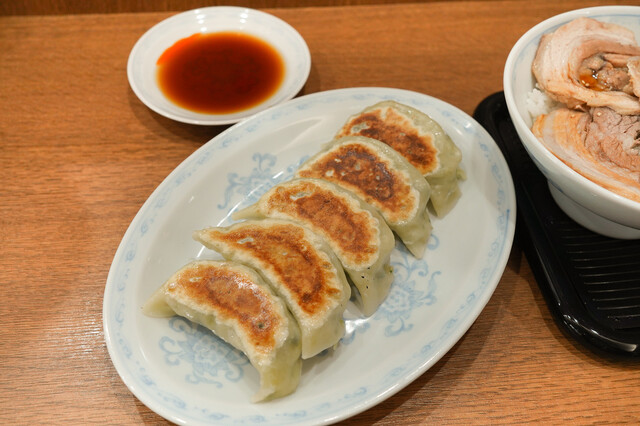
Hoshikawa is not the Yokohama of cruise-terminal postcards or waterfront hotel lobbies. It feels residential, scaled for a neighbourhood meal rather than a staged night out. That matters for gyoza. In Japan, dumpling specialists often move closer to ramen-counter tempo than tasting-menu pacing: arrive, read the room, order without overbuilding, eat while hot, and make space for the next party.
Yokohama Tonton sits firmly in that tradition. The room is small, mixing counter seating and tatami-style seating, so the meal has a compressed rhythm. This is not long-table, wine-pairing Japanese dining. The format tells diners how to behave: keep the order focused, avoid lingering, and treat gyoza as the centre of gravity, not a side dish.
Gyoza as a Yokohama neighbourhood ritual
Yokohama’s restaurant identity is often pulled toward Chinatown, hotel dining, and bayfront polish, but its everyday food culture is broader and more practical. Gyoza houses, ramen shops, donburi counters, curry specialists, yakitori rooms, and Chinese-Japanese kitchens form the city’s working grammar. The interest is not luxury; it is repetition, speed, price discipline, and a dish narrow enough to show whether the kitchen commands its basics.
That is why a dumpling specialist can reveal more than a grander address. Gyoza leaves little room for disguise. The meal depends on proportion, heat, timing, and contrast between filling and wrapper. The diner’s role is just as specific: order decisively, season with restraint, and eat before texture fades. The custom is democratic, but not careless. It rewards attention.
Recognition from Tabelog 100 - Dumplings - 2024 places Yokohama Tonton in a national conversation about a humble category. The same public listing also notes selection in 2021, giving the address more than a single-year spike. That does not make it a luxury room, nor should it be judged as one. It means a low-price, small-format gyoza shop in Hodogaya Ward has been flagged within a specialist category where consistency matters more than spectacle.
The competitive set in Yokohama clarifies the distinction. Mendokoro Tatsunoki and Sakurai Chuka Soba Ten sit in the city’s low-price noodle lane, while Iekei Sohonzan Yoshimura Ya represents the local force of ramen culture. Oishi and PIZZERIA Speriamo! operate in higher spend brackets. Against those references, Yokohama Tonton belongs to a compact, dish-led tier where the question is not occasion dining, but whether a narrow speciality justifies the detour from central Yokohama patterns.
The small-room etiquette of dumplings, donburi, and takeout
The format is part of the assessment. A 16-seat room changes pacing, noise level, group size, and tolerance for indecision. Counter seats suit solo dining; tables and tatami-style seating work for families or friends, but this is still a small shop, not a sprawling group restaurant. Children are welcomed, matching the everyday nature of the address, though compact seating means family dining works well when the meal stays simple.
Gyoza and donburi pair efficiently because both belong to Japan’s practical meal vocabulary. Dumplings provide the focal order; rice bowls can make the stop a fuller lunch or dinner without adding formality. Takeout is also part of the service pattern, important in a neighbourhood setting. It separates the shop from venues built only for seated dining and reinforces dumplings as household food as much as restaurant food.
The no-reservation policy shapes the ritual before anyone sits. This is a show-up restaurant, not a calendar-managed booking. That favours flexible diners and penalizes rigid itineraries. It also keeps expectations honest: the reward is not access to a rarefied room, but participation in a local queue-and-eat rhythm. In a city where visitors plan around waterfront walks and central stations, Hoshikawa asks for a deliberate move into residential Yokohama.
Payment customs also point to an old-school operating style. Cash-only policies remain common at smaller Japanese food shops, especially outside the international hotel and fine-dining circuit. For travellers, that is not charming inconvenience; it is a planning requirement. Arrive with cash, keep the party modest, and avoid peak-meal dawdling as basic respect in rooms like this.
Where it fits in a Yokohama eating itinerary
The case for coming here is strongest for diners who want Yokohama beyond the obvious axes. Chinatown supplies spectacle and volume; Minato Mirai supplies polish; residential wards supply the meal patterns locals repeat. The restaurant belongs to that third category. Its appeal is not architectural drama or chef biography, but a compact expression of gyoza culture with public specialist recognition and a grounded format.
That makes it a poor fit for diners seeking a leisurely tasting menu, bar-driven evening, or room built for ceremonial hosting. It suits solo travellers, small groups, and families who understand that value lies in concentration. The stronger comparison is not luxury restaurants, but Japan’s specialist-counter culture: the yakitori discipline seen at 1000 (Yakitori (Grilled chicken skewers)), the neighbourhood Chinese-Japanese current around Aichun, or the category focus that also defines Ajowan and Alpenjiro Honten.
For a broader Yokohama plan, use it as a counterpoint rather than a centrepiece. Pairing a gyoza stop with the city’s other everyday formats gives a clearer read on the dining culture than chasing only high-spend addresses. The same logic applies across Japan, from the practical comfort-food directness of Anzen Shokudo to regional and overseas Japanese-adjacent references such as -Grilled beef Sukiyaki- KAMAKURA TANUKIAN 鎌倉 たぬき庵 in Kamakura. 鮪と炭火焼き うお炭 秋葉原店 in Tokyo.cafe in Osaka.know in Kumamoto, (Shoku) Vietnam in Kawasaki, [Curry Senmon Ten] Maruyama Kyoju. in Sapporo, Jōdo Saké Bar in Los Angeles, and Onigiri Time in Pasadena.
Readers building a wider city file should start with Our full Yokohama restaurants guide, then use Our full Yokohama hotels guide, Our full Yokohama bars guide, Our full Yokohama wineries guide, and Our full Yokohama experiences guide to place the meal inside a fuller trip. Verdict: go for a small-format gyoza ritual with credible category recognition, not ceremony, luxury, or a long evening at the table.
Category Peers
Nearby venues at a similar price tier for orientation.
| Venue | Cuisine | Price | Notes |
|---|---|---|---|
| Yokohama TontonThis venue — the venue you are viewing | Chinese Dumpling House | $$ | Not listed |
| Aichun | Traditional Cantonese in Yokohama Chinatown | $$ | Naka |
| Keitokuchin | Traditional Sichuan Chinese | $$ | Naka |
| Ganso Juhachiban | Casual Chinese Dumpling House | $ | Naka |
| Goku Chasou | Traditional Chinese Teahouse & Cafe | $$ | Naka |
| Manchinro Tenshinpo (萬珍樓 點心舗) | Cantonese Dim Sum | $$$ | Chinatown |
Recognition history
Dated appearances from independent guides and award organizations, with the underlying list record or original source where available.
Tabelog 100 #86 · No. 86
Tabelog · Tabelog 100 - Dumplings - 2024










At a Glance
- Cozy
- Classic
- Casual Hangout
- Solo
- Family
- Standalone
Current opening hours
- Monday
- 11 AM–2 PM, 4:30–7:30 PM
- Tuesday
- 11 AM–2 PM, 4:30–7:30 PM
- Wednesday
- Closed
- Thursday
- 11 AM–2 PM, 4:30–7:30 PM
- Friday
- 11 AM–2 PM, 4:30–7:30 PM
- Saturday
- 11 AM–2 PM, 4:30–7:30 PM
- Sunday
- Closed
Hours can change for holidays and private events. Last verified .
Warm, compact, and casual, with a cozy dumpling-shop atmosphere rather than a formal dining room.