Yakitori Onjung
.png)
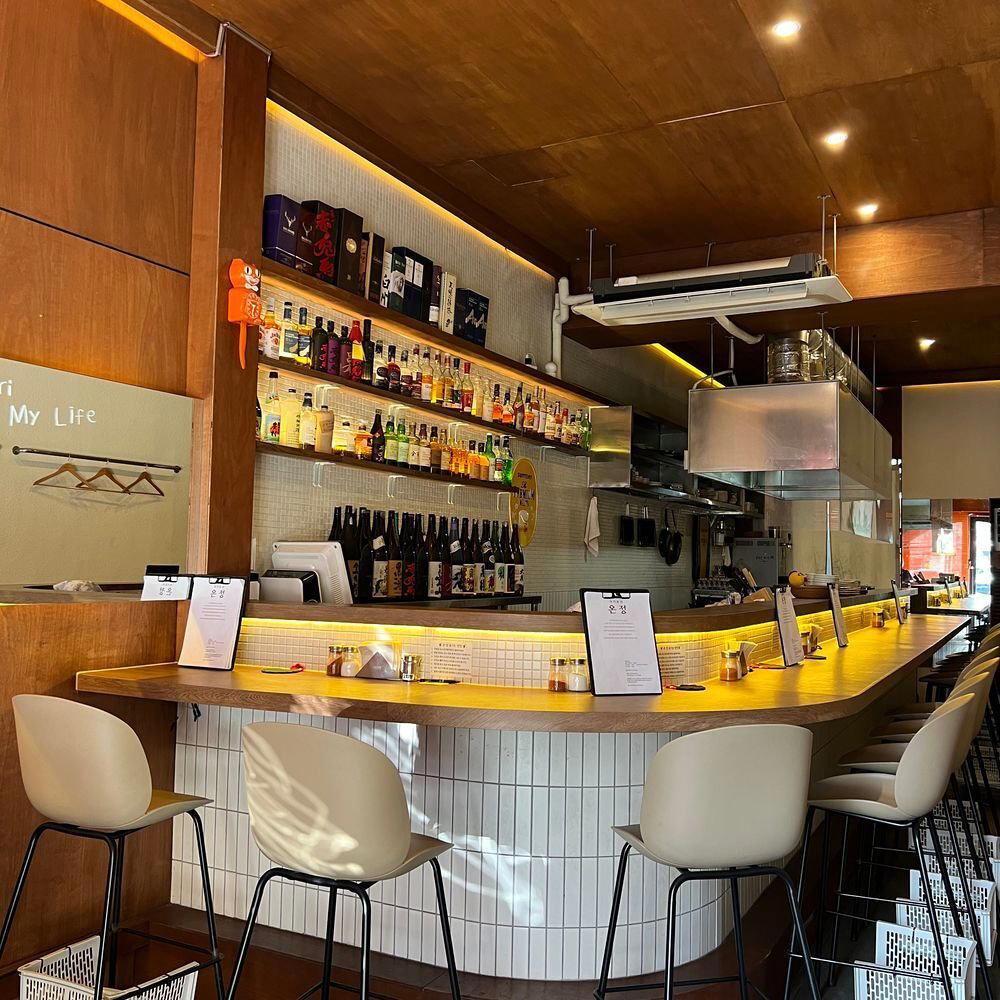
Yakitori Onjung holds back-to-back Michelin Bib Gourmand recognition (2024 and 2025), placing it among the few yakitori counters in Busan with formal international validation at the ₩ price tier. Located in Busanjin District, it represents the growing crossover between Japanese grill tradition and Korea's own appetite for serious skewer cooking, led by Chef Axel Guilbert.
 Discover on Pearl
Pearl is the En Primeur Club membership app — saves, bookings, and concierge access live there. Same editors, same standards.
Smoke, Skewers, and the ₩ Price Tier That Punches Above Itself
There is a particular kind of restaurant that rewards the traveller who pays attention to price-to-recognition ratios rather than star counts. In Busan's Busanjin District, on a side street off Dongcheon-ro, Yakitori Onjung fits that category precisely. The address is not a destination neighbourhood in the tourist-circuit sense; Busanjin is a working district, dense with apartment blocks and local commerce, and the restaurant sits on a lane where you are more likely to pass convenience stores than hotel concierges. That context matters. The absence of a glamorous postcode is partly what keeps prices at the ₩ tier, and it is partly what makes the Michelin Bib Gourmand recognition — awarded in both 2024 and 2025 — read as a genuine quality signal rather than a marketing outcome.
What the Bib Gourmand Actually Signals at This Price Point
Michelin's Bib Gourmand category is structurally different from starred recognition. It is specifically designed to identify quality cooking at prices that do not require a special-occasion budget. In the Korean context, where the ₩ tier overlaps with everyday dining formats like naengmyeon specialists (100.1.Pyeongnaeng) and dwaeji-gukbap houses, earning that recognition twice in succession for a yakitori format is a meaningful data point. It suggests the kitchen is executing with enough consistency and enough care that Michelin's inspectors returned and reached the same conclusion.
The comparison set for Onjung does not include Busan's higher-tier Japanese restaurants like Mori (₩₩₩) or the ₩₩₩₩ steakhouse tier represented by Born and Bred. Those restaurants are operating in a different price register entirely. Onjung's relevant peers are venues where the value proposition is built into the format: a focused menu, a grill-anchored approach, and a dining experience that does not require committing to a tasting menu price. That is a narrower promise, but it is one Onjung keeps , and keeps well enough to have been confirmed by Michelin twice.
Yakitori in Korea: A Format Finding Its Footing
Yakitori as a format has deep roots in Japan, where the tradition of grilling skewered chicken over binchōtan charcoal spans centuries and ranges from standing izakaya counters to the dedicated kappo-style counters that command serious reservation queues. In Osaka, venues like Ichimatsu and Torisho Ishii sit within that established Japanese grill tradition. In Kyoto, Torisaki represents the more restrained end of the spectrum. These are venues operating inside a domestic tradition with centuries of context behind them.
In Korea, the picture is different. The yakitori format arrives as an imported one, translated through a dining culture that has its own deeply established grill traditions (samgyeopsal, galbi, bulgogi) and its own ideas about how smoke and meat interact. For a Korean yakitori restaurant to earn formal Michelin recognition is less about replicating a Japanese template and more about demonstrating that the format has been absorbed and executed with enough integrity to stand on its own terms. Busan's grill scene, informed by both the port city's Japanese-influenced culinary history and its own meat-forward traditions, turns out to be a plausible place for that to happen.
Onjung is not alone in Busan in taking this format seriously. Yakitori Haegong represents another address in the city committed to the yakitori idiom. But two-consecutive-year Bib Gourmand recognition gives Onjung a documented track record that carries weight in the conversation about where the format is landing in Korea's second city.
Chef Axel Guilbert and What a French Name at a Korean Yakitori Counter Tells You
The detail that does not resolve neatly is Chef Axel Guilbert. A French chef leading a yakitori counter in Busan is an unusual configuration, and it is worth placing that in context without overstating it. Contemporary Japanese grill culture has, over the past decade, become a format that international chefs train in and reinterpret across different cities. The binchōtan grill requires technical precision, and the discipline of yakitori , where the quality of the bird, the cut, the salt, and the fire management are the entire story , is one that transfers across national culinary backgrounds when the training is serious. What Michelin's inspectors assessed is the output, not the biography, and the output earned the Bib Gourmand two years running. That is the relevant fact.
For broader context on Korean dining that has earned formal recognition, see our Seoul coverage including Mingles and Gaon, both of which operate at a different price and format tier but reflect the same upward trajectory in Korean fine dining that has given Michelin's Korean guide increasing depth over recent cycles.
How Onjung Fits Into Busan's Broader Dining Picture
Busan does not have the restaurant density of Seoul, but it has a distinctive dining character shaped by its geography, its port-city history, and its proximity to Japan. The seafood is a structural advantage , proximity to the sea means the fish markets are integrated into daily dining in ways they are not in landlocked cities. The grill tradition is strong. And the price tolerance, relative to Seoul, tends to run lower, which means the ₩ tier has real depth here rather than functioning purely as the no-frills end of a spectrum.
Within that context, Onjung occupies a specific and well-defined position: a specialist format (yakitori), a low price tier, and documented quality validation. Palate at ₩₩ and the single-dish specialists at ₩ cover different parts of the Busan dining map. Onjung is the address for serious skewer cooking without the overhead of a formal dining room.
For a broader map of where to eat, drink, and stay in the city, our full Busan restaurants guide covers the range of formats and price tiers in detail. Those planning a longer trip can also consult our guides for Busan hotels, bars, wineries, and experiences. For further reading on Korean dining beyond Busan, Baegyangsa Temple in Jangseong-gun, Kwon Sook Soo in Gangnam-gu, and The Flying Hog in Seogwipo cover different registers of the national scene.
Planning Your Visit
Yakitori Onjung is located at 9-7, Dongcheon-ro 108beon-gil, Busanjin District, Busan , street level, first floor. The ₩ price tier means a full meal is accessible without forward financial planning, which also means it draws a local crowd rather than a tourist one. Google reviews sit at 4.7 from 13 ratings, a small sample but a consistent one. No website or phone number is publicly listed in our database, so the practical approach is to arrive early or check walk-in availability directly. Hours are not confirmed in our data; checking locally before visiting is advisable. Given the back-to-back Bib Gourmand recognition, expect that seats fill at pace during evening service.
The Short List
A quick comparison pulled from similar venues we track in the same category.
| Venue | Cuisine | Price |
|---|---|---|
| Yakitori OnjungThis venue — the venue you are viewing | Yakitori | ₩ |
| Palate | Contemporary | ₩₩ |
| Mori | Japanese | ₩₩₩ |
| Born and Bred | Steakhouse | ₩₩₩₩ |
| 100.1.Pyeongnaeng | Naengmyeon | ₩ |
| Anmok | Dwaeji-gukbap | ₩ |