At Südtiroler Platz, one of Vienna's transit nodes, this Würstelstand holds its place in a category the city treats as a civic institution. The standing counter format, with its Käsekrainer, Debreziner, and cold beer, sits at the democratic opposite of Vienna's €€€€ tasting menu scene, and has evolved with the neighbourhood around it rather than against it.
Pearl is the En Primeur Club membership app — saves, bookings, and concierge access live there. Same editors, same standards.
- Address
- Wiedner Gürtel 3, 1040 Wien, Austria
- Phone
- +434316885397
- Directions
- Get directions
 Saves & bookings on Pearl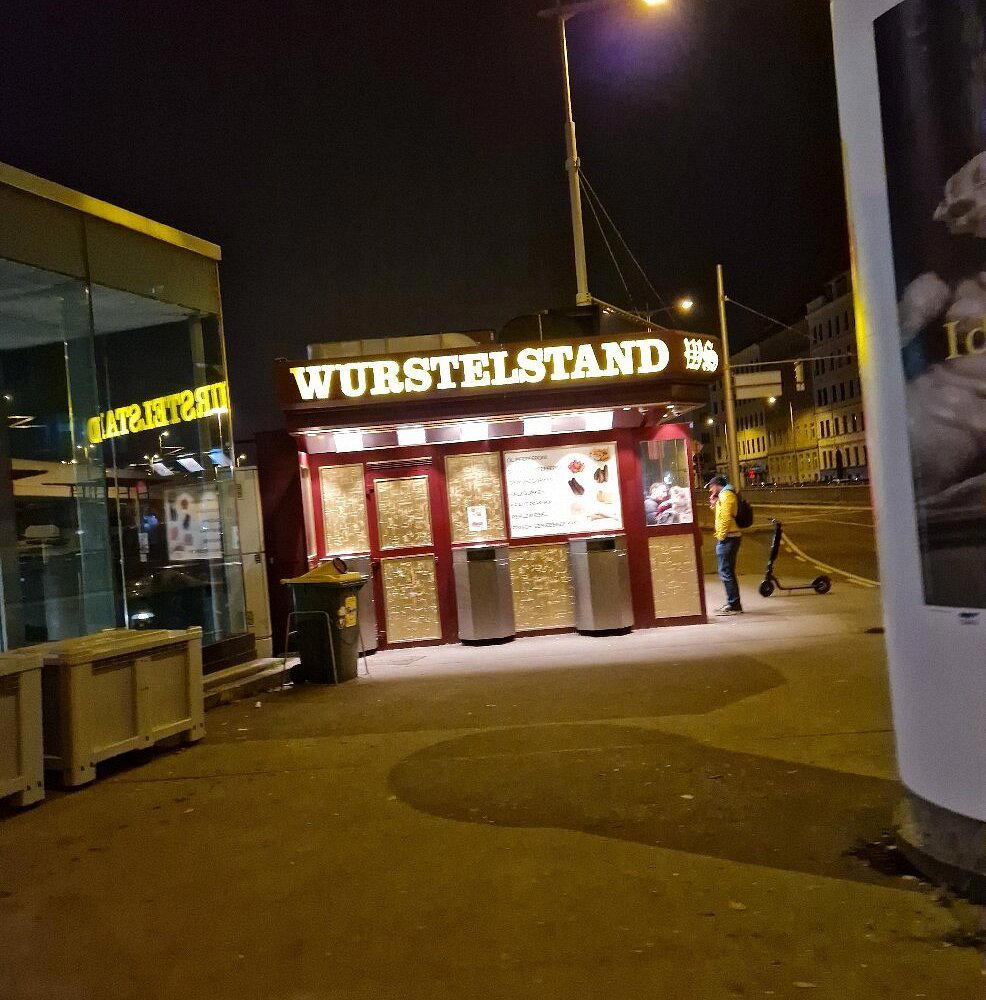
Vienna at Street Level: The Würstelstand as Urban Institution
Würstelstand am Südtiroler Platz is a Vienna Austrian Sausage Stand at Wiedner Gürtel 3, 1040 Wien, Austria, known for its walk-in-friendly service and low price tier. At Südtiroler Platz, where the U1 surfaces and the Wiedner Gürtel carries its steady traffic toward the fourth district, the Würstelstand occupies the kind of position that no amount of urban planning produces deliberately. It arrives at the intersection of transit and appetite, a low-slung counter where the architecture of the moment is a cloud of steam and the soundtrack is the hiss of a heated cabinet and the clatter of the tram. This is not dining as event. It is dining as reflex, and Vienna has built a civic identity around it.
The Viennese Würstelstand is not a remnant of an older city. It is one of the few genuinely democratic formats in a dining culture that otherwise sorts itself into sharp price tiers. At the upper register, restaurants like Steirereck im Stadtpark and Konstantin Filippou represent Austrian fine dining at its most considered, with tasting menus priced at €€€€ and reservation windows measured in weeks. At the creative end of the formal spectrum, Mraz & Sohn and Amador occupy similarly rarefied ground. The Würstelstand exists outside that hierarchy entirely, answering a different question: what does a city eat when it is not performing?
The Stand That Changed With the City Around It
The evolution of the Würstelstand am Südtiroler Platz mirrors the broader arc of Vienna's fourth and fifth districts over the past three decades. Wiedner Gürtel, the ring road that runs along the stand's address, has shifted from a purely transit corridor to a street with denser residential use and a more varied pedestrian population. The Würstelstand absorbed that shift without reinvention. What changed was the crowd rather than the counter: construction workers, night-shift hospital staff, late commuters, and, increasingly, the after-dinner crowd spilling out from the neighbourhood's restaurants, all arriving at the same small window with the same basic requirement.
This kind of institutional permanence is worth marking. Vienna's Würstelstände as a category have faced the same pressures as street food formats across any European capital: rising rents, health code modernisation, competition from quick-service chains, and the attrition of operators who cannot sustain small-margin businesses across multiple decades. The stands that survive do so by becoming genuinely embedded, which means regulars, a reliable product, and a location that proves its value daily. Südtiroler Platz, adjacent to the transit interchange and within the orbit of the Musikverein and Karlsplatz, is a location that earns its footfall without requiring marketing.
What to Order and Why It Matters
The Austrian sausage lexicon at a Würstelstand is more compressed than it appears. The Käsekrainer, a pork sausage threaded with melted cheese pockets, is the format's most discussed item and the one that most polarises visitors unfamiliar with the effect of hot cheese punctuating a casing under heat. The Bratwurst and Frankfurter represent a simpler register, while the Debreziner, with its paprika-forward heat, reflects the culinary geography of a city that spent centuries in trading contact with Hungary. Condiments arrive in the standard configuration: senf in both mild and sharp varieties, ketchup, and horseradish for those who want it.
Bread format matters here. The Semmel, a crusty roll that holds its structure against the weight and juice of a grilled sausage, is standard. Some operators offer Wachauer bread. The physical ritual of standing at a counter, eating from a paper tray, and drinking a beer or a small Veltliner is not incidental to the experience; it is the experience. Tableside service, white linen, and a considered wine list are what defines Landhaus Bacher in Mautern an der Donau. What defines the Würstelstand is precisely the absence of those things.
Visitors whose frame of reference for sausage is limited to international fast food will find the Würstelstand corrective. The product quality at the better Viennese stands is several grades above casual expectation, reflecting a supply chain tied to Austrian butchery standards that remain among the more detailed in Central Europe.
The Format in Its City Context
Vienna's approach to street eating has always been more formalised than Paris or Rome, and less theatrical than a Bangkok night market. The Würstelstand occupies a civic category the city takes seriously enough to licence and regulate as a distinct business type. The stands are not spontaneous; they are permitted, positioned, and in many cases have operated in the same location for a generation or more. That institutional quality is part of what makes them useful reference points in a city where the dining scene otherwise divides sharply between Beisl tradition and the international fine-dining tier exemplified by multi-course tasting menus at addresses like Ikarus in Salzburg or the alpine precision of Griggeler Stuba in Lech.
The Würstelstand operates closest to the Beisl in democratic spirit, though the Beisl offers a table, a menu, and a waiter. The stand removes all of that mediation. Eating here is purely functional in the leading sense: a transaction conducted between a city and its hunger, without ceremony and without delay. That simplicity, in a culture that understands ceremony as well as Vienna does, is its own kind of sophistication.
The broader Austrian dining conversation is worth tracking regionally. Restaurants such as Kräuterreich by Vitus Winkler in Sankt Veit im Pongau, Restaurant 141 by Joachim Jaud in Mieming, and Schwarzer Adler in Hall in Tirol show how deeply embedded the culture of quality eating runs across Austria at every level, from regional fine dining to the stand at the tram stop. Even Ois in Neufelden and Gourmetrestaurant Tannenhof in Sankt Anton am Arlberg point toward a food culture where provenance and craft are expected at every price point.
At-a-Glance Comparison
Comparable venues nearby, for context on price, style, and recognition.
| Venue | Cuisine | Price | Notes |
|---|---|---|---|
| Würstelstand am Südtiroler PlatzThis venue — the venue you are viewing | Austrian Sausage Stand | $ | Not listed |
| eh scho wuascht | Traditional Austrian Würstelstand | $ | Kaiserebersdorf |
| Petra's Würstelstand | Traditional Austrian Sausages | $ | Siebenhirten |
| Würstelwaggon | Viennese Sausage Stand | $ | Simmering |
| Bauer | Traditional Viennese Gasthaus | $ | Prater |
| Würstlstand | Traditional Viennese Sausage Stand | $ | Alsergrund |
Continue exploring
More in Vienna
Restaurants in Vienna
Browse all →
Bars in Vienna
Browse all →
Hotels in Vienna
Browse all →
At a Glance
- Lively
- Well Known
- Late Night
- Casual Hangout
- Standalone
- Beer Program
- Street Scene
Current opening hours
- Monday
- 9 AM–4 AM
- Tuesday
- 9 AM–4 AM
- Wednesday
- 9 AM–4 AM
- Thursday
- 9 AM–4 AM
- Friday
- 9 AM–4 AM
- Saturday
- 9 AM–4 AM
- Sunday
- 9 AM–4 AM
Hours can change for holidays and private events. Last verified .
Lively and diverse street-side atmosphere with a characterful vendor serving quick bites into the early morning hours.