


1 Michelin Star · Tabelog 100 #99
Our verdict
A Michelin-starred Spanish-Japanese counter in Shinjuku's Arakicho district, Ubuka channels a single obsession: crab. Chef Jerome Quilbeuf structures the menu around shellfish, moving between kaiseki-inflected preparations and French technique, hair crab terrine, prawn in sauce américaine, rice finished in earthenware. The result is a focused, generous meal that earned Michelin recognition in 2024 and an Opinionated About Dining recommendation in 2023.

Pearl is the En Primeur Club membership app, where members save venues, book tables and use the concierge.
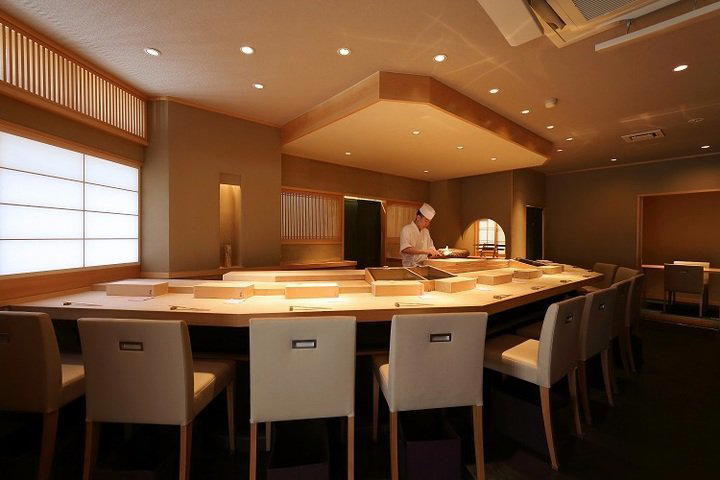
Where Shellfish Sets the Agenda
Tokyo's Michelin tier is crowded with precision and restraint, the hushed sushi counters of Ginza, the kaiseki temples of Akasaka, the French-Japanese hybrids that populate central Minato. Ubuka, a one-star restaurant that opened in the Arakicho pocket of Shinjuku City, operates in a different register. Here, the organising principle is not technique or philosophy in the abstract, but a single ingredient: crab. The menu is structured almost entirely around shellfish, with crab and prawn driving each course from the first to the last. That focus is unusual at this price and recognition level, where menus typically aim for breadth. Ubuka argues that depth has its own rewards.
The Logic of a Single Obsession
Restaurants built around one ingredient are a legitimate format in Japanese dining, the specialist ramen shop, the unagi specialist, the fugu counter, but that model rarely extends into the Western-influenced bracket. Ubuka sits in its own category: a Spanish-coded restaurant, led by a French-trained chef, using a Japanese kaiseki framework to organise a shellfish-centred menu. That combination is rare in any city and almost singular in Tokyo's current Michelin-starred set.
The menu moves through crab and prawn in different registers. A terrine of hair crab draws on French technique, cold-set and sliced with the structural logic of classical charcuterie applied to something oceanic. Fried prawns arrive in sauce américaine, a bisque-based preparation that doubles down on crustacean intensity. The meal closes with crab and vegetables cooked in an earthenware pot with rice, a kaiseki ending that reframes the Western courses that preceded it. Portions, notably, are generous. At a Michelin-starred counter in Tokyo, where restraint sometimes edges into parsimony, that generosity matters. The meal is designed so that guests can fully engage with the shellfish, not merely encounter it.
The cross-pollination of French technique with Japanese seasonal logic and Spanish flavour references is increasingly a feature of Tokyo's mid-tier starred category, where chefs with international training are working outside the French fine dining or sushi templates. For comparison, Crony in Tokyo represents the innovative French end of that spectrum, while L'Effervescence remains the benchmark for classical French discipline translated into a Tokyo context. Ubuka's approach, Spanish-accented, shellfish-focused, kaiseki-framed, occupies a different position within the same broader shift.
Arakicho as Setting
Arakicho is not a dining neighbourhood that appears on most first-time itineraries. Tucked between Shinjuku Gyoen and the bar-heavy corridors of Yotsuya Sanchome, it functions as a quiet residential and low-key restaurant district, far removed from the density and visibility of Ginza or Minami-Aoyama. Restaurants here tend to have regulars rather than queues, and the atmosphere in the evenings reflects that: measured, unhurried, domestic in scale.
That context matters for understanding what Ubuka is. The address, a ground-floor space in the IS Building on Arakicho 2-14, suggests a room that earns its recognition through cooking rather than spectacle. Tokyo's Michelin culture has long validated this format: the restaurant that requires effort to locate, that seats few and books far ahead, that operates on the assumption that its guests have chosen deliberately. Ubuka fits that pattern. It is open Monday through Saturday from 5:30 to 11 pm, closed on Sundays, with an evening-only format that confirms its character as a destination rather than a neighbourhood stop.
The Sensory Architecture of a Crab-Led Menu
The sensory proposition at Ubuka is concentrated rather than varied. Where a kaiseki progression typically sequences contrast, texture against texture, temperature against temperature, delicate against assertive, a shellfish-focused menu asks the kitchen to generate that variation from within a single ingredient's range. Crab offers more latitude than it might initially seem: cold-set in terrine, it reads as mineral and precise; in the earthenware rice pot at the close of the meal, it becomes warmer, earthier, integrated. Prawn in sauce américaine delivers a different register of intensity, the reduction amplifying the natural sweetness of the crustacean until it becomes something approaching savour.
The kaiseki-style closing course, rice, crab, and vegetables in an earthenware pot, functions as both structural anchor and a nod to the dinner's Japanese context. Earthenware-pot rice (donabe-style cooking) carries specific sensory associations in Japanese dining: the weight of the vessel, the steam that carries fragrance, the contrast between the crust at the base and the looser grains above. Applying that format to a shellfish-centred menu connects the French and Spanish elements that precede it to a distinctly Japanese conclusion.
This structural approach invites comparison with restaurants elsewhere in Japan where Western technique meets Japanese seasonal discipline. RyuGin in Tokyo represents the high-formality end of that integration, with kaiseki structure applied to technically demanding Japanese cuisine. Harutaka operates in the sushi counter format that has its own strict sensory logic. Ubuka's register is quieter than either, more focused, without the formal architecture of a full kaiseki progression or the precision theatre of an omakase counter.
Recognition and Position
Both signals confirm consistent execution rather than occasional brilliance. At the ¥¥¥ price range, it sits a tier below comparable multi-starred Tokyo destinations, Sézanne and L'Effervescence both price higher at ¥¥¥¥, which places Ubuka in an accessible bracket for its recognition level. That combination of a Michelin star, Opinionated About Dining visibility, and a mid-tier price point is the kind of value differential that drives the restaurant's consistent bookings.
Chef Jerome Quilbeuf's training background in French cuisine informs the technical language of the menu, particularly in preparations like the hair crab terrine and the sauce américaine. Those credentials function as the kitchen's evidence base, the reason the French-inflected dishes on a Spanish-coded menu read as considered rather than confused. For a longer view of how European-trained chefs are operating in Japan's fine dining tier, akordu in Nara offers a useful point of comparison, as does HAJIME in Osaka, which operates at a higher formality level. Outside Japan, the shellfish-intensive fine dining format has a reference point at Le Bernardin in New York City, where seafood-as-primary-subject has operated at the highest tier for decades.
Planning Your Visit
Ubuka operates Tuesday through Saturday with dinner service running from 5:30 to 11 pm; the kitchen is dark on Sundays and closed on Mondays. The Arakicho address is walkable from Yotsuya Sanchome station on the Marunouchi line, making access direct from central Tokyo despite the neighbourhood's quieter profile. The ¥¥¥ pricing tier places an evening here above an izakaya dinner but below the entry-level cost of Tokyo's leading omakase counters, a realistic budget for a meal that delivers recognised Michelin-standard cooking with a deliberately generous approach to portions.
For those building a broader Tokyo itinerary around serious dining, our full Tokyo restaurants guide maps the starred and recognised options across neighbourhood and cuisine type. Accommodation options for the area are covered in our full Tokyo hotels guide, and for pre- or post-dinner programmes, our full Tokyo bars guide, wineries guide, and experiences guide provide further context. For those extending travel beyond Tokyo, restaurants such as Gion Sasaki in Kyoto, Goh in Fukuoka, 1000 in Yokohama, and 6 in Okinawa represent the wider range of Japan's recognised fine dining circuit. In New York, Atomix provides an interesting parallel as a venue that applies Korean structure to a rigorous tasting format, a different culinary logic, but a comparable level of commitment to a defined point of view.
Frequently asked questions
What is the must-try dish at Ubuka?
Given that the menu is built around shellfish, every course reflects the kitchen's primary focus, but the hair crab terrine is the dish that most clearly signals the restaurant's identity: a French technique applied to Japanese seasonal seafood, cold-set and precise, carrying the mineral character of the ingredient without obscuring it. The earthenware pot of crab and vegetable rice that closes the meal is the structural anchor, a kaiseki-format ending that reframes everything that preceded it. Both preparations appear consistently in the Michelin guide's own description of Ubuka's cooking, which cites the terrine specifically as a reference point for the menu's French-Japanese-Spanish convergence.
Peers You’d Cross-Shop
| Venue | Cuisine | Price | Awards | Notes |
|---|---|---|---|---|
| UbukaThis venue (the venue you are viewing) | Crustacean Kaiseki Omakase | $150–200 | 1 Michelin Star · Tabelog 100 #99 | Not listed |
| Harutaka | Edo-Style Omakase Sushi | $200–300 | 3 Michelin Stars · World's 50 Best #76 | Sushi |
| RyuGin | Modern Kaiseki | $500+ | 3 Michelin Stars · World's 50 Best #41 | Kaiseki, Japanese |
| L'Effervescence | Modern French with Japanese Influences | $200–300 | 3 Michelin Stars · World's 50 Best #69 | French |
| HOMMAGE | Modern French with Japanese Influences | $150–200 | 2 Michelin Stars · World's 50 Best #78 | Innovtive French, French |
| MAZ | Innovative Peruvian-Japanese Fusion | $150–200 | 2 Michelin Stars · World's 50 Best #28 | Innovative |
Recognition history
Dated appearances from independent guides and award organizations, with the underlying list record or original source where available.
Michelin 1 Star
Michelin
Opinionated About Dining Top Restaurants in Japan Recommended
Opinionated About Dining
Tabelog 100 #99 · No. 99
Tabelog · Tabelog 100 - Japanese cuisine - TOKYO - 2025
Full recognition history (5 entries)
Michelin 1 Star
Michelin
Opinionated About Dining Top Restaurants in Japan Recommended
Opinionated About Dining
Continue exploring
More in Tokyo
Restaurants in Tokyo
All restaurants in Tokyo →



Bars in Tokyo
All bars in Tokyo →






Details
- Intimate
- Elegant
- Sophisticated
- Business Dinner
- Special Occasion
- Chefs Counter
- Sake Program
- Omakase
- Sake
- Wine
Current opening hours
- Monday
- 5:30–11 PM
- Tuesday
- 5:30–11 PM
- Wednesday
- 5:30–11 PM
- Thursday
- 5:30–11 PM
- Friday
- 5:30–11 PM
- Saturday
- 5:30–11 PM
- Sunday
- Closed
Hours can change for holidays and private events. Hours as of .
Serene, relaxing, and unpretentious with a humble, tactile atmosphere in a modest 14-seat space.