
On the 46th floor of a Xinyi tower, The Ukai brings the Japanese teppanyaki tradition to one of Taipei's most address-conscious districts. The format is theatrical and precise, the elevation literal.
Pearl is the En Primeur Club membership app — saves, bookings, and concierge access live there. Same editors, same standards.
- Address
- 110, Taiwan, Taipei City, Xinyi District, Songzhi Rd, 17號46樓
- Phone
- +886 2 7730 1166
- Website
- ukai.co.jp
- Directions
- Get directions
 Saves & bookings on Pearl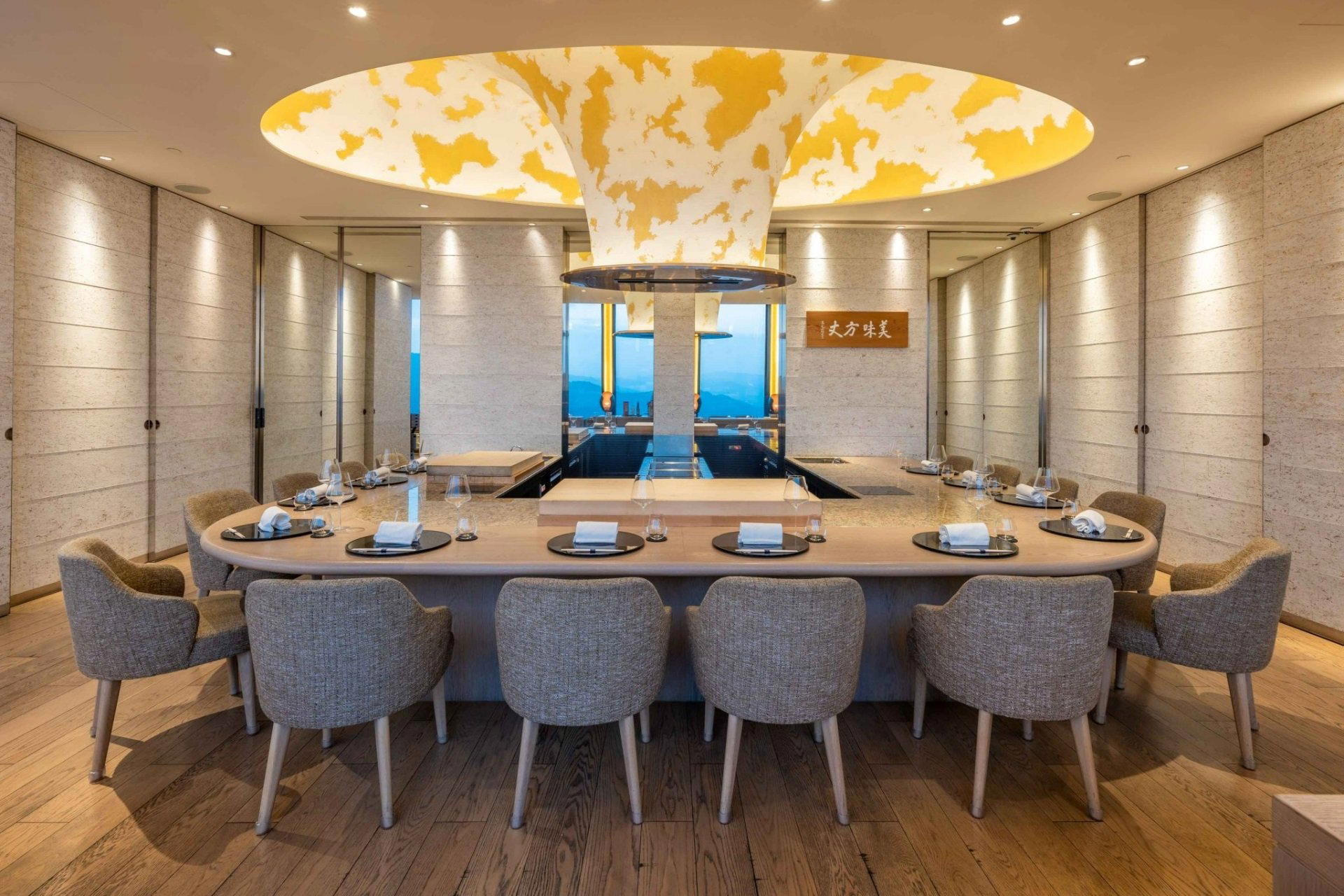
Xinyi at Altitude: Teppanyaki Above the Skyline
Taipei's Xinyi District operates on a vertical logic that few other neighbourhoods in the city share. The streets below are wide, corporate, and deliberately curated, department stores, tower lobbies, and glass facades that signal financial weight rather than culinary adventure. But the restaurants that occupy the upper floors of these towers tell a different story. At 46 storeys above Songzhi Road, the dining room at The Ukai occupies a position that is as much about the city as it is about the plate in front of you. The teppanyaki counter here does not exist despite its corporate surroundings, it is, in a specific way, an extension of them: formal, controlled, spatially precise.
This is a meaningful context for understanding what teppanyaki means in this part of Taipei. The format arrived in Taiwan as an import from Japan, where counter cooking around a flat iron griddle had long served as a theatrical compromise between the kaiseki tradition and the demands of a time-pressured, expense-account dining culture. In Xinyi's upper floors, that compromise finds its most natural home. The neighbourhood's proximity to major financial institutions and luxury retail creates a clientele for whom the teppanyaki format, sequential, unhurried, visually legible, is a specific kind of business hospitality as much as a culinary exercise.
The Teppanyaki Format in Taipei's Premium Tier
Within Taipei's broader premium Japanese dining circuit, teppanyaki occupies a distinct position. It sits apart from the omakase counters that have proliferated across the city's sushi and kaiseki segments, and it functions differently from the izakaya-influenced formats popular in Da'an and Zhongshan. The ritual is public and communal in a way that a private omakase room is not, diners watch the same surface, follow the same sequence, and share a spatial experience that is legible to everyone at the counter simultaneously.
Robin's Teppanyaki and Zan represent different points on Taipei's teppanyaki spectrum, the former with a longer local history, the latter operating in a more compact format. For comparison, logy and Taïrroir operate in the same price tier ($$$$) but in European and Taiwanese-contemporary idioms respectively, making The Ukai a specific choice for those who want the Japanese counter format at equivalent spend.
The restaurant's recognition signals that it has cleared the guide's minimum threshold for kitchen quality without yet reaching star level. In Taipei's competitive fine-dining field, which includes two-star operations like Le Palais, the Plate functions as a credible marker of consistency rather than a claim to category leadership. It is a useful signal for first-time visitors who want assurance without the full commitment of a starred reservation.
Elevation as Editorial Statement
The address at 17 Songzhi Road, 46th floor, is not incidental. In Taipei's fine-dining geography, height carries deliberate associations. Restaurants that occupy the upper floors of Xinyi towers are, by structural default, destination dining, no foot traffic, no passing trade, no casual drop-in. Every diner arrives by choice and by arrangement. That changes the room's character in ways that ground-floor restaurants rarely achieve. The city spread below functions as a constant ambient presence, particularly after dark when the Xinyi grid resolves into a pattern of light that frames the counter cooking in a way that daylight does not.
This vertical positioning also places The Ukai in a specific Taipei conversation about how Japanese restaurant brands have expanded into the city. The restaurant group originates in Japan, where it operates across multiple formats including teppanyaki, shabu-shabu, and tofu kaiseki. Its presence in Taipei's Xinyi tower reflects a pattern visible across the district: established Japanese hospitality operators treating the neighbourhood as a regional anchor point, calibrating their format to a clientele that moves between Tokyo, Singapore, and Taipei with fluency.
Situating the Visit: Regional and International Teppanyaki Context
For readers building a picture of where the restaurant sits in a wider Asian teppanyaki circuit, the comparison points are instructive. Hibana by Koki in Hanoi represents the format's adaptation to a Southeast Asian market, while Ishigaki Yoshida in Tokyo and JIBUNDOKI in Osaka sit in the format's home market, where the expectations and reference points differ considerably. Taipei's teppanyaki offer occupies a middle position: strongly Japanese in technique and format, but operating in a city whose dining culture has its own distinct priorities around value, volume, and theatrical presentation.
For those whose Taiwan itinerary extends beyond Taipei, the island's broader premium dining geography is worth mapping. JL Studio in Taichung and GEN in Kaohsiung represent the southern and central cities' approaches to high-concept dining, while A Cun Beef Soup in Tainan anchors the island's street-food tradition at the opposite end of the formality spectrum. For resort dining outside the capital, Volando Urai Spring Spa & Resort in Wulai and Akame in Wutai Township sit in entirely different registers, both geographically and culinarily.
Xinyi's restaurant scene is also worth reading against the rest of Taipei's dining districts. The neighbourhood's offer skews formal, international, and vertically oriented in ways that Da'an's ground-level density and Zhongshan's mid-range Japanese corridor do not. Those distinctions shape the district's dining landscape.
Know Before You Go
Address: 46F, 17 Songzhi Road, Xinyi District, Taipei City 110, Taiwan
Cuisine: Teppanyaki
Price range: $$$$
Awards: Michelin Plate (2024)
3 / 5 (1,229 reviews)
Booking: Advance reservation recommended.
Reputation Context
Comparable venues nearby, for context on price, style, and recognition.
| Venue | Cuisine | Price | Awards | Notes |
|---|---|---|---|---|
| The UkaiThis venue — the venue you are viewing | Japanese Kappou and Teppanyaki | $$$$ | Michelin Plate | Not listed |
| Uke | Edomae-style Omakase | $$$$ | Michelin Plate | Xicun |
| Sushi Touryuumon | Japanese Omakase | $$$$ | Michelin Plate | Checeng |
| Sasa | Traditional Edomae Omakase | $$$$ | Michelin Plate | Zhongshan |
| Zan | Japanese Teppanyaki | $$$$ | Michelin Plate | Fude |
| Sushi Nomura | Edomae Sushi Omakase | $$$$ | Michelin Plate | Dunhuang |
Recognition history
Dated appearances from independent guides and award organizations, with the underlying list record or original source where available.
Michelin Plate
Michelin
Continue exploring
More in Taipei
Restaurants in Taipei
Browse all →
Bars in Taipei
Browse all →
Hotels in Taipei
Browse all →
Wineries in Taipei
Browse all →
At a Glance
- Elegant
- Sophisticated
- Intimate
- Scenic
- Date Night
- Business Dinner
- Celebration
- Special Occasion
- Open Kitchen
- Panoramic View
- Private Dining
- Sake Program
- Extensive Wine List
- Mountain
- Skyline
Current opening hours
- Monday
- 12–3 PM, 3:30–5:30 PM, 6–10 PM
- Tuesday
- 12–3 PM, 3:30–5:30 PM, 6–10 PM
- Wednesday
- 12–3 PM, 3:30–5:30 PM, 6–10 PM
- Thursday
- 12–3 PM, 3:30–5:30 PM, 6–10 PM
- Friday
- 12–3 PM, 3:30–5:30 PM, 6–10 PM
- Saturday
- 12–3 PM, 3:30–5:30 PM, 6–10 PM
- Sunday
- 12–3 PM, 3:30–5:30 PM, 6–10 PM
Hours can change for holidays and private events. Last verified .
Cozy, elegant atmosphere with futuristic decorations, open kitchen views of chefs at work, and dramatic city and mountain vistas from the 46th floor.