Our verdict
The Sultan's Tent has held its place on Front Street East as one of Toronto's most enduring North African dining rooms, serving Moroccan and broader Maghrebi cuisine in a setting that leans hard into ceremonial atmosphere. The room, the format, and the menu all speak to a dining tradition built around collective ritual rather than individual plates. For Toronto's Old Town dining corridor, it occupies a cultural register few others attempt.

Pearl is the En Primeur Club membership app — saves, bookings, and concierge access live there. Same editors, same standards.
The menu
What to order
- Rack of Lamb
- Chicken Tagine
- B’stila
- Harira
Where North African Ceremony Meets a Canadian Dining Room
Toronto's Old Town strip along Front Street East has long attracted restaurants that trade on atmosphere as much as food: the neighbourhood draws pre-theatre crowds, hotel guests, and expense-account dinners in roughly equal measure. Within that corridor, The Sultan's Tent operates in a category almost entirely its own. Moroccan and broader Maghrebi cuisine in Canada is a relatively thin field at the formal dining level, and the restaurants that do it well tend to anchor their identity in ceremony: the sequence of courses, the communal vessels, the spiced tea poured from height. The Sultan's Tent has built its reputation around precisely that kind of structured hospitality.
The Cultural Logic of Maghrebi Dining
To understand what The Sultan's Tent is doing, it helps to understand what Moroccan restaurant dining actually is as a tradition. The format descends from a concept of hospitality that treats the meal as a social event with defined stages. It begins with cold and warm salads, moves through a bastilla (the celebrated sweet-savoury pastry of pigeon or chicken, almonds, and spiced egg), then to a tagine or couscous as the centrepiece, and closes with mint tea and pastries. Each stage has its own logic: the salads test the kitchen's range across spice and texture; the bastilla is a technical set piece that rewards a kitchen with real skill in pastry and spice balance; the tagine or couscous is the slow-cooked heart of the meal. In Morocco itself, this sequence is the standard architecture for a celebratory meal. Transplanted to a Canadian dining room, it becomes something slightly theatrical by default, and the question any restaurant in this category must answer is whether the theatre is earned or hollow.
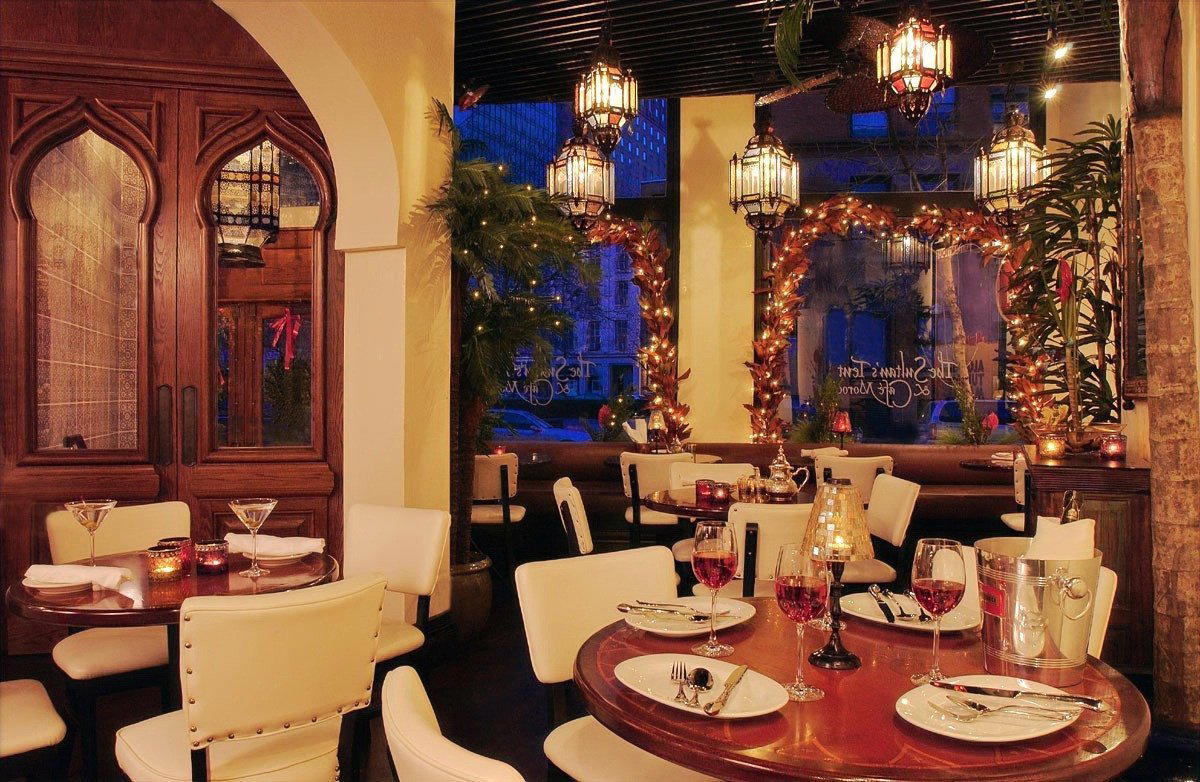
The answer at The Sultan's Tent leans toward earned. The room's design works with the food's ceremonial logic rather than against it: draped fabrics, lantern lighting, and low seating configurations borrow from the aesthetic of a Marrakech riad's dining courtyard without tipping into kitsch. That balance is harder to strike than it sounds. Many North African restaurants in North American cities either over-explain the tradition in a way that flattens it, or abandon the architecture entirely in favour of a modernised small-plates format. The Sultan's Tent holds the line on the traditional sequence.
Front Street East in Context
The restaurant's address at 49 Front Street East places it within walking distance of the St. Lawrence Market, one of Toronto's oldest and most active food markets, and a short distance from the city's theatre district. This geography matters. Front Street East draws diners who are already in a celebratory frame of mind, making it a natural fit for a format that leans into occasion dining. The competition along this corridor skews toward steakhouses, Italian rooms, and Canadian contemporary, which means North African cuisine occupies an essentially uncontested niche in the immediate neighbourhood.
At the broader Toronto level, the city's premium dining scene has become increasingly concentrated around a particular kind of modern tasting-menu format. Restaurants like Alo (Contemporary) and Sushi Masaki Saito (Sushi, Japanese) represent the city's top tier by conventional critical measure, both operating at the $$$$ price point with format discipline and narrow booking windows. Aburi Hana (Kaiseki, Japanese) and Don Alfonso 1890 (Contemporary Italian, Italian) similarly anchor themselves in a distinct culinary tradition with a fixed, sequential format. What The Sultan's Tent shares with these venues is the sequential, structured meal; what separates it is the cultural origin and the accessibility of the atmosphere, which sits closer to celebratory-accessible than to minimalist-reverent.
What the Format Delivers
The bastilla is worth pausing on as a measure of any Moroccan kitchen's ambition. The dish requires confident pastry work, a precise spice hand with ras el hanout or cinnamon-forward blends, and the nerve to commit to the sweet-savoury pairing that confuses guests on first encounter. It is the kind of dish that either converts people immediately or leaves them unsure what they just ate. Getting it right is a genuine technical challenge. When it works, it functions as one of North African cuisine's most compelling arguments for its place at the formal dining table.
Tagines, the other major set piece, reward patience both from the kitchen and the diner. The slow-braised format, with preserved lemon, olive, and spice combinations that vary by protein and regional tradition, produces a sauce density that is difficult to shortcut. For diners accustomed to the quick-fire tempo of modern urban restaurants, the tagine's pace is itself part of the experience.
Where This Fits in the Canadian Restaurant Picture
Across Canada, the restaurants attracting the most critical attention tend to fall into two categories: highly localised Canadian cuisine (foraging-forward, terroir-driven) and imported European or Japanese fine dining traditions executed at high technical levels. North African cuisine sits outside both of those categories, which means places like The Sultan's Tent operate without a large peer reference group in the Canadian context. For a comparison of how different cultural dining traditions are playing out across the country, see Tanière³ in Quebec City for the hyper-local Canadian end, or Jérôme Ferrer - Europea in Montreal for a European fine dining anchor. At the Ontario level, restaurants like DaNico (Italian) in Toronto or Eigensinn Farm in Singhampton show the range of what formal dining looks like across the province, none of it particularly close to the Maghrebi tradition The Sultan's Tent is working within.
For readers building a broader picture of Toronto's dining scene, our full Toronto restaurants guide maps the city's key dining corridors and price tiers. And for reference points outside Canada, the kind of precision tasting format that The Sultan's Tent's sequential meal loosely echoes at the other end of the formality spectrum can be found at Le Bernardin in New York City or Atomix in New York City, where the sequenced, culturally-rooted meal has been taken to a different extreme. Closer to home in Ontario, Restaurant Pearl Morissette in Lincoln, The Pine in Creemore, and Barra Fion in Burlington represent the regional restaurant scene at its most considered, each working within a very different cultural register than the Maghrebi tradition but sharing a commitment to format integrity. Further afield, AnnaLena in Vancouver, Narval in Rimouski, Aux Anciens Canadiens in Quebec, and Bearspaw Golf Club in Calgary each anchor their identities in specific regional and cultural traditions, which is the same foundational move The Sultan's Tent is making, just from a very different cultural starting point.
Planning Your Visit
The Sultan's Tent is located at Address: 49 Front Street East, Toronto, in the Old Town/St. Lawrence area, easily reached by TTC to Union Station or King Station. Reservations: Booking ahead is advisable given the venue's event and group dining appeal, particularly on weekends and pre-theatre evenings. Format: Expect a multi-course, sequenced meal in the Moroccan tradition; this is not a venue for a quick dinner. Leading for: Occasion dinners, groups, and diners with genuine interest in North African culinary tradition rather than a passing curiosity.
Frequently asked questions
Can I bring kids to The Sultan's Tent?
How would you describe the vibe at The Sultan's Tent?
at The Sultan's Tent?
Is The Sultan's Tent suitable for large group celebrations?
Cuisine and Credentials
| Venue | Cuisine | Price | Awards | Notes |
|---|---|---|---|---|
| The Sultan's TentThis venue — the venue you are viewing | Moroccan & Middle Eastern Fusion | $50–100 | Not listed | Not listed |
| Alo | Modern French Fine Dining with Asian Influences | $200–300 | 1 Michelin Star · La Liste Top Restaurants | Contemporary |
| Sushi Masaki Saito | Edomae-Style Omakase | $500+ | 1 Michelin Star · La Liste Top Restaurants | Sushi, Japanese |
| Aburi Hana | Modern Japanese Kyō-Kaiseki | $300–500 | 1 Michelin Star · The Best Chef One Knife | Kaiseki, Japanese |
| Don Alfonso 1890 | Modern Italian Fine Dining | $200–300 | 1 Michelin Star · La Liste Top Restaurants | Contemporary Italian, Italian |
| Edulis | Mediterranean Seafood Tasting Menu | $150–200 | 1 Michelin Star · World's 50 Best #25 | Canadian, Mediterranean Cuisine |
Continue exploring
More in Toronto
Restaurants in Toronto
All restaurants in Toronto →
Bars in Toronto
All bars in Toronto →

Details
- Romantic
- Elegant
- Ornate
- Intimate
- Date Night
- Special Occasion
- Celebration
- Group Dining
- Live Music
- Historic Building
- Prix Fixe
- A La Carte
- Vegetarian Friendly
- Vegan Options
- Gluten Free Options
- Halal
Intimate and romantic atmosphere with lantern-lit tents, plush divans, tapestries, and ambient Arabic music creating an ornate, cultural escape.