Our verdict
Tanoshii sits on Brabanter Strasse in Cologne's Belgisches Viertel, a neighbourhood where Japanese-inflected dining has carved out a quiet but serious foothold alongside the area's broader fine-dining current. The address places it within walking distance of several of the city's most recognised restaurant kitchens, making it a natural entry point for those tracing Cologne's more understated dining register.

Pearl is the En Primeur Club membership app, where members save venues, book tables and use the concierge.
The menu
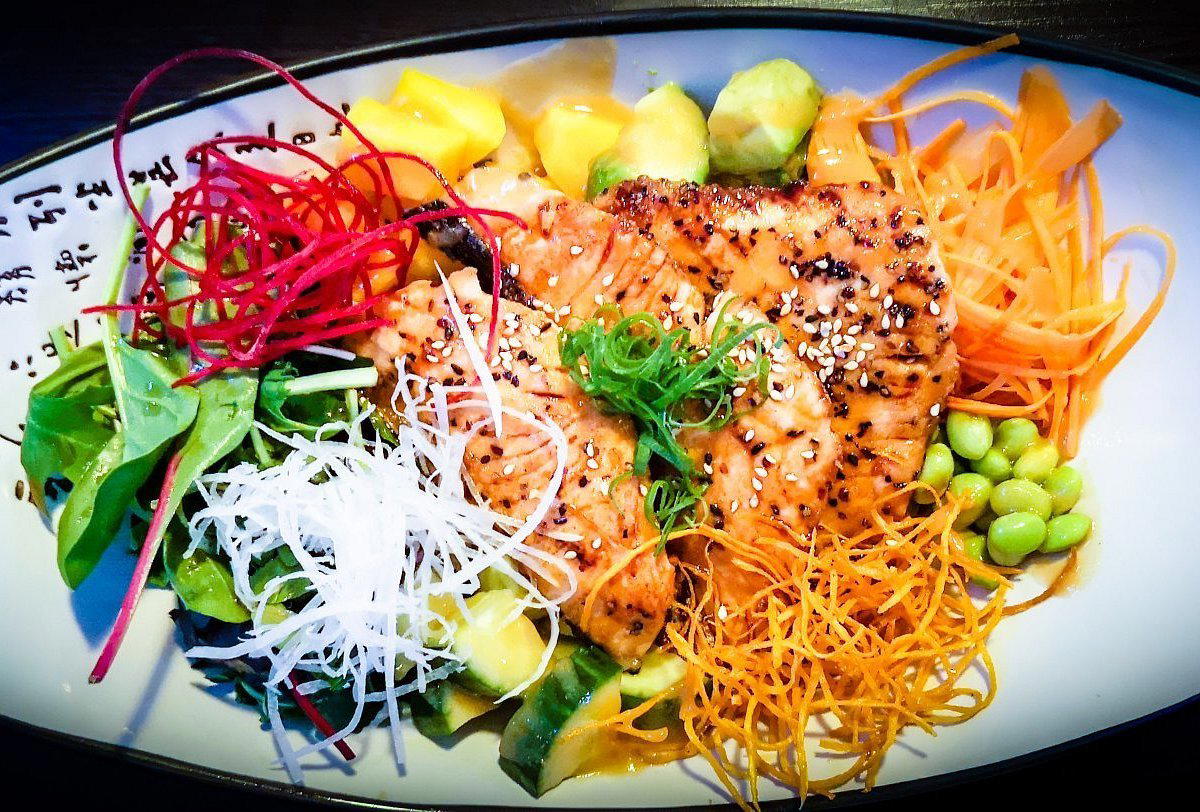
What to order
- Tanoshii Roll
- Volcano Roll
- Unagi Dragon Roll
- Black Salmon Miso
A Street, a Neighbourhood, and What the Meal Promises
Brabanter Strasse runs through the Belgisches Viertel, one of Cologne's more considered dining districts, where the density of serious kitchens is higher than the foot traffic might suggest. The quarter has attracted a tier of restaurants that operate without the volume ambitions of the city centre: smaller rooms, deliberate menus, a presumption that the guest has come with purpose. Tanoshii, at number 3, occupies that same register. The name itself, Japanese for pleasure or enjoyment, signals an orientation toward the experience of eating rather than the architecture of spectacle.
Cologne's fine-dining scene has consolidated around a handful of distinct cuisines and price points. At the upper end, addresses like Ox & Klee and La Cuisine Rademacher represent the modern European tradition with strong local recognition. Japanese cooking, by contrast, occupies a smaller and more dispersed space in the city, rarely commanding the same institutional visibility but sustaining a loyal audience that values precision over profile. Tanoshii positions itself within that quieter current.
How the Meal Unfolds: Following the Arc
The editorial angle that makes Japanese dining legible, particularly in European cities, is sequencing. A well-constructed Japanese meal is not a parade of dishes but a progression: something light and clean to calibrate the palate, a middle register of umami-forward courses that build on each other, and a close that restrains sweetness in favour of resolution. That arc is the grammar of the tradition, and it is what separates considered Japanese dining from a menu that simply assembles Japanese ingredients.
In cities like Tokyo, the tasting progression at counters such as those at the three-Michelin-starred Aqua-level comparables across Germany is built around seasonal availability and supplier relationships that shift weekly. European kitchens working within Japanese frameworks face the structural challenge of sourcing within a different supply geography, which tends to push them toward either adaptation, substituting local fish and produce within Japanese technique, or import dependency, which raises costs and narrows flexibility. The more durable approach, as seen across Germany's more established Japanese-influenced addresses, is the hybrid model: Japanese sequencing and technique applied to the leading available Central European ingredients.
Germany's broader fine-dining map offers some instructive reference points. JAN in Munich and CODA Dessert Dining in Berlin both demonstrate how a structural logic borrowed from non-German traditions can be applied to a distinctly local ingredient vocabulary. The same structural thinking is visible in the output of kitchens like Schwarzwaldstube in Baiersbronn and Vendôme in Bergisch Gladbach, where French sequencing principles have been applied so consistently over years that the tradition feels embedded rather than imposed. Tanoshii operates within a younger and less mapped version of that same phenomenon, Japanese structure applied to a Rhenish dining room.
Where Tanoshii Sits in Cologne's Current
The Belgisches Viertel supports a dining range that runs from relaxed bistro formats, the neighbourhood-anchored Le Moissonnier Bistro is a useful reference, through to more destination-driven rooms. La Société and maiBeck each represent the modern European approach from different angles. Tanoshii's Japanese identity marks it as categorically distinct from those addresses, which is both a competitive advantage and a positioning challenge: the guest pool for serious Japanese dining in Cologne is smaller, but its commitment level is higher.
Internationally, the standard for Japanese-inflected tasting menus in Western cities is set by addresses like Atomix in New York City, where Korean-Japanese technique and hyper-specific sequencing have become the formal framework around which an entire restaurant identity is built. Closer to the European fine-dining tradition, Le Bernardin in New York City demonstrates how a commitment to a single protein category, in that case, fish, can structure every course in a progression without the menu feeling narrow. These references are not peers of Tanoshii in scale or recognition, but they illustrate the structural ambitions that the leading Japanese-influenced dining formats pursue. The question for any kitchen working in this mode is whether the sequencing is intentional enough to deliver that arc coherently.
Germany's more established fine-dining tier, Victor's Fine Dining by Christian Bau in Perl, Waldhotel Sonnora in Dreis, Restaurant Haerlin in Hamburg, Schanz in Piesport, and ES:SENZ in Grassau, tends to operate within French or modern European frameworks. Japanese dining occupies a distinct niche within that national fine-dining culture, one that rewards the guest who knows the tradition's own logic rather than mapping it onto French-derived expectations. The absence of a bread course is not an omission; the temperature progression of courses is deliberate; the seasoning register is lower, and the appreciation of that restraint is part of the experience.
Know Before You Go
Address: Brabanter Str. 3, 50674 Köln, Germany
Neighbourhood: Belgisches Viertel, Cologne
Price range: Not confirmed in; check directly before visiting
Dietary requests: Verify vegetarian or allergy accommodations directly with the venue before booking
Further reading: See our full Cologne restaurants guide for broader context on the city's dining scene
Frequently asked questions
What part of town is Tanoshii in?
Tanoshii is located at Brabanter Str. 3, 50674 Köln, Germany, Cologne.
How does Tanoshii compare to other Japanese restaurants in Cologne?
Cologne's Japanese dining scene is small enough that a kitchen operating in the Belgisches Viertel, specifically on Brabanter Strasse, a street associated with considered European and international formats, occupies a distinct position. Rather than competing with fast-casual sushi operations elsewhere in the city, Tanoshii aligns with the neighbourhood's bistro-to-serious-kitchen register, placing it closer to destination dining than neighbourhood convenience.
What should I order at Tanoshii?
Tanoshii sits in the Belgisches Viertel on Brabanter Strasse, a stretch that supports deliberate, course-driven kitchens. Given the Japanese format the editorial context signals, the logic is to follow the kitchen's sequence rather than order à la carte, the meal is structured to build, and interrupting that arc typically works against you. Arrive without a fixed agenda and let the progression do the work.
Should I book Tanoshii in advance?
The Belgisches Viertel draws a consistent dining crowd, and Brabanter Strasse in particular runs at high occupancy most evenings. For a Japanese kitchen operating in this neighbourhood, walk-in seats are rarely guaranteed. Booking ahead, ideally several days to a week out, is the practical approach, especially for weekend sittings.
What's the signature at Tanoshii?
The body context points to sequencing as Tanoshii's defining editorial frame: a meal structured in arcs rather than dishes delivered in isolation. In the context of Japanese dining in a European city, that commitment to progression, each course setting up the next, is the signature, more than any single plate.
Can Tanoshii handle vegetarian requests?
Japanese kitchens at this level typically accommodate dietary requirements when notified ahead of the booking, since the course structure requires the kitchen to adjust the full sequence rather than swap a single dish. Contact Tanoshii directly at their Brabanter Strasse address to confirm what the kitchen can accommodate for your visit.
Is Tanoshii worth it?
The Belgisches Viertel is one of Cologne's more seriously curated dining districts, and a Japanese kitchen holding a position on Brabanter Strasse is competing in a neighbourhood that already draws committed diners. Whether the meal justifies the evening depends on how much the format, structured, course-led Japanese dining, matches what you're after; if it does, the neighbourhood context and kitchen approach suggest the answer is yes.
Comparable Spots, Quickly
Comparable venues nearby, for context on price, style, and recognition.
| Venue | Cuisine | Price | Notes |
|---|---|---|---|
| TanoshiiThis venue (the venue you are viewing) | Japanese Sushi with Vietnamese Fusion | $30–50 | Not listed |
| Takumi | Authentic Japanese Ramen | $10–20 | Altstadt/Süd |
| Nobiko | Vegan Japanese Udon Noodle Bar | $20–30 | Kalk |
| Shima Bistro | Creative Japanese Fusion | $30–50 | Neustadt/Nord |
| Takumi 3 | Japanese Ramen | $20–30 | Nippes |
| Tigermilch | Modern Peruvian-Japanese Fusion | $30–50 | Neustadt/Süd |