
Tabelog 100 #45
Our verdict
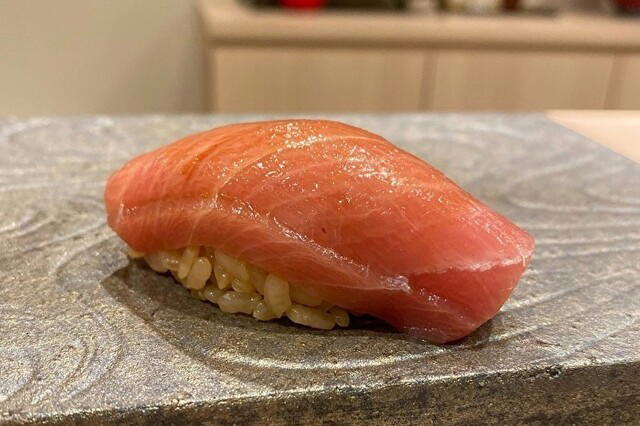
Sushi Akazu places red-vinegar sushi rice at the centre of an Osaka sushi counter where format matters as much as fish. The eight-seat, reservation-only room in Kitashinchi was selected for Tabelog Sushi WEST 100 in 2021, 2022 and 2025, putting it in the city’s serious sushi conversation rather than its casual dining orbit.

Pearl is the En Primeur Club membership app, where members save venues, book tables and use the concierge.
The menu
What to order
- Red vinegar sushi rice (akazu shari)
- Seasonal nigiri omakase
- Abalone liver sauce
Osaka’s restaurant scene has its own grammar: focused rooms, careful pacing, and a shift from street-level appetite to more concentrated dining. Here, Osaka sushi is less about display than sequence, temperature, rice and timing. Sushi Akazu sits within the city’s premium sushi conversation, where the meal is best understood through category focus and controlled progression rather than a casual à la carte exchange.
That matters because Osaka’s dining identity is often reduced to appetite and informality. A sharper reading separates everyday food culture from specialist rooms that treat Japanese seafood dining with more discipline. Here, sushi is not tourist shorthand for luxury. It is a format with rules; the question is whether those rules suit the evening.
Sushi, Japanese cuisine and seafood set the structure
The restaurant’s listed categories give the clearest organising principle. Sushi, Japanese cuisine and seafood point to a meal built around precision, seasonality and marine ingredients rather than broad, all-purpose dining. That kind of category focus rewards diners who notice rhythm: lighter and richer elements, texture, seasoning and temperature do not simply arrive as isolated bites; they build the shape of the meal.
Sushi Akazu is classified across sushi, Japanese cuisine and seafood, a useful Osaka signal, where a sushi restaurant can negotiate between purity and breadth. The seafood focus suggests a meal architecture that can be broader than a bare-bones sequence, though sushi remains the centre of gravity. That differs from neighbourhood places where sushi shares casual dining logic, and from the city’s louder celebration dining.
The 2025 Tabelog Hyakumeiten recognition places the restaurant in a regional sushi conversation, not merely an Osaka one. Tabelog’s Hyakumeiten lists tend to reward category depth and repeat local attention; for sushi in western Japan, the restaurant is read against other serious rooms rather than general fine dining. The 2025 score of 3.71 is not a Michelin-style star system, but in Tabelog culture this band can signal a substantial following among detail-oriented diners.
A focused room changes the social contract
Specialist sushi dining compresses the expectations of a meal. There is less room for distraction, less tolerance for drift, and stronger dependence on shared pacing. Osaka’s serious sushi rooms can feel more exacting than the city’s reputation suggests. The city may be conversational and food-obsessed, but a structured sushi meal asks diners to match the restaurant’s tempo. Sushi Akazu’s positioning is best understood as serious sushi with a room culture shaped by focus rather than spectacle.
That distinction matters. Many premium sushi restaurants can feel rigid by default, even without a formal rule. Here, the listed profile creates a narrower category: serious sushi and seafood-led Japanese dining without needing to read the room as a performance of formality. It does not make the restaurant casual; it signals a hospitality code different from the hush of some more austere dining rooms. For Osaka, that feels apt.
The format clarifies the experience: dining as a guided progression, not compartmentalised entertaining. The editorial logic stays the same throughout the meal: the sequence is shaped by the house, not assembled table by table. Diners choosing between Sushi Uchida, in a similar Osaka sushi price band, and this restaurant are deciding less between cuisines than between versions of concentration, category focus and room culture.
Where it sits in Osaka's premium dining map
Osaka has long supported expense-account meals and late-evening dining, but its stronger restaurants are not all formal in the same way. The city supports sushi, bars and compact specialist rooms because it has an audience for repeat, category-specific dining. Sushi Akazu fits this Osaka context better than a broad restaurant-floor decision: it asks for intent before arrival.
Comparison helps. Yakitori Shidare occupies a similar spend bracket but speaks through charcoal, skewers and poultry sequence rather than rice and fish. Yakitori Torisen and Sobadokoro Toki sit in different category lanes, reminding visitors that Osaka’s serious eating is not only sushi-led. BAR JUNIPER, at a far lower spend band, belongs to the after-dinner map rather than the meal decision. These are not substitutes, but show how Osaka can split evenings by format: sushi, yakitori, soba, cocktail bar, then the city’s casual snack economy.
The listing details reinforce that reading. The restaurant’s categories, sushi, Japanese cuisine and seafood, place it within contemporary premium Japanese dining rather than a looser all-purpose restaurant world. The stronger point is the category focus: sushi remains the natural language, while the broader Japanese and seafood labels leave room for a meal that thinks across acidity, fat and umami.
For travellers building a wider Osaka itinerary, this is a high-commitment sushi slot, not a drop-in meal. The city handles both ends of the spectrum, from casual snacks and bakeries to coffee, Italian cooking and pizza. The point is not to rank them against a sushi restaurant, but to understand Osaka as a city where precision dining and everyday appetite are not opposites.
Use Our full Osaka restaurants guide for the broader dining map, then cross-check sleep, drinks and itinerary planning through Our full Osaka hotels guide, Our full Osaka bars guide, Our full Osaka wineries guide and Our full Osaka experiences guide. For a wider Japan-and-beyond reading list, compare how specialist formats travel through other dining rooms in Japan and overseas, while keeping Sushi Akazu anchored in Osaka’s own premium sushi conversation.
Booking and Cost Snapshot
Comparable venues by category and price.
| Venue | Cuisine | Price | Awards | Notes |
|---|---|---|---|---|
| Sushi AkazuThis venue (the venue you are viewing) | Traditional Edomae Omakase Sushi with Red Vinegar Rice | $150–200 | Tabelog 100 #45 | Not listed |
| Ishii Jr. | Yakitori & Chicken Dishes Omakase | $50–100 | Tabelog 100 #98 | Kita, Yakitori & Chicken Dishes Omakase |
| Yakiniku Mikazuki Tenjinbashi ten | Premium Kuroge Wagyu Yakiniku | $100–150 | Tabelog 100 #60 | Kita, Premium Kuroge Wagyu Yakiniku |
| Yama Hashiru | Yakitori Omakase | $50–100 | Tabelog 100 #77 | Kita, Yakitori Omakase |
| Nagahori | Michelin-starred Japanese Izakaya Omakase | $50–100 | Tabelog 100 #20 | Chūō, Michelin-starred Japanese Izakaya Omakase |
| Etchuya | Casual Neighborhood Sushi | $50–100 | Tabelog 100 #88 | Nishinari, Casual Neighborhood Sushi |
Recognition history
Dated appearances from independent guides and award organizations, with the underlying list record or original source where available.
Tabelog 100 #45 · No. 45
Tabelog · Tabelog 100 - Sushi - WEST - 2025
Continue exploring
More in Osaka
Restaurants in Osaka
All restaurants in Osaka →




Bars in Osaka
All bars in Osaka →



Hotels in Osaka
All hotels in Osaka →




Wineries in Osaka
Browse all →
Details
- Cozy
- Intimate
- Date Night
- Special Occasion
- Solo
- After Work
- Chefs Counter
- Standalone
- Sake Program
- Local Sourcing
- Sustainable Seafood
- Omakase
- Counter Dining
- Tasting Menu
- Sake
- Pescatarian Friendly
Counter-only omakase in a compact basement space, with a simple, unpretentious interior that puts the focus on the chef’s sushi and creates a calm, relaxed atmosphere for serious sushi fans.