Our verdict
Sur Mer occupies a narrow address on Rue de Marseille in Paris's 10th arrondissement, where the Canal Saint-Martin quarter has become one of the city's more closely watched dining corridors. The restaurant works at the intersection of coastal French produce and technique-forward cooking, positioning itself in a neighbourhood that rewards curiosity over convention.

Pearl is the En Primeur Club membership app, where members save venues, book tables and use the concierge.
The menu
What to order
- Mullet ceviche
- Razor clam tartare
- Oysters from Utah Beach
Canal Saint-Martin and the Coastal Dining Wave
Paris's 10th arrondissement has been rewriting its culinary identity for the better part of a decade. The Canal Saint-Martin strip, once defined by neighbourhood bistros and late-night bars, now holds a cluster of restaurants doing something more considered: applying serious kitchen technique to produce sourced from beyond the Île-de-France. Sur Mer, at 1 Rue de Marseille, sits at the heart of that shift. The address itself is a statement of position: a street named for the southern port city, in a district that draws a younger, internationally minded crowd without the formality that comes with the right bank's grander arrondissements.
French coastal cooking has always carried a particular logic. The Mediterranean and Atlantic coastlines generate produce with enough inherent character that technique, historically, was asked only to clarify rather than transform. What has changed in contemporary Parisian kitchens is the willingness to layer method on top of that material: longer fermentation, more precise temperature control, borrowings from Japanese or Nordic traditions that arrived in France through a generation of chefs who trained abroad before returning. Sur Mer operates in that register, where the name signals the geographic origin of ingredients while the kitchen applies tools that have no single national passport.
The 10th and Its Peer Context
To understand where Sur Mer fits, it helps to map the broader Parisian dining hierarchy. At the upper end of the market, three-Michelin-star addresses like L'Ambroisie (French, Classic Cuisine) and Alléno Paris au Pavillon Ledoyen (Creative) operate in the €€€€ bracket with decades of institutional weight behind them. The mid-tier, where technique is serious but format is less ceremonial, is where the 10th arrondissement has carved its niche. Restaurants in this part of the city tend to have shorter, market-driven menus, tighter room counts, and a service style that runs warmer than the white-tablecloth formality of the 8th or Place des Vosges.
That positioning matters for a place like Sur Mer. It is not competing with Le Cinq at the Four Seasons George V (French, Modern Cuisine) for the same diner. Kei (Contemporary French, Modern Cuisine), which brought Japanese precision to a classical French framework and earned Michelin recognition for the effort, offers a useful reference point for the kind of cross-cultural technical ambition that now has a home in Paris without requiring a grand dining room to house it.
What Local Ingredients, Global Technique Actually Means
The phrase gets used loosely, but in the context of French coastal cooking it has a specific meaning. France's Atlantic and Mediterranean seaboards produce some of Europe's most closely watched shellfish, white fish, and cured product. Breton oysters, line-caught sea bass from the Bay of Biscay, sea urchin from Brittany, and the salt-dried preparations of the south all carry strong regional identity. The question any kitchen in this mode has to answer is what technique adds without displacing that identity.
The precedents are instructive. Mirazur in Menton, working at the Italian-French border on the Mediterranean, built one of the world's most-discussed menus by treating coastal produce as the fixed point and letting technique serve it rather than compete with it. Flocons de Sel in Megève applied a similar logic to Alpine ingredients. Both earned three Michelin stars by making the provenance argument as carefully as the cooking argument. In Paris, the same principle operates without the geographic proximity to source: ingredients have to travel to the city, which means the relationship between kitchen and supplier is more deliberate, and the sourcing story becomes part of what a restaurant is selling.
Sur Mer's name positions it explicitly in that coastal tradition. Whether the execution sustains the premise is the question any diner brings to Rue de Marseille.
The Room and What You Find There
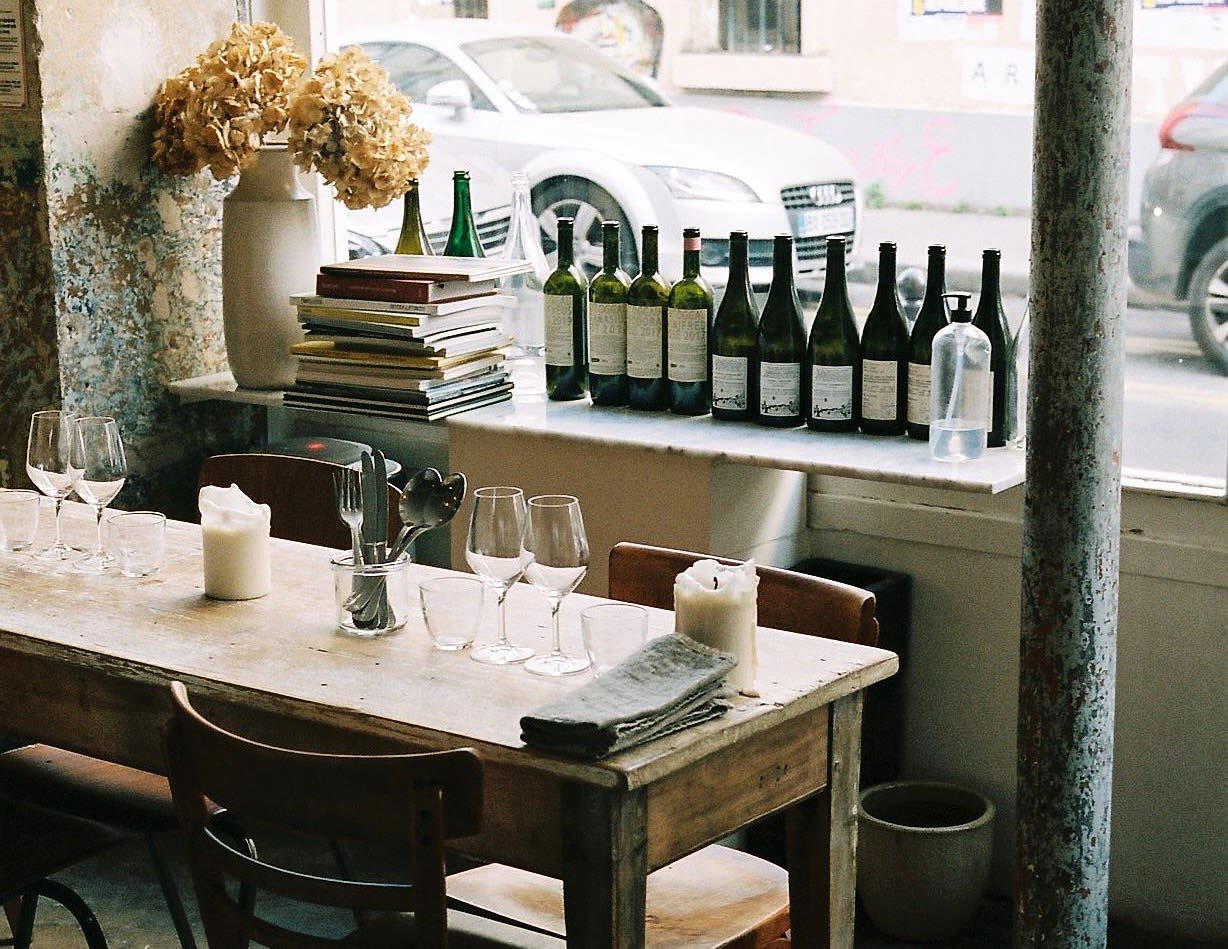
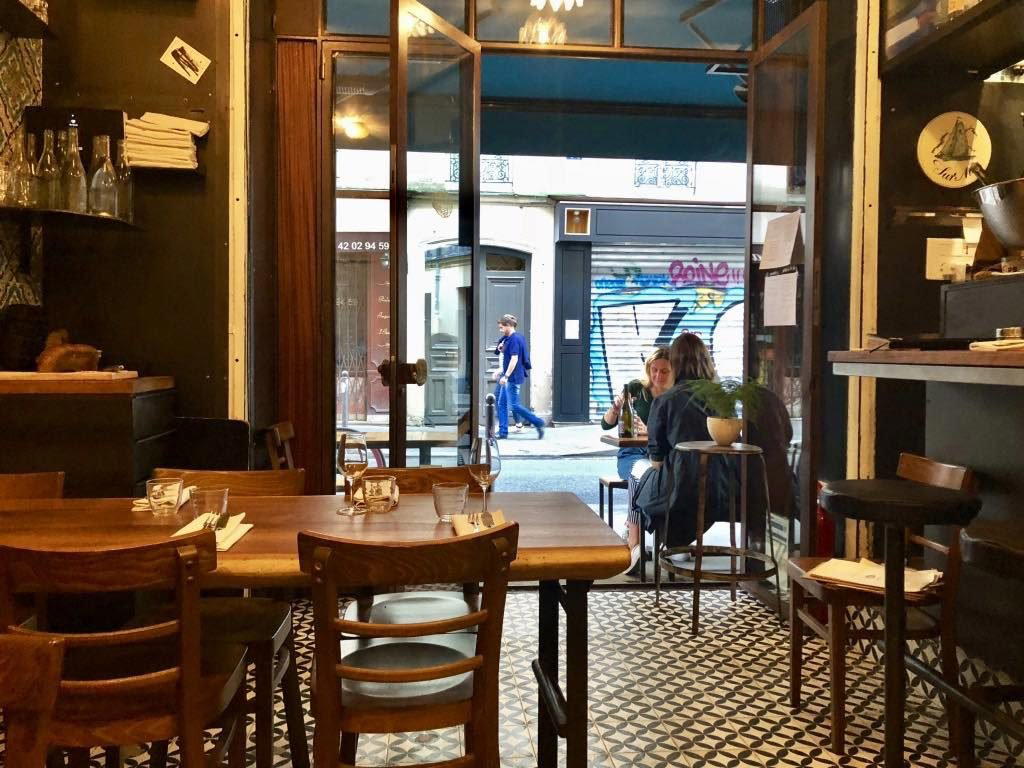
The Canal Saint-Martin end of the 10th has a physical character that shapes the restaurants within it. Buildings tend to be narrow, ceilings are lower than in Haussmann-era rooms, and natural light comes principally from street-facing windows. Rooms in this format seat fewer covers than a comparable mid-tier address in the 6th or 7th, which concentrates the service and makes the noise floor more variable on busy evenings. The atmosphere is closer to a well-run neighbourhood room in Lyon's presqu'île than to the deliberate theatre of a destination restaurant. That is, for many diners, precisely the point.
French coastal cooking historically found its leading expression in rooms that felt contingent on the catch: menus written by hand, chairs that didn't quite match, a wine list built around what the owner happened to like. The 10th's version of that tradition is tidier, the wine lists are longer, and the kitchens are better resourced, but the informality of address is retained. Sur Mer sits in that tradition.
France's Wider Coastal Table
The restaurants that have most seriously defined what French coastal cooking can be at the highest level are, by and large, outside Paris. Auberge du Vieux Puits in Fontjoncouse, La Table du Castellet in Le Castellet, and the longer-established Auberge de l'Ill in Illhaeusern all draw their authority from proximity to product. The Parisian kitchen has always had to compensate with technique for what it cannot have through geography. When that compensation is handled well, it produces something distinct: a distillation of a regional tradition filtered through a city's resources and talent base. Arpège (Creative) did this for garden produce; the question is which Paris kitchens are doing it credibly for coastal ingredients.
Internationally, the parallel conversation has produced restaurants like Le Bernardin in New York City, where French technique applied to fish over several decades built one of the world's most sustained arguments for seafood as a serious dining category. The ambition at that scale is different, but the underlying premise is the same: that coastal produce, handled with precision and restraint, does not need elaboration to be serious. For the broader view of what ambitious French cooking in provincial settings can look like, Troisgros in Ouches, Bras in Laguiole, Les Prés d'Eugénie in Eugénie-les-Bains, Paul Bocuse in Collonges-au-Mont-d'Or, and Georges Blanc in Vonnas all remain reference points for how French kitchens have historically argued for terroir. Sur Mer operates in a different register, urban and less institutional, but the tradition it draws on is the same one. See our full Paris restaurants guide for the wider picture.
Know Before You Go
Address: 1 Rue de Marseille, 75010 Paris, France
Neighbourhood: Canal Saint-Martin, 10th arrondissement
Getting there: Jacques Bonsergent (line 5) is the closest Métro stop; République (lines 3, 5, 8, 9, 11) is a short walk
Leading timing: The 10th arrondissement dining corridor is active year-round; summer evenings bring terrace culture to the canal area, while autumn and winter see shorter, more produce-focused menus across the neighbourhood
Dress code: Not confirmed, the neighbourhood norm leans smart-casual rather than formal
Frequently asked questions
Can I bring kids to Sur Mer?
Sur Mer sits on Rue de Marseille in the 10th arrondissement, a neighbourhood where restaurants trend toward relaxed, convivial formats rather than formal dining rooms. The Canal Saint-Martin crowd skews local and mixed-age, which generally makes the area accommodating for families.
What should I expect atmosphere-wise at Sur Mer?
The 10th arrondissement's Canal Saint-Martin end is characterised by low ceilings, narrow room footprints, and a neighbourhood tempo that resists the formality of the Right Bank. Sur Mer at 1 Rue de Marseille sits within that physical and social context, so expect a room shaped by those architectural constraints rather than a sprawling open-plan dining hall. The area's dining culture runs conversational and unhurried.
How does Sur Mer fit into Paris's wider coastal French dining scene?
Paris has historically deferred to coastal cities like Biarritz, Marseille, and Concarneau for serious seafood cooking, but the 10th arrondissement has emerged over the past decade as one of the city's more credible addresses for French Atlantic and Mediterranean influence. Sur Mer on Rue de Marseille is part of that shift, bringing a coastal focus to a neighbourhood better known for its wine bars and natural-leaning bistros than for fish-forward menus.
What's the signature dish at Sur Mer?
The restaurant's coastal French focus, consistent with the broader wave of Atlantic and Mediterranean-influenced cooking taking hold in the 10th arrondissement, points toward fish and shellfish as the core of the menu. check the venue's official channels or check current reviews for dish-level detail.
Where is Sur Mer located?
Sur Mer is located at 1 Rue de Marseille, 75010 Paris, France, Paris.
Should I book Sur Mer in advance?
Canal Saint-Martin restaurants with a strong local following routinely fill mid-week as well as on weekends, particularly those operating smaller rooms typical of the 10th's building stock. Sur Mer's address at 1 Rue de Marseille places it in a high-footfall stretch of the neighbourhood. Reserving ahead of arrival is the practical approach; walk-in availability at peak times is unlikely to be reliable.
Budget Reality Check
Comparable venues nearby, for context on price, style, and recognition.
| Venue | Cuisine | Price | Notes |
|---|---|---|---|
| Sur MerThis venue (the venue you are viewing) | Modern Seafood Small Plates | $50–100 | Not listed |
| L’Huitrerie Regis | French Oyster Bar | $50–100 | Saint-Germain-des-Prés, French Oyster Bar |
| Maria Belza | Basque Tapas & Regional Spanish | $30–50 | 10th arrondissement (Canal Saint-Martin), Basque Tapas & Regional Spanish |
| Aux Crus de Bourgogne | Classic French Bistro with Burgundian Specialties | $50–100 | Montorgueil, Classic French Bistro with Burgundian Specialties |
| Chez Julien | Classic French Brasserie with Modern Twists | $50–100 | Le Marais, Classic French Brasserie with Modern Twists |
| L'Ecailler du Bistrot | French Seafood Bistro | $50–100 | 11e Arr. – Popincourt, French Seafood Bistro |