Spicy Village
Our verdict
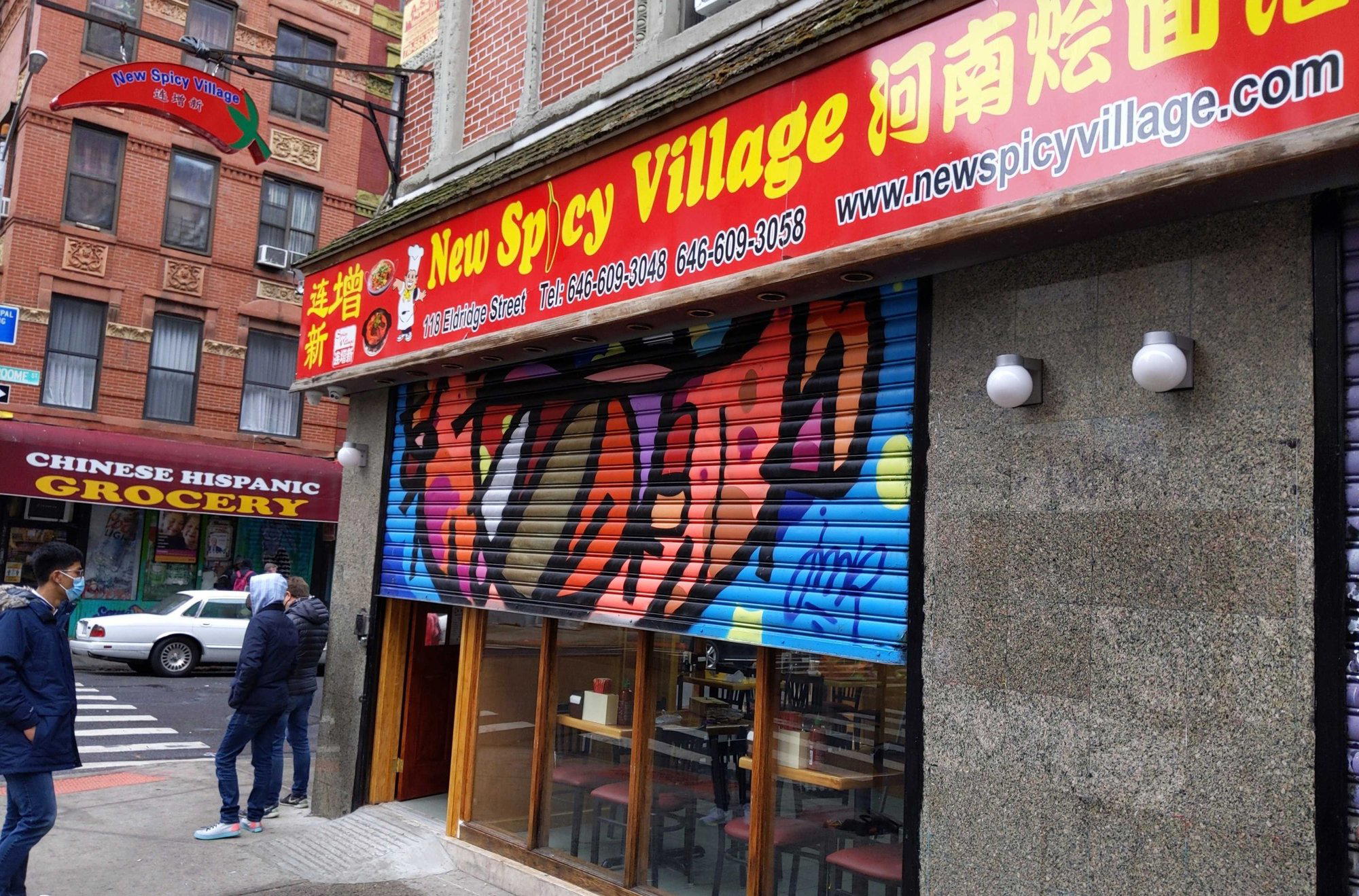
Spicy Village on Forsyth Street sits at the center of Manhattan's Chinatown hand-pulled noodle scene, where Henan-style cooking and high-heat wok technique draw long lines and repeat regulars. Against the backdrop of New York's pricier tasting-menu circuit, it represents a different kind of seriousness: one measured in broth depth and queue length rather than Michelin stars.

Pearl is the En Primeur Club membership app, where members save venues, book tables and use the concierge.
The menu
What to order
- Spicy Big Tray Chicken
- Hui Mei with Spicy Brisket
- Pork Pancakes
Where Chinatown's Noodle Tradition Gets Serious
New York's lower Manhattan food corridor has never operated on the same logic as the city's formal dining tier. While counters like Masa and omakase-style rooms charge per-seat minimums that approach four figures, the blocks around Canal and Forsyth Streets have long sustained a parallel economy of serious cooking measured in bowls, not covers. Spicy Village, at 68 Forsyth Street in Manhattan's Chinatown, occupies a specific position in that economy: a Henan-focused kitchen that has built its following on a single category of dish executed with enough consistency to generate queues that stretch onto the pavement most weekends.
Henan cuisine is not the most visible regional Chinese tradition in New York. The city's Cantonese restaurants set the early template; Sichuan heat arrived later and captured wider attention; and the prestige tier of contemporary Chinese cooking now runs through restaurants like Atomix or Jungsik New York, which frame Asian culinary traditions through a fine-dining lens. Henan, landlocked and wheat-centered, remains less understood outside specialist circles, which is part of why Spicy Village's persistence over years of operation carries some weight as a cultural marker.
The Dish That Defined the Address
The hand-pulled, spicy cumin lamb noodle is the reference point around which Spicy Village's reputation cohered. Hand-pulled noodles (la mian) require a technique that doesn't scale easily: the dough is stretched, folded, and stretched again until the strands reach the right thickness, a process that demands consistent labor rather than equipment. In a city where kitchen costs and staffing pressures push many operations toward shortcuts, maintaining that technique over a sustained period is its own form of credential.
The cumin lamb combination is Henan-inflected but also reflects broader northern Chinese and northwestern influences, where lamb and spice appear in ways that differ sharply from coastal Chinese traditions. For diners who arrived at Spicy Village through word of mouth rather than a press cycle, the dish's specificity was part of the appeal: it wasn't a generalised pan-Asian menu built for a broad audience, but a focused offering rooted in a particular regional logic.
Against the formal dining grid of New York, this approach sits at the opposite end from how restaurants like Le Bernardin or Per Se build their identity through multi-course architecture and ingredient provenance narratives. Spicy Village's authority comes from repetition and technique at volume, not from scarcity or curation.
How the Spot Has Shifted Over Time
EA-GN-20 applies here in a particular way: Spicy Village's evolution is less about a dramatic reinvention and more about what happens when a neighbourhood spot accumulates critical mass. The restaurant moved through phases common to places that gain attention without seeking it. Early coverage in New York food media focused on the novelty angle, framing it through the discovery narrative that publications use when something operating below the radar lands on the radar. Over time, the framing shifted from discovery to institution, and with that shift came a different kind of pressure.
High-profile coverage in national outlets brought visitors who were not Chinatown regulars, changing the crowd composition and the wait-time dynamics. That influx is a double-edged pattern across many American cities: see how Lazy Bear in San Francisco or Alinea in Chicago navigated attention at scale, though both operate in entirely different price and format brackets. For a cash-focused Chinatown counter, the challenge is different: how do you keep the kitchen honest when the room is full of people who arrived because of a trend cycle rather than a decade of repeat visits?
The answer, at Spicy Village, appears to be operational stubbornness. The address, the format, and the core menu logic have not undergone the kind of concept drift that sometimes follows media attention. That consistency is, in itself, an editorial point: not every restaurant that gets noticed reinvents itself around the attention. Some simply continue.
Chinatown's Place in the New York Dining Spectrum
New York's restaurant scene sorts itself into tiers with unusual clarity. At the leading end, tasting-menu destinations like Blue Hill at Stone Barns or the structured formality of The Inn at Little Washington (in DC, but part of the same elite American dining conversation) define what premium looks like through provenance, service architecture, and price. Regional American equivalents include Bacchanalia in Atlanta, Addison in San Diego, Providence in Los Angeles, Single Thread Farm in Healdsburg, and The French Laundry in Napa. Internationally, the same logic plays out at 8½ Otto e Mezzo Bombana in Hong Kong or Alain Ducasse Louis XV in Monte Carlo.
Spicy Village operates in a completely different register from all of those, and that's precisely the point. The Chinatown that Spicy Village belongs to is one of the city's most durable food corridors, where cooking authority is communicated through technique and consistency rather than service ratio or wine list depth. A visitor who spends an evening moving through this end of lower Manhattan will eat more distinctly New York food than most tasting menus can deliver, simply because the concentration of regional specificity along these blocks reflects immigration patterns and community cooking that formal restaurants rarely replicate. For broader orientation across the city's dining geography, our full New York City restaurants guide maps the full spectrum.
Comparisons to New Orleans, where Emeril's helped define a different kind of American regional dining prestige, are instructive: both cities carry cooking traditions that predate the current fine-dining framework, and both reward visitors who follow neighbourhood logic rather than award lists.
Planning Your Visit
| Factor | Spicy Village | Comparable Tier (NYC) | Fine-Dining Tier (NYC) |
|---|---|---|---|
| Booking | Walk-in; queues expected at peak | Walk-in or same-day | Advance reservation, weeks to months |
| Price range | Low (cash-friendly) | Low to mid | $$$$ (e.g. Masa, Per Se) |
| Wait times | 20-45 min weekends | Varies | By reservation only |
| Format | Counter/casual, high turnover | Casual sit-down | Multi-course, seated service |
| Location | 68 Forsyth St B, Chinatown, Manhattan | Lower East Side / Chinatown | Midtown / Upper West Side |
Weekday visits before the lunch peak reduce wait times noticeably. The room runs at high turnover, so lingering is not the format here. Cash payment has historically been the norm in this category of Chinatown restaurant, though payment policies should be confirmed on arrival.
Frequently asked questions
Where is Spicy Village in New York City?
Spicy Village is located at 68 Forsyth St B, New York, NY 10002, New York City.
Is Spicy Village in New York City associated with a specific regional Chinese cuisine?
Spicy Village's menu draws from Henan province traditions, placing it within a corner of New York's Chinese restaurant scene that receives far less coverage than Cantonese or Sichuan kitchens. The hand-pulled noodle technique and cumin-forward seasoning are characteristic of that central Chinese cooking lineage. For diners working through New York's Chinatown on Forsyth Street, it represents a regional tradition with limited representation at this consistency level in the city.
What's the signature dish at Spicy Village?
The hand-pulled spicy cumin lamb noodle is the dish around which Spicy Village's reputation cohered. La mian, noodles pulled to order by hand, require a level of technical consistency that most casual kitchens don't maintain. That combination of cumin-spiced lamb and freshly pulled noodles at the Forsyth Street address is what drew sustained attention from New York food media and repeat visitors alike.
How hard is it to get a table at Spicy Village?
Spicy Village operates as a walk-in counter in lower Manhattan's Chinatown, which means the friction is queue-based rather than reservation-based. Peak weekend hours, particularly lunch and early dinner, draw lines that extend onto Forsyth Street. Arriving at off-peak hours on weekday afternoons is the practical workaround most regulars use.
What has Spicy Village built its reputation on?
Spicy Village built its standing on a narrow, executed-well menu rather than range. In a New York dining scene where tasting-menu destinations compete on elaboration, Spicy Village's credibility runs in the opposite direction: one reference dish, done consistently, at a price point that keeps the room full. That focus is what separated it from the broader Chinatown block and earned it coverage in serious food publications.
The Quick Read
Comparable venues nearby, for context on price, style, and recognition.
| Venue | Cuisine | Price | Awards | Notes |
|---|---|---|---|---|
| Spicy VillageThis venue (the venue you are viewing) | Henan Chinese Noodles | $20–30 | Not listed | Not listed |
| Xi'an Famous Foods 西安名吃 | Upper East Side 78th&2nd | Authentic Xi'an Chinese Noodles | $10–20 | Not listed | Upper East Side-Lenox Hill-Roosevelt Island, Authentic Xi'an Chinese Noodles |
| Shu Jiao Fu Zhou | Fuzhou Dumplings & Noodles | $10–20 | Chinese Restaurant Awards · Opinionated About Dining Casual in North America | Chinatown-Two Bridges, Fuzhou Dumplings & Noodles |
| Breeze | Sichuan with Dim Sum | Not listed | Not listed | Greenpoint, Sichuan with Dim Sum |
| Junzi Kitchen | Northern Chinese Fast Casual | $10–20 | Not listed | Morningside Heights, Northern Chinese Fast Casual |
| Rice Bird NYC | Cantonese Claypot | Not listed | Not listed | East Village, Cantonese Claypot |