
Michelin Bib Gourmand · Tabelog 100 #92
Our verdict
In Minami-Otsuka, Toshima, Nakiryu operates a single four-hour lunch service daily, building its reputation around a menu that bridges Japanese and Chinese noodle traditions. Dandan noodles layered with sesame paste and chilli oil appear alongside soy-sauce ramen drawn from whole chicken and oyster broth. Opinionated About Dining has ranked it among Japan's top casual restaurants in three consecutive years.

Pearl is the En Primeur Club membership app, where members save venues, book tables and use the concierge.
Where Japanese and Chinese Noodle Traditions Meet in a Single Bowl
Tokyo's ramen scene divides along fairly clear lines: shoyu counters chasing clarity, tonkotsu shops building depth through pork bone, and a smaller, more specialised tier where Japanese ramen technique absorbs influence from Chinese noodle traditions. Sosakumenkobo NAKIRYU operates in that third category, out of a ground-floor space in Minami-Otsuka, Toshima, running a single lunch service that closes at 3 pm and draws a queue well before it opens. Opinionated About Dining has ranked it among Japan's casual dining leaders three years in succession: #46 in 2023, #64 in 2024, and #82 in 2025, a sustained presence in a list that tracks consistent quality rather than novelty.
The name carries deliberate weight. "Nakiryu" translates as "roaring dragon," a reference to the dragon of Yakushido Hall in the Nikko Toshogu Shrine and to the two people behind the counter, both born in the Year of the Dragon, working in close coordination on each service. That dual influence, Japanese and Chinese, personal and culinary, shapes everything about how the menu is constructed and how the meal unfolds.
The Architecture of the Bowl
What distinguishes the menu here from a standard ramen counter is the deliberate combination of two noodle traditions within a single offering. Japanese-style preparations, including soy-sauce ramen, salt ramen, and tsukemen, sit alongside Chinese-derived formats: dandan noodles and hot-and-sour noodles. Most ramen shops stay firmly on one side of that divide. The appeal at Nakiryu lies precisely in moving between them.
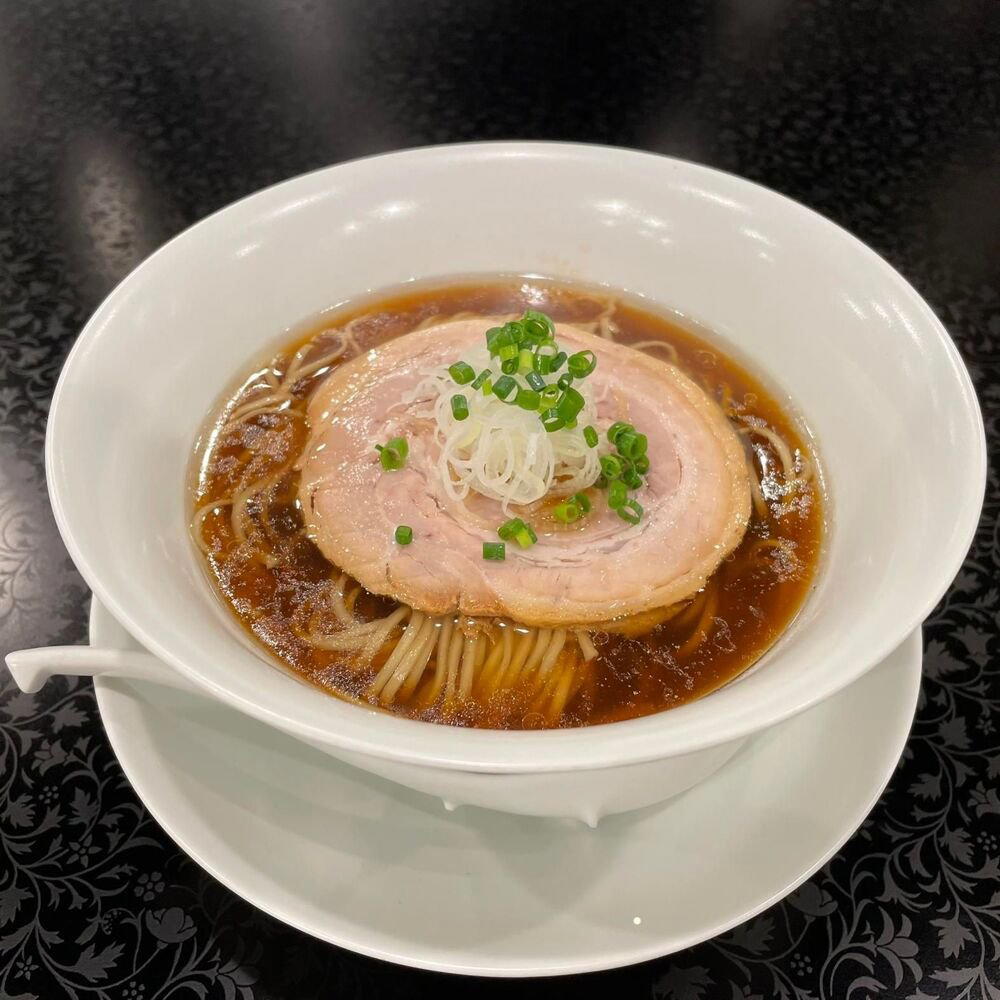
The dandan noodles have become the signature draw. The format here layers meat miso, Chinese sesame paste, and chilli oil to build what the kitchen describes as a deep, amplified umami, a construction that owes more to Chinese culinary logic than to Japanese broth-making. The soy-sauce ramen takes the opposite approach: its flavour rests on restraint and source material, with the soup drawn from whole chicken and oysters, producing a broth that reads as elegant rather than assertive. Both bowls reflect Chef Kazumasa Saito's background in Chinese cuisine, applied here to full advantage across styles that would normally remain separate.
The supporting dishes reinforce that cross-cultural framing. Steamed chicken with spicy sauce and shrimp wontons extend the Chinese register; boiled gyoza dumplings sit closer to the Japanese side. The menu is compact, which is characteristic of counters that operate a single short service, and the discipline of that brevity keeps execution consistent.
The Ritual of a Single Daily Service
Format at Nakiryu is part of what defines the dining experience. A four-hour lunch window, six days a week, with Tuesdays closed, means the kitchen operates under conditions that reward preparation and penalise inefficiency. The queuing system adds a further layer: numbered tickets are distributed in early morning, allocating spots before the doors open. This is a common mechanism at high-demand Tokyo counters, and it reframes the experience from casual drop-in to planned visit.
Arriving early matters. The ticket system means that capacity is effectively decided before service begins, and latecomers face the full weight of an already-committed queue. For visitors used to reservation-based dining, this introduces a different kind of anticipation, one that is oriented around timing and positioning rather than a confirmation number. It is worth understanding that ritual before visiting, not as an inconvenience but as a feature of how certain Tokyo counters maintain quality through controlled volume.
The brevity of the service window also shapes the pace inside. A counter like this runs at a different tempo than an evening kaiseki or a multi-course French progression. There is no extended arc. The meal is the bowl, the supporting dishes if ordered, and the broth at the end. That compression concentrates attention. Compared to the more drawn-out rituals of, say, an omakase sushi counter or a tasting menu format, ramen at this level is immediate, physical, and done in under an hour. The craft is in what arrives in front of you, not in how long the meal takes.
Tokyo's Broader Ramen Tier
Within Tokyo's ramen category, a distinction has emerged between mass-market chains, neighbourhood staples with long local histories, and a smaller number of counters that attract consistent critical recognition. Nakiryu operates in the last group, alongside places like Afuri, Fuunji, Chukasoba Ginza Hachigou, and Chukasoba KOTETSU, each with a distinct technical identity. What they share is a commitment to consistency across a tightly controlled format.
For a broader view of where Nakiryu sits in Tokyo's dining ecosystem, the full Tokyo restaurants guide maps the city's categories across price points and formats.
Ramen of this calibre also has a reach beyond Japan. Counters like Afuri Ramen in Portland and Akahoshi Ramen in Chicago demonstrate how the format has exported to new cities with its discipline largely intact, though the source-material logic of a bowl like Nakiryu's soy-sauce ramen remains difficult to replicate outside the specific supply chains that make it possible.
If the broader Tokyo trip extends to other cities, HAJIME in Osaka, Gion Sasaki in Kyoto, akordu in Nara, Goh in Fukuoka, 1000 in Yokohama, and 6 in Okinawa each represent the kind of focused, format-specific excellence that defines serious dining in Japan across its regions. Tokyo's own bars, hotels, and experiences are covered in the bars guide, the hotels guide, and the experiences guide. The wineries guide covers the city's growing natural wine and sake retail scene for those exploring beyond restaurants.
For Chinese-influenced cooking in a different format and price tier, Chuogo Hanten Mita offers a useful point of comparison within Tokyo's broader Chinese dining category.
Planning Your Visit
Address: SKY Minami-Otsuka 1F, 2-34-4 Minami-Otsuka, Toshima, Tokyo. Hours: Tuesday closed; all other days 11 am to 3 pm. Tickets: Numbered tickets distributed in early morning; arrive well before service opens to secure a place. Budget: ¥ price range, making this one of the most accessible entry points in Tokyo's critically recognised dining category. Reservations: No advance booking; ticket system only. Dress: No stated code; counter casual is standard across Tokyo ramen at this tier.
What Should I Eat at Sosakumenkobo NAKIRYU?
The dandan noodles are the most discussed item on the menu, built from meat miso, Chinese sesame paste, and chilli oil in a layered construction that reflects Chef Kazumasa Saito's Chinese culinary background. The soy-sauce ramen is the other anchor dish, with a broth drawn from whole chicken and oysters that reads as clean and precise rather than heavy. If appetite allows, the steamed chicken with spicy sauce, shrimp wontons, and boiled gyoza dumplings are the recommended supporting dishes, each extending the Chinese register of the kitchen's training. Hot-and-sour noodles and tsukemen round out the menu for those working through multiple visits. The Opinionated About Dining rankings across 2023, 2024, and 2025 reflect consistent execution across these dishes rather than a single standout.
Frequently asked questions
What kind of cuisine does Sosakumenkobo NAKIRYU serve?
What's Sosakumenkobo NAKIRYU's location?
Sosakumenkobo NAKIRYU is located at Japan, 〒170-0005 Tokyo, Toshima City, Minamiotsuka, 2 Chome−34−4 SKY南大塚 1F, Tokyo.
What distinctions does Sosakumenkobo NAKIRYU have?
Sosakumenkobo NAKIRYU has received recognition including: ‘Nakiryu’ means ‘roaring dragon’. The name is rich with meaning: it’s a reference to the dragon of Yakushido Hall in the Nikko Toshogu Shrine, to hopes for business growth, and to the couple who craft bowls of ramen together in perfect sync….
What should I eat at Sosakumenkobo NAKIRYU?
The dandan noodles are the counter's signature: sesame paste and chilli oil layered over meat miso for a concentrated umami that reads as neither purely Chinese nor Japanese. The shoyu ramen, built from whole chicken and oysters, is the cleaner, more restrained option on the same menu. If the queue allows for extras, the steamed chicken with spicy sauce and boiled gyoza are drawn from chef Kazumasa Saito's Chinese cuisine background. Nakiryu is ranked #82 on Opinionated About Dining's Casual Japan list for 2025, which reflects the consistency of these specific bowls rather than any rotating seasonal programme.
Cost and Credentials
| Venue | Cuisine | Price | Awards | Notes |
|---|---|---|---|---|
| Sosakumenkobo NAKIRYUThis venue (the venue you are viewing) | Michelin-Starred Tantanmen Ramen | $10–20 | Michelin Bib Gourmand · Tabelog 100 #92 | Not listed |
| Harutaka | Edo-Style Omakase Sushi | $200–300 | 3 Michelin Stars · World's 50 Best #76 | Sushi |
| RyuGin | Modern Kaiseki | $500+ | 3 Michelin Stars · World's 50 Best #41 | Kaiseki, Japanese |
| L'Effervescence | Modern French with Japanese Influences | $200–300 | 3 Michelin Stars · World's 50 Best #69 | French |
| HOMMAGE | Modern French with Japanese Influences | $150–200 | 2 Michelin Stars · World's 50 Best #78 | Innovtive French, French |
| MAZ | Innovative Peruvian-Japanese Fusion | $150–200 | 2 Michelin Stars · World's 50 Best #28 | Innovative |
Recognition history
Dated appearances from independent guides and award organizations, with the underlying list record or original source where available.
Michelin Bib Gourmand
Michelin
Opinionated About Dining Casual in Japan Ranked #146
Opinionated About Dining
Tabelog 100 #92 · No. 92
Tabelog · Tabelog 100 - Ramen - TOKYO - 2025
Full recognition history (7 entries)
Opinionated About Dining Casual in Japan Ranked #82
Opinionated About Dining
Michelin Bib Gourmand
Michelin
Opinionated About Dining Casual in Japan Ranked #64
Opinionated About Dining
Opinionated About Dining Casual in Japan Ranked #46
Opinionated About Dining