
Tabelog 100 #17
Our verdict
SOMA gives Osaka’s spice-curry culture a compact, lunch-focused expression in Nakatsu, where vegetable-led cooking and small-room pacing matter more than ceremony. Its repeated selection for Tabelog Curry WEST 100, including 2024, puts it in the city’s serious curry conversation without pushing the experience into luxury-restaurant territory.

Pearl is the En Primeur Club membership app, where members save venues, book tables and use the concierge.
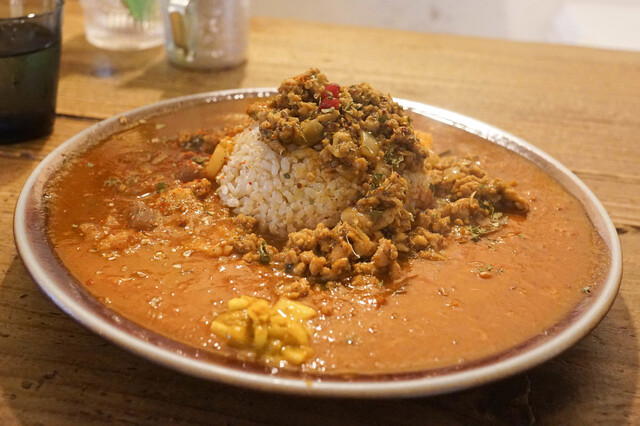
The menu
What to order
- Spice curry mix plate
- Vegetable-forward Japanese curry
Osaka changes register quickly: the commercial force of the city recedes, shutters sit close to small galleries and lunch rooms, and the appetite becomes more local in scale. In that setting, SOMA belongs to Osaka’s curry current, a category that treats curry less as a fixed comfort dish and more as a plate built through contrast, sequence, heat and texture.
Osaka has long been one of Japan’s more interesting curry cities because it allows informality and technical ambition to share the same room. The category stretches from quick counter lunches to specialist kitchens with serious followings, and the difference is often measured not by tablecloths but by rhythm: how the rice, sauce and condiments are arranged so the plate changes as it is eaten. SOMA’s 2024 recognition from Tabelog Hyakumeiten places it in that specialist conversation, alongside a citywide field where selection matters more than hype.
Curry in a small Osaka room
The useful way to read this kind of Osaka curry is as progression, not abundance. A good plate does not need a long menu narrative; it needs a beginning, a middle and a finish. The first phase is usually clarity, where rice and curry establish the base. The second is movement, as side elements begin to alter texture and seasoning. The final phase is integration, when the diner has mixed enough of the plate for the curry to become less singular and more layered.
SOMA’s public profile points toward the focused end of the spectrum, with curry treated as the centre of the identity rather than one option among many. That matters in Osaka, where the category can sometimes lean heavily on intensity alone. Here, the stronger editorial signal is balance: a concise format and a plate style suited to a direct, casual meal. The experience is not framed here as fine dining; its value sits in the attention the curry asks from the first spoonful onward.
The setting reinforces that pace. SOMA is not best understood as a restaurant built around a long dining-room arc. It belongs to the Japanese casual dining tradition, where the serious part happens inside a focused sequence: arrival, ordering, the plate, the quiet calibration of heat and texture, then the day moving on. In a city often caricatured through street-food excess, this kind of format is a better clue to how Osaka can eat with precision as well as appetite.
How it fits Osaka's curry conversation
Within the comparison set, SOMA sits in an accessible lunch-price band while its award signal places it in a more curated curry conversation than a casual budget label would suggest. DIAMOND BIRYANI, Think Shokudo and Spice Curry Maruse show how broad Osaka’s curry field has become, while TXAGORVA and Japoni underline how varied the city’s dining map can be. SOMA’s role is narrower: a focused curry room where the draw is the plate’s internal movement rather than a broad evening programme.
That distinction matters for travellers building an Osaka food itinerary. The city rewards those who do not spend every meal chasing spectacle in the busiest dining zones. A curry stop at SOMA creates a different kind of day: a shorter meal, and a sharper sense of how modern casual restaurants in Osaka compete through craft rather than luxury codes. For broader planning, Our full Osaka restaurants guide is the natural anchor, while nearby category research can extend through Our full Osaka bars guide, Our full Osaka hotels guide, Our full Osaka wineries guide, and Our full Osaka experiences guide.
Osaka’s eating culture also benefits from contrast. A curry lunch here can sit beside bakery, café, regional Japanese and international cooking without feeling like a detour. For adjacent restaurant browsing, EP Club’s Osaka coverage includes other casual dining rooms, specialist counters and city restaurants across a wide range of formats. Wider Japan and overseas reference points can be useful for context, but SOMA’s appeal is best understood through Osaka’s own compact, craft-driven casual food culture.
What to understand before going
The editorial case for SOMA is strongest for diners who value precision in a casual format. The 2024 Tabelog Hyakumeiten recognition, the JPY 1,000 - JPY 1,999 listed price range, and the curry category all point to a place where the appeal is tightly connected to a specific style of meal. It is better treated as a focused curry stop than as a flexible all-purpose restaurant.
The practical reading is simple: plan around the meal rather than around a long reservation-led evening. The format is focused, and the point is the plate rather than a drawn-out dining-room experience. For travellers, the smarter move is to place it within an Osaka day and avoid overloading the schedule immediately afterward. Osaka’s curry rooms often run on pace and availability, and the reward comes from giving the plate enough attention to move from first spoonful to final mix without treating it as a quick box to tick.
Frequently asked questions
What's the price range at SOMA?
Pricing at SOMA is listed as JPY 1,000 - JPY 1,999.
What are the opening hours for SOMA?
Opening hours for SOMA are not provided in the verified venue details here; check current operating information before going.
What's the address for SOMA?
Osaka.
What's SOMA best at?
SOMA is strongest as a focused curry room in Osaka. Its 2024 Tabelog Hyakumeiten recognition gives it clear editorial weight, and the accessible listed price range keeps the experience focused on the plate rather than the room.
Can SOMA handle vegetarian requests?
Vegetarian-specific details are not provided in the verified venue information here. The confirmed category is curry, with a listed JPY 1,000 - JPY 1,999 price range in Osaka.
Snapshot
Comparable venues by cuisine and category.
| Venue | Cuisine | Price | Awards | Notes |
|---|---|---|---|---|
| SOMAThis venue (the venue you are viewing) | Spice-focused Japanese curry | $10–20 | Tabelog 100 #17 | Not listed |
| Kishimen Amano | Nagoya-style miso udon and kishimen | $10–20 | Tabelog 100 #95 | Kita |
| Mori no Okashi | Seasonal Japanese wagashi (ohagi & dorayaki) shop | $1–10 | Tabelog 100 #47 | Kita |
| Motsuyaki Doppo Tenma ten | Japanese motsuyaki standing bar | $20–30 | Tabelog 100 #60 | Kita |
| Hirokawa Tailor | Japanese stand-up bar (tachinomi) | $20–30 | Tabelog 100 #12 | Chūō |
| Kokopelli Curry | Japanese curry house | Not listed | Tabelog 100 #56 | Kita |
Recognition history
Dated appearances from independent guides and award organizations, with the underlying list record or original source where available.
Tabelog 100 #17 · No. 17
Tabelog · Tabelog 100 - Curry - WEST - 2024

Continue exploring
More in Osaka
Restaurants in Osaka
All restaurants in Osaka →



Bars in Osaka
All bars in Osaka →



Hotels in Osaka
All hotels in Osaka →




Wineries in Osaka
Browse all →
Details
- Cozy
- Trendy
- Intimate
- Solo
- Casual Hangout
- After Work
- Group Dining
- Standalone
- Design Destination
- A La Carte
- Counter Dining
- Vegetarian Friendly
Current opening hours
- Monday
- 12–3 PM
- Tuesday
- 12–3 PM
- Wednesday
- 12–3 PM
- Thursday
- 12–3 PM
- Friday
- Closed
- Saturday
- 12–3 PM
- Sunday
- Closed
Hours can change for holidays and private events. Hours as of .
A small, stylish yet relaxed curry shop with counter-focused seating, simple decor, and a calm atmosphere suited to solo diners and small groups rather than large, noisy crowds.